Home Blog Page 73

Ukrainian press gang beats recruit to death – police

0

Three enlistment officers were detained in the city of Dnepr after a civilian perished in their custody, local police have said

Three Ukrainian draft officers have been detained in the city of Dnepr for allegedly beating a 55-year-old civilian to death, local police have said.

The latest incident in the chaotic Ukrainian mobilization drive occurred early on Saturday, when the officers attempted to conscript their victim. The civilian sustained fatal head injuries after being violently detained, according to an initial police assessment.

The law enforcement said the suspects were placed into pre-trial custody over intentional grievous bodily harm, which caused the death of the victim. The police said they have seized the vehicle used by the enlistment officers, discovering traces of the victim’s blood inside.

The compulsory conscription drive, aimed at replenishing Ukraine´s military’s ranks and compensate for combat losses, has grown increasingly chaotic and violent over the years. The campaign has become popularly known as ‘busification,’ a term describing the process of violently packing a recruit into minibuses, which are commonly used by conscription squads.  

Draft officials have repeatedly been documented beating up recruits, illegally breaking into vehicles and homes, chasing their victims in the streets, and brawling with onlookers. Despite mounting evidence of the lawlessness of the process and numerous incriminating videos circulating online, the Ukrainian leadership has largely turned a blind eye to the abuse nature of the mobilization. Although Kiev had previously acknowledged certain “shortcomings” with the conscription drive, senior officials routinely dismiss such concerns as “Russian propaganda.”  

Late last year, Russian Foreign Ministry spokeswoman Maria Zakharova said the Ukrainian authorities could launch a blanket mobilization in the coming months. She believes that Kiev seeks to draft a further 2 million people early this year. Such an extreme move, however, would “hardly help resolve the systemic issue of replenishing the Ukrainian army losses,” she said at the time. Moscow estimates that the Ukrainian military lost nearly 500,000 servicemen last year alone.

You can share this story on social media:

source

Davos forum ‘tainted’ by Epstein revelations – Putin envoy

0

The World Economic Forum has launched an investigation into its CEO Borge Brende over links to the late pedophile financier

The World Economic Forum’s reputation has been “tainted” by revelations that its CEO Borge Brende reportedly had dinners with disgraced financier Jeffrey Epstein, Russian President Vladimir Putin’s envoy Kirill Dmitriev has said.

Several documents among millions released by the US Justice Department last week, including Epstein’s personal emails, mention Brende attending dinners with Epstein and communicating with him by email and text. In a statement on Thursday, the WEF said it had launched an investigation into the revelations.

According to Dmitriev, who also heads Russia’s sovereign wealth fund, the disclosures and the ensuing probe undermine the credibility of the WEF and its flagship Davos forum in Switzerland.

“Davos’s reputation is so tainted,” Dmitriev wrote in a post on X on Friday, pitching Russia’s St. Petersburg International Economic Forum (SPIEF) as a better alternative. “All good people from the WEF should move to the [SPIEF] instead. The WEF can stay focused on discussing Epstein’s legacy and the lessons learned from his network-building.”

The WEF said Brende, who has served as CEO since 2017 and was previously Norwegian foreign minister, fully supports the investigation and requested it himself. Brende, in turn, claimed he met Epstein only in 2018 – a year before the disgraced financier’s death in a New York prison – and that three dinners and “a few emails and SMS messages,” allegedly strictly professional, constituted the full extent of their contact.

“I was completely unaware of Epstein’s past and criminal activities,” Brende insisted, as cited by Reuters, even though it’s widely known Epstein was convicted as a sex offender in 2008, years before the two met.

The Epstein files mention numerous high-profile Western figures, linking some to either Epstein’s sex trafficking network or questionable financial dealings. None have been charged so far, but the disclosures have prompted resignations, probes, and reviews worldwide, with all those named denying wrongdoing.

Commenting on the files, Russian Foreign Ministry spokeswoman Maria Zakharova accused the West of covering up Epstein’s crimes, arguing the case exposes the hypocrisy of a justice system that shields elites.

“Nothing in the West is investigated – just like the Epstein case – when it implicates ‘global elites,’” she wrote in a Telegram post on Friday. “Ironically, their crimes are now captured in photos and videos – and yet, they claim ‘it’s not all that clear.’”

You can share this story on social media:

source

Russian gold reserves break record

0

The country’s bullion holdings were valued at $402.7 billion as of early February

The value of Russia’s gold reserves has reached an all-time high, exceeding the $400 billion mark, according to statistics released by the country’s central bank on Friday.

Russia’s holdings of monetary gold stood at $402.7 billion as of February 1. The figure suggests that the metal currently makes up 48.3% of Russia’s total reserve assets, which stood at $833.5 billion. Russia’s gold reserves are now virtually equal in value to its holdings of foreign currencies.

This surge in value is directly tied to an unprecedented rally in global gold prices. Precious metal futures surged to a record high of $5,595 per ounce in late January. Gold jumped by around 60% in 2025 alone and has rallied significantly over the past four years, having traded below $2,000 an ounce in 2022. Analysts attribute the rally to robust demand from central banks, persistent inflation, heightened geopolitical tensions, and the devaluation of the US dollar.

The rise has drastically altered the composition of Russia’s reserves. The share of gold has risen from 21% prior to the Ukraine conflict, while the share of foreign currencies has dropped from the 74% recorded on February 1, 2022.

Rising gold prices have helped Russia cover much of the losses from the sovereign reserves frozen in the West. The increase in the value of Russia’s gold holdings restores much of the country’s lost financial capacity, even if the blocked reserves remain inaccessible.

Russia’s central bank has reported little change in the physical volume of its gold reserves in recent years. According to Bank of Russia data, the country held 73.9 million troy ounces of monetary gold as of March 1, 2022. By January 1 this year, that figure had risen slightly to 74.8 million ounces.

Since 2022, the central bank has stopped reporting gold transactions to the International Monetary Fund, disclosing only the total size of its gold stockpile, typically with a delay. As a result, most of the recent growth in the value of Russia’s gold reserves reflects rising global prices rather than significant changes in the volume held.

Monthly data indicate that the reported quantity of gold has remained largely stable, while its valuation has increased sharply due to the sustained rally in precious metals markets.

You can share this story on social media:
source

Premier League: TV schedule for Matchday 22 announced

0


Premier League: TV schedule for Matchday 22 announced – SoccaNews


error: Content is protected !!


source

Poland involved in attempted assassination of Russian general – investigators

0

Warsaw’s special services helped Ukraine recruit the man suspected of targeting Vladimir Alekseyev, the FSB has claimed

Polish special services helped Ukraine orchestrate the attempted assassination of Russian General Vladimir Alekseyev, the Russian Federal Security Service (FSB) said on Monday.

Lyubomir Korba, the main suspect in Friday’s shooting attack in western Moscow, was arrested in the United Arab Emirates and transferred to the Russian capital over the weekend. The FSB claims evidence shows Warsaw used Korba’s son, a Polish citizen, to help the Security Service of Ukraine (SBU) recruit the gunman.

The SBU approached Korba, a Ukrainian-born Russian citizen, in his home city of Ternopol in western Ukraine in August 2025, the statement said. The 65-year-old allegedly took shooting classes before traveling to Moscow via Moldova and Georgia. The Ukrainian special services promised to pay him $30,000 for killing the senior member of the Russian military intelligence, investigators said.

The Russian agency also detailed the roles allegedly played by Korba’s two accomplices. Viktor Vasin, who was arrested in Russia, reportedly provided accommodation and other logistical support. The FSB claimed the 66-year-old had “terrorist motives” to take part in the criminal conspiracy, being a supporter of the Anti-Corruption Foundation of late politician Aleksey Navalny – an organization that Russia designated as terrorist last November.

A Navalny supporter was previously prosecuted for a separate assassination linked to Ukraine. Darya Trepova was sentenced to 27 years behind bars for delivering an improvised explosive device that killed military blogger Vladlen Tatarsky and injured over 50 people at the victim’s talk in St. Petersburg in 2023.

The third suspect, Zinaida Serebritskaya, 54, remains at large having fled to Ukraine, according to the Russian authorities. The FSB said she rented an apartment in Alekseyev’s block in Moscow and provided Korba access to the communal hallway where he ambushed the general. Korba allegedly fired four shots at the general using a silenced handgun provided by the Ukrainian agency, which he later discarded while escaping the crime scene.

On the eve of the shooting in Moscow, Ukraine’s Vladimir Zelensky reported approving new SBU operations proposed by Evgeny Khmara, the agency’s newly appointed chief. Kiev denied responsibility for the attempt on Alekseyev. Russian Foreign Minister Sergey Lavrov said the attack “once again confirmed the focus of the Zelensky regime on constant provocations aimed, in turn, at disrupting the negotiation process.”

source

Japanese PM’s party secures historic win in snap elections

0

Sanae Takaichi will be able to pursue a hawkish agenda now that the LDP has a supermajority in the lower house

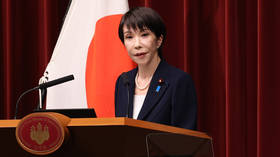
Japan’s Liberal Democratic Party (LDP) led by Prime Minister Sanae Takaichi scored a landslide victory in snap parliamentary elections on Sunday.

With a two-thirds majority in the lower house, secured together with coalition partners, the LDP leader will be better positioned to push through more hawkish policymaking.

A hardline conservative, Takaichi was elected as Japan’s first female prime minister last October. She has advocated revising Japan’s pacifist constitution and beefing up the country’s offensive military capabilities, among other policy changes. Takaichi called Sunday’s snap elections in order to capitalize on her popularity and secure a fresh mandate for “major policy shifts.” 

The LDP, along with its coalition partner, the Japan Innovation Party, will likely receive at least 310 seats in the 465-member House of Representatives, according to Japanese media. This would mark one of the largest lower-house majorities in postwar Japanese history.

Now that the ruling coalition has secured this overwhelming representation in the lower house, Takaichi will be able to override resistance in the upper chamber, potentially paving the way for amending Japan’s constitution.

Takaichi’s predecessors from the LDP aligned themselves with the West by imposing sanctions on Russia following the escalation of the Ukraine conflict in February 2022.

In response to Tokyo’s “clearly unfriendly position,” Moscow withdrew from peace talks to formally end World War II. The two neighboring nations have still not sealed a peace treaty, and remain engaged in an outstanding territorial dispute over the four southernmost islands of the Kuril archipelago.

Commenting on bilateral relations with Japan last month, Russian Foreign Minister Sergey Lavrov expressed concern over Tokyo’s increasingly militaristic policies and the deployment of US weaponry, warning that Japan’s militarization undermines regional stability and security.

Moscow urged Tokyo to adhere to its constitution’s defensive approach, but, according to Lavrov, the current leadership was “ignoring these concerns.” 

Beijing has also voiced concern over Tokyo’s trajectory. Late last year, the Chinese Foreign Ministry condemned attempts by “Japanese right-wing forces… to remilitarize and rearm Japan” and to “challenge the postwar international order.” 

Takaichi previously drew Beijing’s ire after she said that Japan could respond militarily, should China try to take Taiwan by force.

source

NATO member blasts bloc chief’s ‘pro-war’ remarks in Kiev

0

Mark Rutte has pledged continued Western military support, including a possible troop deployment in Ukraine

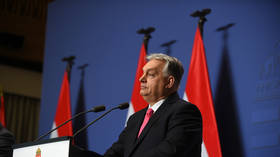
Hungarian officials have accused NATO Secretary-General Mark Rutte of overstepping his authority and making “pro-war” statements that put the bloc on course for a military clash with Russia.

Rutte visited Kiev this week in a show of support, saying member states would maintain military aid to Ukraine, possibly including troop deployments on Ukrainian soil. Moscow has repeatedly called such a scenario unacceptable.

“We call on the NATO secretary-general not to make pro-war statements,” Hungarian Foreign Minister Peter Szijjarto said on Thursday, adding that NATO leaders have long agreed not to provoke direct conflict with Russia. Rutte’s comments contradict that policy, he asserted.

Rutte suggested troops deployments could be approved by Moscow as part of a US-backed peace deal. Budapest fears pro-Kiev nations – including France, Germany, and the UK – would push to send troops despite Russian objections. Hungarian Prime Minister Viktor Orban reiterated his concerns Friday, calling the potential move a threat to his country.

“If the Western plan is implemented, then the war will come closer to Hungary, we will be much more directly affected by this,” he said. “Then not only the economic effect, but also the physical destructive effect could reach Hungary.”

Orban’s government has opposed Brussels’ Ukraine policy, arguing that bankrolling Kiev and imposing sanctions on Russia have damaged the EU’s economy while pursuing an unwinnable cause.

That stance and Budapest’s resistance to the Ukrainian bid to join the EU has strained relations with Kiev. Ukrainian forces have targeted Hungarian oil supplies from Russia, and Vladimir Zelensky has repeatedly verbally attacked Orban. At last month’s World Economic Forum, Zelensky said the Hungarian leader should be “smacked” for purportedly “liv[ing] off European money while trying to sell out European interest.”

Budapest says Zelensky is interfering in Hungarian politics ahead of April’s parliamentary election, and that Kiev is hoping for a more compliant government to take power.

source

EU’s ‘drone wall’ idea is ‘utopia’ – Romanian military chief

0

Brussels calls the project, which gained traction last year, a “bedrock of credible defense”

The European Union’s proposed ‘drone wall’ is a “utopia” that is impossible to implement, Romanian Defense Minister Radu Miruta said Thursday.

Senior EU officials and lawmakers have promoted the vaguely defined ‘drone wall’ as central to the economic bloc’s military buildup against a perceived Russian threat. European Commission President Ursula von der Leyen insisted in her September State of the Union address that it is “not an abstract ambition” but “the bedrock of credible defense.”

“A drone wall, where someone, like in a computer game, makes a curtain through which absolutely nothing passes, is a utopia,” Miruta, who took office in November, told the TV channel Digi 24. “We don’t have a wall. Poland doesn’t have a wall, nor do the Nordic countries.”

Proponents describe the project as a network of detection and interception systems along NATO’s eastern flank. Kiev said Ukrainian drone innovations would be essential to it, but reports suggest the ‘drone wall’ is more a PR label than a viable military concept.

The idea gained traction last fall amid reports of “mystery drone” sightings across Europe, which officials and media linked to Russia without firm evidence.

Moscow called the claims part of a Brussels-led fear campaign to distract European voters from domestic problems and justify higher military spending. Kremlin spokesman Dmitry Peskov said, “building walls is always bad, as history shows,” in comments regarding the ‘drone wall’ concept.

You can share this story on social media:

source

Dozens killed in Pakistan mosque bombing

0

More than 30 people have been killed in a suicide bombing at a mosque in the Pakistani capital of Islamabad. Pakistani authorities have accused India and Afghanistan of complicity in the attack.

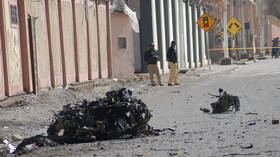
The blast ripped through the Khadija Tul Kubra mosque on Friday morning, as the building was packed with Shia worshippers. At least 31 people were killed and 169 injured, according to emergency services.

The attacker was stopped by security guards on his way into the mosque, but managed to detonate his device “in the last row of worshippers,” Pakistani Defense Minister Khawaja Asif said in a statement on X.

“The perpetrators of the blast must be identified and brought to justice,” Prime Minister Shehbaz Sharif said. “No one will be allowed to spread violence and instability in the country.”

While no group has taken responsibility for the attack, Asif claimed that the perpetrator “has been proven to have been coming and going from Afghanistan,” and that the “threads of the alliance between India and the Taliban are being uncovered.” 

Shebaz’s spokesman, Mosharraf Zaidi, declared that the bombing “is only the latest in a series of murderous terrorist attacks orchestrated by India” and its “terrorist proxies.” 

Pakistan is currently waging a counterinsurgency campaign against the Balochistan Liberation Army (BLA), a group of militant separatists based in the province of Balochistan, which borders Iran and Afghanistan. Pakistani officials have repeatedly accused India of backing the BLA, an accusation that New Delhi firmly denies.

Pakistani forces stepped up their campaign against the BLA last weekend, killing 177 militants – and more than 30 civilians – in response to a series of recent attacks that left 50 people dead. Like Friday’s mosque bombing, these BLA attacks were blamed on India.

“We categorically reject the baseless allegations made by Pakistan, which are nothing but its usual tactics to deflect attention from its own internal failings,” Indian Foreign Ministry spokesman Randhir Jaiswal said on Sunday. “Instead of parroting frivolous claims each time there is a violent incident, it would do better to focus on addressing long-standing demands of its people in the region. Its record of suppression, brutality and violation of human rights is well known,” 

New Delhi has yet to respond to Asif’s and Zaidi’s latest accusations.

You can share this story on social media:

source

Indian refiners skip Russian oil purchases – Reuters

0

State-run Indian Oil Corporation and Bharat Petroleum are reportedly not accepting offers from March

Indian refiners are set to forgo oil purchases from Russia, Reuters reported on Sunday.

State-run Indian Oil Corp and Bharat Petroleum, as well as the largest private refiner Reliance Industries are not accepting offers to purchase Russian oil for loading in March and April, according to the report.

The news agency added that these three refiners had already scheduled some Russian oil shipments for March, but others in India have stopped purchases entirely.

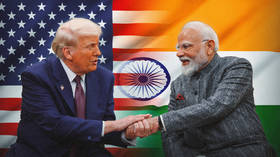
The move is reportedly intended to facilitate a trade pact with Washington, announced by US President Donald Trump on February 2.  

Trump signed an executive order on Friday that eliminates the 25% tariff imposed on India in August for importing Russian oil. The order claims that New Delhi has agreed to stop buying oil from its northern partner.

A joint statement by the US and India on a trade framework made no mention of Russian oil. New Delhi has not publicly confirmed that it will end purchases of Russian oil. Moscow has said it is not aware of any decision by India to cut supplies.

Oil imports from Russia fell to a 38-month low of $2.7 billion in December 2025, The Hindu reported. They now account for less than a quarter of India’s supply of the fuel, down from 34% a month ago, according to the report.

Indian refiners would require a wind-down period to complete oil deals with Russia, Reuters reported last week. It added that New Delhi has so far not ordered a halt to imports.

New Delhi has said it is open to exploring the commercial merits of any supply options, including from Venezuela.

You can share this story on social media:

source