Home Blog Page 70

Actress sues government over AI minister image  

0

Anila Bisha has reportedly claimed her likeness was used without permission to create the world’s first virtual government official

An Albanian actress has sued the Balkan country’s government over its use of her likeness for a virtual minister for digital intelligence.

Diella, billed as the world’s first virtual government official, could soon lose her face after Anila Bisha, the actress whose likeness was used to create the AI bot, sued the government, media reported on Wednesday.

Albanian Prime Minister Edi Rama last year floated the idea of appointing an AI minister and weeks later unveiled ‘Diella’, a virtual official tasked with tackling corruption in public procurement. Albania ranked 80th out of 180 countries in Transparency International’s Corruption Perceptions Index in 2024.

The bot initially launched on the e-Albania platform as a virtual assistant helping citizens access state services, appearing as a young woman in traditional Albanian dress.

Now authorities risk forfeiting the right to use the image of the virtual minister, who was modelled on the appearance and voice of actress Anila Bisha. She alleges her image was used without proper permission to create the virtual minister.

The actress has filed a lawsuit against the Council of Ministers, Prime Minister Edi Rama, a private company involved in the project and the National Agency for Information Society (AKSHI), according to Gazeta Express.  

Bisha claimed her contract with the company Aleat allowed the use of her likeness only for a virtual assistant on the e-Albania platform and only until the end of 2025, and did not cover its use for creating or promoting a “virtual minister.”

“In our view, this lawsuit is nonsense, but we welcome the opportunity to solve it once and for all in a court of law,” Albanian government spokesperson Manjola Hasa told Politico.

In court documents reported by multiple Albanian media outlets, the 57-year-old actress is seeking an injunction to immediately halt the use of her image for AI minister Diella until the legal case is resolved, saying the government’s unauthorized use has caused “significant and irreversible” harm.

Last September, Bisha told local television that she had recorded video and audio for the e-Albania chatbot for a limited period and nominal payment, with no permission for other uses.

You can share this story on social media:

source

Russia preparing oil lifeline to Cuba – embassy

0

Russia is preparing to send a shipment of oil and petroleum products to Cuba, Moscow’s embassy in Havana has announced. The island is facing its worst energy crisis in years after the US doubled down on its campaign to cut off its energy supplies.

The fuel crisis intensified dramatically after US forces kidnapped Venezuelan President Nicolas Maduro in early January, severing oil supplies from Caracas, which had been one of Cuba’s main suppliers.

Washington subsequently threatened to impose tariffs on any country providing oil to Cuba, with Mexico later suspending crude shipments to the island. The US itself has maintained an economic embargo on the island since the 1960s.

The Russian Embassy in Cuba confirmed to Izvestia that the Caribbean island is facing “an acute shortage of oil and petroleum products,” adding that while the crisis has lasted for more than a year, the stop of supplies from Venezuela “has aggravated this situation.”

The embassy said it is planning to send oil and petroleum products to Cuba in the near future as “humanitarian aid,” though without specifying the timeframe or volumes.

The last major Russian oil delivery to Cuba occurred in February 2025, when Moscow sent 100,000 tons through a state credit worth $60 million approved by President Vladimir Putin. Cuba is estimated to consume 500 to 600 tons of fuel per day for its most critical needs, and requires over 8 million tons of fuel per year to function normally.

In addition, Russian officials reported that Moscow is assisting Cuba in developing its domestic oil reserves. While the island’s proven crude oil reserves are officially around 120 million barrels, the offshore zone of the North Cuba Basin is estimated to hold up to 20 billion barrels.

Moscow has condemned the US pressure campaign on Cuba as economic “strangulation” and “neocolonial practice” while reaffirming solidarity with the island.

US President Donald Trump suggested last month that the pressure campaign would force the Cuban leadership to “come to us and want to make a deal,” claiming that the island “would be free again.”

You can share this story on social media:

source

Colombian president reports ‘assassination attempt’

0

The alleged plot comes after a senator escaped a kidnapping attempt in the run-up to elections

Colombian President Gustavo Petro has claimed he has survived an assassination attempt following months of warnings about an alleged plot by drug traffickers to target him.

The South American nation has been scarred by decades of conflict involving guerrillas and other armed groups. The alleged attempt on his life also comes ahead of congressional elections on March 8 and presidential elections scheduled for May.

During a live-streamed cabinet meeting on Tuesday, Petro said that hours earlier he was in his helicopter with his daughters and was unable to land at a destination in the Colombian department of Cordoba on the Caribbean coast due to fears that unidentified individuals “were going to shoot.”

“I’m trying to escape being killed. That’s why I couldn’t arrive on time last night, because I couldn’t land where I had said. This morning, I couldn’t land where I was supposed to either, because there was information that the helicopter was going to be shot at,” he said.

Constitutionally barred from seeking a second term, Petro claimed that a drug-trafficking organization has targeted him since he took office in August 2022. He had previously reported another alleged attempt on his life in 2024.

According to El Tiempo, Colombia’s largest cartel, the Gulf Clan, operates in Cordoba. The outlet also notes that the group recently suspended peace talks with the government after Petro agreed with US President Donald Trump on cooperation to capture cartel leader Hobanis de Jesus Avila Villadiego.

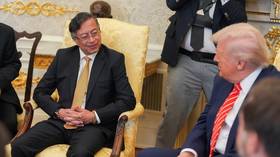
Petro and Trump met at the White House earlier this month amid rising tensions, with the latter criticizing Colombia’s efforts against drug trafficking as inadequate after previously calling the country’s president an “illegal narco-leader.” Petro rejected the accusations and criticized Washington’s operations in the Caribbean and Venezuela, actions he said were harmful to regional stability.

Petro made the latest statements after Colombian Senator Aida Quilcue was taken by unknown people in her home department of Cauca, a conflict-affected, coca-growing region contested by dissidents of the now-disbanded FARC guerrilla army.

The award‑winning Indigenous activist was rescued, her team reported on X, hours after the vehicle she had been traveling in with two bodyguards was found abandoned. The 53‑year‑old activist told AFP she had been taken by “various armed men,” without saying which group they belonged to.

You can share this story on social media:

source

What’s behind von der Leyen’s two-tier EU plan?

0

The European Commission president won’t let individual member states stand in the way of her maximalist goals

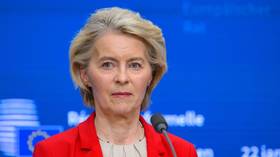
European Commission President Ursula von der Leyen wants groups of EU countries to pass ambitious economic reforms without the consent of the entire bloc. The move is about trade, regulations, and – of course – Ukraine.

EU leaders will meet in Belgium’s Alden Biesen castle on Thursday to discuss the bloc’s moribund economy. The meeting comes two years after former European Central Bank President Mario Draghi released a report calling on Brussels to slash regulations and invest up to €800 billion annually, or face “slow agony” as the economies of China and the US pull ahead.

Von der Leyen immediately opposed borrowing Draghi’s recommended €800 billion, given that her EU member underlings have yet to come up with the €90 billion to be borrowed for Ukraine that was announced last December. However, in a letter to the bloc’s leaders on Monday, she proposed a “deep house cleaning” of red tape and regulations, new trade deals along the lines of the one signed with India this month, and the elimination of remaining trade barriers between member states.

One paragraph in the letter stands out: “Our ambition should always be to reach agreement among all 27 Member States. However, where a lack of progress or ambition risks undermining Europe’s competitiveness or capacity to act, we should not shy away from using the possibilities foreseen in the treaties on enhanced cooperation.”

In a speech to the European Parliament in Strasbourg on Wednesday, von der Leyen made her position even more clear. The commission, she said, will “crack down” on “unnecessary” national laws standing in the way of her reforms.

What is enhanced cooperation?

The EU’s Amsterdam and Nice treaties allow a minimum of nine member states to cooperate on certain policy initiatives without the consent of the rest of the bloc. According to the EU’s legal database, “the procedure is designed to overcome stalemate where a particular proposal is blocked by one or more Member States who do not want to take part. It does not, however, allow for an extension of powers outside those permitted by the EU Treaties.”

Member states cannot veto the establishment of enhanced cooperation groups, except on matters of defense and the bloc’s common foreign policy.

What is the letter really about?

According to von der Leyen, her proposed reforms are so important that they risk delay or dilution if subjected to the bloc’s normal unanimity requirement. However, her letter neglects to mention a key European industry that would benefit from “enhanced cooperation”: the weapons industry.

Last month, German Finance Minister Lars Klingbeil proposed creating “a Europe of two speeds,” in which Germany, France, Poland, Spain, Italy and the Netherlands – the so-called ‘E6’ – would collaborate on defense spending, lobby for increased military expenditure in the EU’s next multiannual budget, and raise money to turn “defense into an engine for growth.”

“Europe has to become stronger and more resilient,” Klingbeil said in a letter to his French counterpart, Roland Lescure. “Work towards this goal needs to be sped up in all dimensions. Continuing as before is not an option.”

Klingbeil’s proposal would likely face staunch opposition from Europe’s dissident center. Hungarian Prime Minister Viktor Orban, Slovak Prime Minister Robert Fico, and Czech Prime Minister Andrej Babis have all spoken out against the EU’s increased militarization. By recruiting three more countries and using the mechanisms of enhanced cooperation, the E6 could bypass this opposition and form an ideologically-aligned bloc within the bloc.

Why is this important for Germany?

Strengthening the European arms industry is an existential matter for Germany. Berlin’s decision to abandon Russian gas imports has left the country reeling, with its economy contracting in 2023 and 2024, and flatlining last year. Industrial giants such as BASF, Bosch, and Volkswagen have closed factories in Germany, but the weapons sector is booming.

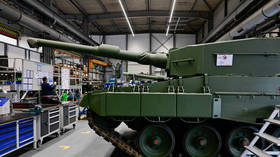
Rheinmetall, Germany’s largest defense contractor, has seen its stock rise more than 1,750% since January 2022, largely on the back of massive orders of 155mm ammunition and Leopard tank components for Ukraine. Airbus and Thyssenkrupp, both of which have substantial defense divisions, are up around 200%. Rheinmetall is now Germany’s sixth-largest company by market capitalization, outranking Volkswagen, Mercedes-Benz, and BMW.

According to some estimates, defense spending has accounted for as much as 20% of total EU economic growth since 2022.

Where does Ukraine come into the picture?

Ukraine benefits in material terms from every Rheinmetall shell it fires and tank it repairs at the company’s facility near Lviv. Kiev also benefits from any political decision that lets its most fervent supporters in Europe – namely the European Commission, France, Germany, and Poland – act without interference from the rest of the bloc.

For example, when the European Commission proposed a €90 billion debt-funded loan to Ukraine last year, it was opposed by Hungary, Slovakia, and the Czech Republic. The EU Council used enhanced cooperation to issue the loan last month, with the first payment to Kiev expected in April.

The bottom line

Von der Leyen has used the Ukraine conflict to dramatically centralize power in the EU. Aside from using enhanced cooperation to issue a loan that Kiev will never be able to repay, the EC president has proposed an end to the unanimity requirement for foreign policy and defense decisions, and until this week planned to create a dedicated intelligence unit under her control, citing the supposed threat of Russian “hybrid warfare.”

Now that the EU economy is buckling under the weight of the commission’s decisions, namely its abandonment of cheap Russian oil and gas, von der Leyen is yet again tearing up the rulebook to achieve her goals. Ahead of Thursday’s meeting in Belgium, it seems that the much-vaunted unity of the bloc is of little concern to her if it stands in the way of her ambitions.

source

One-on-one diplomacy meets double-track reality in US-Russia ties

0

Moscow’s top diplomat is warning that dialogue with Washington is continuing in words but not in deeds

A deal announced by US Vice President J.D. Vance during a high-profile visit to Armenia on Monday has been presented in Washington as economic cooperation and regional stabilization. But the agreement landed in Moscow against a backdrop of long-standing Russian warnings that Yerevan’s growing engagement with the West risks undermining its traditional regional partnerships. 

This is Washington’s double-track policy: dialogue on paper, pressure in practice.

In Moscow, that contradiction has crystallized into a division of labor. One set of officials continues to test transactional engagement with Washington. Another has begun saying openly that it is not possible.

On one track is Kirill Dmitriev, the Harvard-educated financier and head of Russia’s sovereign wealth fund, tasked with maintaining dialogue and exploring large-scale economic deals with the West.

On the other is Sergey Lavrov, esteemed diplomat and the longest-serving foreign minister in the world. He is increasingly the man saying publicly what Moscow believes privately: that the US is negotiating in words while escalating in practice.

That contrast has come into full view following a series of interviews Lavrov gave respectively to RT, TV BRICS, and in subsequent public remarks.

Lavrov’s diagnosis 

The ‘Spirit of Anchorage’ and broken promises

Lavrov openly challenged the idea that the US and Russia are still working toward a framework of cooperation emerging from talks in Anchorage, Alaska.

He said Russia accepted Washington’s proposals on resolving the war in Ukraine, only to find that the US has backed away from them in practice:

“If you approach it, so to speak, man-to-man, they made an offer, we agreed – the problem should have been resolved. […] And so, having accepted their proposals, we believed we had fulfilled the task of resolving the Ukrainian issue and could move on to full-scale, broad, mutually beneficial cooperation. But in practice everything looks the opposite.”

’US objective is global dominance’

He described the continuation and expansion of sanctions as evidence Washington has abandoned cooperation:

“The US’ objective is global economic dominance, implemented through a wide range of coercive measures inconsistent with fair competition, including tariffs, sanctions, direct prohibitions, and even restrictions on communication for some partners. We must take all this into account,” Lavrov said.

This echoes his comment that there is no “bright future” in economic ties with the US.

The ‘war’ against tankers

The Russian foreign minister specifically framed the extraordinary US intervention and seizure of Russia-flagged oil tankers on the high seas as coercive:

“[It is] a ‘war’ against tankers in the open sea in violation of the UN Convention on the Law of the Sea.”

The targeting of tankers, Russia’s foreign minister believes, is part of a larger Western pressure campaign.

Russian partners under fire

Lavrov also used the interview to expand his critique beyond Russia’s direct ties with the United States, arguing that Washington is exerting pressure on Russia’s partners – most notably India – to reduce their energy cooperation with Moscow:

“India and other partners are being pressured to stop buying cheap, accessible Russian energy resources.”

“America is trying to control Russia’s trade and military ties with some of our strongest partners like India. Unfair methods are being used against us,” he said in an interview with TV BRICS.

What this means in context

Taken together, these statements illustrate why Lavrov has shifted toward unfiltered diplomatic observation. His remarks amount to a strategic diagnosis – one that defines the boundaries within which Moscow now views engagement with Washington. 

He rejects the premise that earlier diplomatic frameworks still apply, and treats continued sanctions, energy pressure, and interference with partners as evidence that, for now at least, cooperation has been hollowed out.

Dmitriev: Operating after diagnosis

Testing what, if anything, still works 

As head of Russia’s sovereign wealth fund, Dmitriev has been Moscow’s most visible advocate of transactional engagement with the West. Harvard-educated and fluent in the language of global finance, his role has been to explore whether large-scale economic cooperation remains possible even as political relations deteriorate.

Dmitriev has been a central figure in ongoing Russia-US tracks on Ukraine and economic dialogue. Reuters reported that he travelled to Miami in late January to meet members of the US administration ahead of a new round of peace talks in Abu Dhabi. 

At those and related meetings, he reiterated that work continues on reviving economic ties and advancing negotiations, even amid sanctions and geopolitical friction. According to a recent Reuters report, Dmitriev said progress was being made toward a diplomatic solution to the Ukraine conflict, noting that while other actors sought to disrupt the process, there was nonetheless “positive movement forward” in trilateral discussions involving Russia, Ukraine, and the United States. 

His participation in meetings with US envoys, including at forums like the World Economic Forum in Davos and in preparatory talks ahead of the Abu Dhabi round, reflects Moscow’s interest in testing whether points of pragmatic cooperation still exist.

Importantly, Dmitriev’s efforts come at a time when Western officials have publicly engaged him despite his personal sanctions, and both sides have used his meetings to signal interest in maintaining at least channels of contact even as broader relations deteriorate. 

Synthesis: Two tracks, one reality

Taken together, Lavrov and Dmitriev embody the dual character of Russia’s current foreign policy posture toward the United States:

  • Lavrov’s rhetoric signals a strategic judgment that Washington’s actions have surpassed the limits of cooperation, redefining engagement as pressure rather than partnership.

  • Dmitriev’s activity demonstrates that, even under these conditions, Moscow continues to probe whether narrow, transactional interactions – especially those linked to peace negotiations and economic dialogue – can still yield results.

One voice articulates Moscow’s broader assessment of US intentions, without fear or favor, the other tests the boundaries of what can be achieved.

What Armenia proves

Armenia matters in Moscow because it sits at the intersection of several trends Russian officials have already flagged as red lines.

Over the past two years, Yerevan has publicly distanced itself from Russian-led security arrangements, suspended active participation in the CSTO, deepened defence cooperation with the West, and questioned the value of Russia’s role as a security guarantor after Nagorno-Karabakh. Russian officials have repeatedly warned that Armenia’s westward turn carries strategic consequences, particularly when framed as “diversification” rather than rupture.

Against that backdrop, the deal announced by Vance may be interpreted in Moscow as part of a cumulative reorientation: US involvement expanding precisely where Russian influence has been politically weakened.

This is where Lavrov’s broader argument comes in. In his telling, Washington is institutionalizing shifts away from Russia while maintaining the language of dialogue. Armenia, in this sense, is confirmation.

Sanctions are being expanded, maritime pressure on Russian energy exports intensified, and Russia’s partners – including India – are being urged to scale back cooperation. In that environment, US engagement in Armenia reads in Moscow as strategic sequencing, which tests Lavrov’s case. And for now, Lavrov appears to believe the test has already been answered.


source

Trump threatens to block bridge to Canada

0

The US president has demanded ownership of “at least half” of the crossing between Ontario and Michigan

US President Donald Trump has threatened to block the opening of a major new bridge linking Canada and the US unless Washington receives compensation and a partial ownership stake in the project.

In a lengthy post on his Truth Social platform on Monday, Trump said he would not allow the Gordie Howe International Bridge – connecting Windsor, Ontario, and Detroit, Michigan – to open until the US is “fully compensated” and Canada treats its neighbor with what he described as “fairness and respect.”

“With all that we have given them, we should own, perhaps, at least one half of this asset. The revenues generated because of the US market will be astronomical,” he wrote.

Trump accused Canada of benefiting disproportionately from the project, claiming it was built with “virtually no US content” and alleging that a waiver issued under former President Barack Obama allowed Canada to bypass ‘Buy American’ requirements. He also repeated longstanding grievances over Canadian dairy tariffs, provincial restrictions on US alcohol sales, and Ottawa’s recent outreach to China.

The new six-lane crossing is expected to open early this year following final testing and inspections, and will become one of the busiest trade links between the two countries. The bridge, which began construction in 2018, is projected to cost about $6.4 billion, up from an original estimate of $5.7 billion.

According to the Canadian government, the bridge has been fully funded by Ottawa but will be publicly owned by Canada and the state of Michigan. Windsor Mayor Drew Dilkens said parts of the US president’s post were “just insane,” insisting that US steel was used on the Michigan side of the project.

Trump endorsed the bridge during his first term, calling it a “vital economic link,” despite lobbying from the owners of the Ambassador Bridge, who have long opposed the project.

The new threat comes amid broader strains in US-Canada relations. In recent weeks, Trump has also warned of steep tariffs on Canadian-made aircraft and suggested punitive measures if Ottawa deepens trade ties with Beijing.

Canadian Prime Minister Mark Carney has rejected claims that Canada is pursuing a free-trade deal with China and has urged Washington to respect Canadian sovereignty.

You can share this story on social media:

source

Canadian police identify mass school shooter as transgender

0

Authorities have admitted that the “gunperson in a dress” who killed his family and seven others was a biological male

The shooter who killed nine people in Tumbler Ridge, Canada, has been identified by police as “an 18-year-old female by the name of Jesse van Rootselaar,” but was actually born as a “biological male.”

A suspect initially described as a “female in a dress” fatally shot two people in a house and another seven people at a high school in the British Columbia town of Tumbler Ridge on Tuesday afternoon. Police said the “gunperson” injured 25 others before committing suicide by gunshot.

At a press conference on Wednesday, Royal Canadian Mounted Police (RCMP) Deputy Commissioner Dwayne McDonald named the suspect as “an 18-year-old female by the name of Jesse van Rootselaar.”

However, when pressed about the suspect’s gender identity, he said: “I can say that Jesse was born as a biological male who approximately … six years ago, began to transition to female, and identified as female, both socially and publicly.”

Canada’s CTV initially identified the shooter as Jesse Strang on Wednesday. According to the broadcaster, the two bodies in the house have been identified as his mother and brother.

Several hours before CTV’s report, Juno News, a right-wing outlet, claimed that it had been contacted by the suspect’s uncle, who said that Jesse was transgender. Unconfirmed reports on social media link him to a Reddit account where the suspect purportedly expressed interest in firearms and transitioning to female at 15 years old.

The attack is the third-deadliest mass shooting in Canadian history. At least eight mass shootings in the US since 2018 have been carried out by men who identified as women. Most recently, 23-year-old Robert Westman, who had legally changed his name to ‘Robin’, shot two people dead and injured 30 others in an attack on a church in Minneapolis, Minnesota last August.

Canadian Prime Minister Mark Carney canceled a planned trip to Germany in the wake of the shooting. In an address on Wednesday, he called the attack an act of “unheard-of cruelty,” adding “what happened has left our nation in shock and all of us in mourning.”

You can share this story on social media:

source

US revises India trade deal fact sheet – media

0

The changes have reportedly been made on pulses, an investment pledge, and a tax waiver to allay New Delhi

The White House has revised its fact sheet on the recently announced India-US trade deal, according to media reports. It had initially released the document on the agreement on Monday.

The updated version of the statement includes three main changes, according to a Hindustan Times report.

The changes were made after New Delhi reportedly flagged wordings and references that were not agreed upon, the outlet said.

The White House removed the reference to certain pulses from the initial version that said India would eliminate or reduce tariffs on agricultural goods.

India is the world’s biggest producer and consumer of pulses, and any concessions would make US supplies more competitive.

New Delhi’s insistence on leaving out dairy and agricultural products was seen as one of the main hindrances to a trade deal with Washington. Agriculture has always been a bone of contention in US-India trade talks, as farmers are a sensitive political constituency in both countries.

The removal of pulses from the wording is seen as successful pushback by New Delhi, according to the HT report.

The other change is related to the reported commitment made by India to buy additional American goods. The new statement says India “intends to buy” more American products, matching the wording in the India-US joint statement issued last week.

The White House also tweaked the reference that New Delhi “will remove its digital services taxes.” The new version states India is “committed to negotiate” digital trade rules.

US President Donald Trump’s Truth Social post announcing the deal had claimed India had agreed to buy over $500 billion worth of American energy, technology, agricultural, coal, and other products.

Trump’s claims on tariff concessions by India were unlikely, a former Indian foreign secretary told RT after the deal was announced.

The US-India trade deal reduced India’s tariff burden to 18% from the earlier 50%, which was the highest for any country in Asia.  Indian exports to the US now enjoy the second-best tariff rate in Asia, after Japan.

You can share this story on social media:

source

UK’s King Charles comments on brother’s Epstein links

0

The monarch has said he is concerned by new revelations of ex-Prince Andrew’s ties with the convicted sex offender

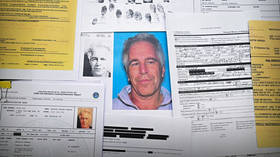
The UK’s King Charles has said he will back a police probe into his brother, the former Prince Andrew, over claims that he provided confidential government information to the late convicted sex offender Jeffry Epstein.

Thames Valley Police confirmed on Monday that it was assessing whether to launch a formal investigation into reports that Andrew Mountbatten-Windsor, who was stripped of his titles after previous revelations of his links with Epstein, had also been leaking official British trade documents to the disgraced financier.

Emails from the latest batch of the Epstein files, released by the US Justice Department last month, suggested that the King’s brother shared data with Epstein in 2010 after the financier had been found guilty of child sex crimes.

King Charles broke his silence on the issue on Monday, with Buckingham Palace saying in a statement that the monarch “has made clear, in words and through unprecedented actions, his profound concern at allegations” against the former prince.

“While the specific claims in question are for Mr Mountbatten-Windsor to address, if we are approached by Thames Valley Police, we stand ready to support them as you would expect,” the palace said.

The King’s “thoughts and sympathies have been, and remain with, the victims of any and all forms of abuse,” the statement added.

On Tuesday, US Democratic Congressman Ro Khanna, a member of a committee investigating the Epstein scandal, told Sky News that “this is the most vulnerable the British monarchy has ever been. They ought to ask the King and Queen questions and maybe this will be the end of the monarchy.”

Khanna insisted that King Charges “has to answer… what he knew about Andrew, and just stripping Andrew of a title is not enough,” and that Mountbatten-Windsor should himself appear before the US congressional committee.

British journalist Martin Jay told RT that “a lot of damage has been done” to the British monarchy by the former Prince Andrew, but noted that expecting King Charles to abdicate his throne would be “stretching it a bit.”

The British monarch will now “be thinking about how to pull off another miracle PR exercise and try and re-brand the royal family very quickly,” Jay suggested.

You can share this story on social media:

source

Middle East on the brink of war: Why US-Iran talks may be the last chance for peace

0

As war clouds gather over Iran, will Hezbollah and the Houthis step in to defend Tehran?

Another round of talks between the US and Iran is expected to be held in the upcoming days. With regional allies on edge and militant groups warning of escalation, the outcome of the negotiations could determine whether diplomacy holds or whether the Middle East slides toward a broader war.

What’s at stake in the new round of US-Iran talks?

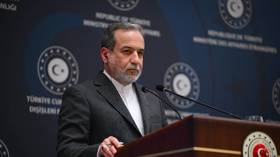
Iran and representatives of the Trump administration are expected to hold another round of talks in the coming days, Iranian Foreign Minister Abbas Araghchi said on Friday.

The announcement follows a six-hour marathon of talks in Muscat, the capital of Oman, where Araghchi and his team met with Jared Kushner, US President Donald Trump’s son-in-law, Steve Witkoff, the US special representative for the Middle East, and Gen. Brad Cooper, chief of staff of US Central Command (CENTCOM).

The venue for the next round has yet to be finalized. Oman may be replaced by another Gulf country or possibly Türkiye, but the focus of the discussions is expected to remain unchanged: Iran’s military capabilities.

At the center of the agenda is Tehran’s nuclear program, which Iran insists is designed solely for civilian energy and research purposes. 

Washington, however, remains deeply skeptical, arguing that Iran’s enrichment levels, stockpiles, and technological advances point toward potential military use. The US wants the program either sharply curtailed or dismantled entirely.

But the nuclear issue is only one of several major fault lines separating the two adversaries.

Speaking at a press conference last Wednesday, US Secretary of State Marco Rubio outlined what he described as the minimum conditions for the talks to succeed. In addition to nuclear restrictions, Rubio said Iran’s ballistic missile program must be addressed, and Tehran must halt its support for armed Islamist groups across the Middle East.

Those demands reflect long-standing US concerns. Iran’s missile program is viewed in Washington as a delivery system for a future nuclear weapon, while Iranian backing of groups such as Hezbollah, the Houthis, and various Iraqi militias is seen as a destabilizing force across the region.

Red lines that don’t move

Iran, however, has consistently rejected such conditions. Officials in Tehran argue that their missile program is defensive and non-negotiable, especially given the country’s experience with war, sanctions, and isolation. Likewise, Iranian leaders have repeatedly framed support for allied groups as a legitimate response to Israeli and Western influence in the Middle East.

For that reason, expectations for a breakthrough remain low.

Iran is unlikely to make meaningful concessions on its ballistic missile program, nor is it expected to abandon its long-standing allies, including Hezbollah in Lebanon and the Houthis in Yemen. If those positions remain unchanged, analysts warn that the path toward military confrontation becomes increasingly narrow.

Experts have repeatedly cautioned that a direct conflict between Iran and the United States would almost certainly spiral beyond bilateral fighting. Instead, it could ignite a region-wide war, particularly if Iranian-backed groups enter the fray.

How Lebanon’s most powerful militia views a possible war

A Hezbollah official, who agreed to speak on condition of anonymity, echoed those fears, warning that the entire Middle East could be dragged into a full-scale confrontation.

“All countries in the region are prepared for this confrontation,” the official said. “That is why Saudi Arabia, the UAE, Jordan, and others issued statements saying they will not allow their airspace to be used to strike Iran. The Iranian Supreme Leader, Ali Khamenei, has also stated that any war on Iran will be a regional one. For Tehran, it would be a war of survival. The repercussions will affect all countries in the region.”

Despite the dire warnings, the official stopped short of confirming whether Hezbollah would actively intervene if Iran were attacked.

“We may or may not intervene,” he said. “Sheikh Naim Qassem [Hezbollah’s chief – ed.] emphasized the right of resistance and the defense of Lebanon. Our position is that we will not accept the Israelis, or anyone else, striking us while we stand idly by.”

Such statements underline Hezbollah’s attempt to maintain strategic ambiguity. Yet analysts note that even if the group wished to intervene decisively, its capacity has been significantly degraded following its most recent confrontation with Israel.

Before the war that erupted in October 2023, Hezbollah was widely believed to possess one of the largest rocket and missile arsenals in the world, estimated at more than 150,000 projectiles. After months of sustained Israeli airstrikes and targeted operations, that stockpile is believed to have shrunk dramatically, by as much as 70 to 80%, according to several assessments. Rocket launchers have also been severely degraded, with some estimates suggesting they have been reduced to a small fraction of their pre-war levels.

The damage has not been limited to weapons. Hezbollah has also suffered heavy personnel losses. Senior figures such as Hassan Nasrallah, Hashem Safieddine, Fuad Shukr, Ali Karaki, and others have been killed. Tunnel systems, storage depots, and command centers have been destroyed, while financial networks that once funneled money to fighters and supporters have been disrupted or crippled.

Still, the Hezbollah official insists the group remains capable of resisting Israel.

“The Israelis know that even after the war ended, resistance rockets were falling in many parts of the entity [Israel], especially in Tel Aviv,” he said.

“They know the war did not end with the resistance losing its capabilities. Quite the opposite is true. This is why the Israelis and Americans are trying to pressure Hezbollah to disarm.”

According to the official, such pressure will not succeed.

“We are a group that refuses to live in humiliation. In our conviction and belief, we are the people of dignity, and we will not accept our country being occupied, aggressions being perpetrated, innocent people being killed, while we stand idly by.”

Why Yemen could become another front

Similar defiant rhetoric has also emerged from Yemen. Speaking from Sanaa, Houthi spokesman Mohammed al-Bukhaiti told RT that the group has “no concerns at all” when it comes to confronting Israel or the US.

“In fact, we prefer direct confrontation with the American and Israeli enemy over indirect confrontation with their tools in the region or their mercenaries at home,” he said.

We view martyrdom in the cause of God as a victory, not a loss.

Al-Bukhaiti said Iran has “sacrificed a lot” for the Yemeni people and that the Houthis intend to respond “to loyalty with loyalty.”

Yet, as with Hezbollah, the Houthis face serious constraints. Even before the October 7, 2023 Hamas attack on Israel that triggered the current regional escalation, Yemen’s economy was in dire condition after years of civil war. Israeli strikes on ports and key infrastructure carried out in response to Houthi missile and drone attacks have only worsened the situation, with estimated direct and indirect damages exceeding $1 billion.

Despite these setbacks, al-Bukhaiti claims the group’s “military capabilities have increased and developed significantly” and says the Houthis are “more prepared to engage in the coming rounds.” He declined to specify what those capabilities are or what actions the group would take if Iran were attacked.

In the past, Houthi responses have included missile and drone launches toward Israel, attacks on international shipping, disruptions to oil flows, and even interference with undersea internet cables. Should tensions escalate again, analysts believe similar tactics could be employed.

As negotiators prepare to meet again, the gulf between US demands and Iranian red lines remains wide. Whether diplomacy can still rein in the crisis, or whether the region edges closer to a multi-front war, may depend not only on what is said at the negotiating table, but on how far Iran’s allies are willing, and able, to go once words give way to action.


source