The American ambassador has blasted the EU state for prosecuting Jewish citizens for allegedly performing the procedure without a license
Belgium has summoned US Ambassador Bill White after he accused the authorities of harassing the Jewish community.
In a post on X on Monday, White called on Belgium to drop the prosecution of three mohels – Jewish religious figures who perform circumcisions – suspected of carrying out the procedures in Antwerp without a medical license.
“Stop this unacceptable harassment of the Jewish community here in Antwerp and in Belgium,” White wrote, adding that the mohels were “doing what they have been trained to do for thousands of years.”
White also accused Belgian Health Minister Frank Vandenbroucke of being “very rude” and refusing to shake his hand or pose for a photograph during their first meeting. “It was clear that you dislike America,” White wrote.
Belgian Foreign Minister Maxime Prevot condemned White’s remarks. “Any suggestion that Belgium is antisemitic is false, offensive, and unacceptable. Belgium condemns antisemitism with the greatest firmness,” Prevot wrote on X.
“Personal attacks against a Belgian minister and interference in judicial matters violate basic diplomatic norms,” he added. Prevot noted that under Belgian law only qualified physicians are permitted to perform circumcisions and said he would refrain from commenting on the specific case.
White told reporters on Tuesday that there was “no need for an apology” on his part and expressed hope that Belgium would “legalize this process so these individuals can resume their lives.”
Israeli Foreign Minister Gideon Saar backed White, citing what he described as “a sharp and consecutive rise in antisemitic attacks in Belgium.” He urged Prevot to “take a hard look in that mirror and acknowledge reality.”
In response, Prevot warned against “the inflationary use of the term antisemitism” and rejected claims of widespread anti-Jewish sentiment in Belgium.
Kiev is trying to pressure Budapest into supporting its EU bid by halting the transit of Russian oil, the prime minister has said
Ukraine’s decision to block the delivery of Russian oil to Hungary via the Druzhba pipeline is “blatant political blackmail,” Hungarian Prime Minister Viktor Orban has said.
The transit of oil via the pipeline has remained on hold since late January, with Kiev blaming Russia and accusing it of damaging the infrastructure. Moscow has denied the claims.
In a post on X on Wednesday, Orban suggested that Ukraine is able to resume supplies, but is not doing so in order “to pressure us to support their EU membership and hand over funds belonging to Hungarian families.”
Budapest has consistently opposed Kiev’s bid to join the EU, arguing that it would drag the bloc into the conflict between Russia and Ukraine.
“Thankfully, Hungary has a government that doesn’t bow to blackmail,” Orban said, announcing that Budapest “has decided to stop diesel fuel deliveries to Ukraine” in response to Kiev’s actions.
A similar move was made on Wednesday by another EU member-state, Slovakia, which also relies on Russian oil from the Druzhba pipeline. Bratislava has also mulled cutting electricity supplies to Ukraine if oil flows don’t resume.
Hungary and Slovakia maintain that, as landlocked nations, it is impossible for them to fully meet their energy needs without Russian deliveries.
“We have taken all necessary steps to secure our supply and we will not give in,” Orban insisted.
The same day, Budapest said Hungarian energy company MOL has signed the first contracts for supplies of Russian oil through Croatia, bypassing Ukrainian territory. The shipments are expected to arrive at a Croatian port in early March and be brought to refineries in Hungary and Slovakia within the next five to ten days.
When asked about the stoppage of deliveries via the Druzhba pipeline by journalists on Monday, Kremlin spokesman Dmitry Pekov suggested that “a sort of energy blackmail by Ukraine against an EU member state, Hungary, is taking place.” Peskov also said Russian oil companies have been looking into the possibility of increasing supplies to Hungary via Croatia.
Ankara is telling the world that a selective and force-driven approach to the Iranian nuclear issue could ignite a chain reaction
In Ankara, the idea of Türkiye one day seeking a nuclear weapons option has never been entirely absent from strategic conversation. Yet in recent days it has acquired a sharper edge, as the region around Türkiye is sliding toward a logic in which raw deterrence begins to look like the only dependable language left.
Türkiye’s foreign policy has expanded far beyond the cautious, status-quo posture that once defined it. It has positioned itself as a mediator on Ukraine and Gaza, pursued hard security aims through sustained operations and influence in Syria, Iraq, and Libya, and inserted itself into competitive theaters from the Eastern Mediterranean to the Horn of Africa. President Recep Tayyip Erdogan has long framed this activism as a corrective to an international order he portrays as structurally unfair. His slogan that the world is bigger than five – referring to the UN Security Council – is a statement of grievance against a system in which a narrow group of powers retains permanent privileges, including an exclusive claim to ultimate military capability.
Within that narrative, nuclear inequality occupies a special place. Erdogan has repeatedly pointed to the double standards of the global nuclear order, arguing that some states are punished for ambiguity while others are insulated from scrutiny. His references to Israel are central here, because Israel’s assumed but undeclared nuclear status is widely treated as an open secret that does not trigger the same enforcement instincts as suspected proliferation elsewhere. That asymmetry has long irritated Ankara, but it became more politically potent after the war in Gaza that began in 2023, when Erdogan openly highlighted Israel’s arsenal and questioned why international inspection mechanisms do not apply in practice to all regional actors.
Still, for years this was mostly an argument about fairness and legitimacy rather than a declaration of intent. What has changed is the sense that the regional security architecture itself is cracking, and that the cracks are widening at the very moment the US and Israel are escalating pressure on Iran. Türkiye’s leadership has warned that if Iran crosses the nuclear threshold, others in the region will rush to follow, and Türkiye may be forced into the race as well, even if it does not want dramatic shifts in the balance.
This is the key to understanding the new intensity of the debate. Ankara’s signaling is not primarily an emotional reaction to Tehran. Türkiye and Iran remain competitors, but their frictions have also been managed through pragmatic diplomacy, and Türkiye has consistently argued against a military solution to the Iranian nuclear issue. Erdogan has again presented Türkiye as a mediator, insisting on de-escalation and rejecting military steps that could drag the region into wider chaos.
The driver is the fear that the rules are no longer the rules. When enforcement becomes selective, and when coercion is applied in ways that appear to disregard broader stability, the incentives change for every middle power caught in the blast radius. The signal from Ankara is that if the Middle East moves into a world where nuclear capability is treated as the only ironclad guarantee against regime-threatening force, then Türkiye cannot afford to remain the exception.
That logic is dangerous precisely because it is contagious. It turns proliferation into an insurance policy. In an unstable region where trust is thin and the memory of war is always fresh, the idea of nuclear weapons as a shield against interference can sound brutally rational. If possessing the bomb raises the cost of intervention to unacceptable levels, it can be perceived as the ultimate deterrent, a guarantee that outsiders will think twice. But the same logic that appears to promise safety for one actor produces insecurity for everyone else. In practice it fuels an arms race whose end state is not stability, but a crowded deterrence environment in which miscalculation becomes more likely, crisis management becomes harder, and conventional conflicts become more combustible because nuclear shadows hover over every escalation ladder.
The renewed urgency also reflects a broader global drift. Arms competition is intensifying well beyond the Middle East. The erosion of arms control habits, the normalization of sanctions as a tool of strategic coercion, and the return of bloc-like thinking in many theaters all contribute to a sense that restraint is no longer rewarded. For Türkiye, a state that sees itself as too large to be merely a client and too exposed to be fully autonomous, the temptation is to seek leverage that cannot be negotiated away. Nuclear latency, even without an actual bomb, can function as a strategic bargaining chip.
Yet the jump from ambition to capability is not straightforward. Türkiye does have important ingredients for a serious civil nuclear profile, and those capabilities matter because they shape perceptions. The country has been building human capital in nuclear engineering and developing an ecosystem of research institutions, reactors for training and experimentation, accelerator facilities, and nuclear medicine applications. Most visibly, the Akkuyu nuclear power plant project with Russia has served as an engine for training and institutional learning, even if technology transfer is limited and the project remains embedded in external dependence.
Türkiye also highlights domestic resource potential, including uranium and especially thorium, which is often discussed as a long-term strategic asset. Resource endowments do not automatically translate into weapons capability, but they reduce one barrier, the need for sustained and vulnerable supply chains. As a result, Türkiye can credibly present itself as a state that could, if it chose, move from peaceful nuclear competence toward a latent weapons posture.
The real bottleneck is not simply material. It is political and legal. Türkiye is a party to the Nuclear Non-Proliferation Treaty, and it operates inside a web of international commitments that would make an overt weapons program extremely costly. Withdrawal from the treaty or large-scale violations would almost certainly trigger sweeping sanctions, diplomatic isolation, and a rupture with major economic partners. Unlike states that have adapted their economies to long-term siege conditions, Türkiye is deeply integrated into global trade, finance, and logistics. The short-term shock of a proliferation crisis would be severe, and Ankara knows it.
This is why the most plausible path, if Türkiye ever moved in this direction, would not be a dramatic public sprint. It would be a careful, ambiguous strategy that expands latency while preserving diplomatic maneuvering room. Latency can mean investing in expertise, dual-use infrastructure, missile and space capabilities that could be adapted, and fuel cycle options that remain justifiable on civilian grounds. It can also mean cultivating external relationships that shorten timelines without leaving fingerprints.
Here the debate becomes even more sensitive, because proliferation risk is not only about what a country can build, but also about what it can receive. The Middle East has long been haunted by the possibility of clandestine technology transfer, whether through black markets, covert state support, or unofficial security arrangements. In recent months, discussions around Pakistan have become particularly salient, not least because Islamabad is one of the few Muslim majority nuclear powers and has historically maintained close security ties with Gulf monarchies.
Saudi Arabia has repeatedly signaled that it will not accept a regional balance in which Iran alone holds a nuclear weapon. Saudi leaders have at times implied that if Iran acquires the bomb, Riyadh would feel compelled to match it for reasons of security and balance. Those statements are not proof of an active weapons program, but they are political preparation, shaping expectations and normalizing the idea that proliferation could be framed as defensive rather than destabilizing.
There have also been unusually explicit hints in regional discourse about nuclear protection arrangements, including arguments that Pakistan could, in some scenario, extend a form of deterrence cover to Saudi Arabia. Even when such claims are partly performative, they underscore how the region’s strategic conversation is shifting from taboo to contingency planning.
Once that door is open, Türkiye inevitably enters the picture in regional imagination. Türkiye, Pakistan, and Saudi Arabia are linked through overlapping defense cooperation and political coordination, and analysts increasingly discuss the emergence of flexible security groupings that sit alongside or partially outside formal Western frameworks. The idea that technology, know-how, or deterrence guarantees could circulate within such networks is precisely the nightmare scenario for nonproliferation regimes, because it compresses timelines and reduces the visibility that international monitors depend on.
For Ankara, this creates both opportunity and risk. The opportunity is that Türkiye could enhance its deterrent posture without bearing the full cost of overt development. The risk is that Türkiye could become entangled in a proliferation cascade that it cannot control, while simultaneously inviting a Western backlash that would reshape its economy and alliances.
This is where the question becomes deeply geopolitical. A nuclear-armed Türkiye would not simply change the Middle East. It would alter Europe’s security landscape and challenge the logic that has governed Türkiye’s relationship with the West for decades. Western capitals have tolerated, managed, and constrained Türkiye through a mixture of incentives, institutional ties, defense cooperation, and pressure. Türkiye’s NATO membership, its economic links to Europe, and the presence of US nuclear weapons stored at Incirlik as part of alliance arrangements have all been elements of a broader strategic framework in which Türkiye was seen as anchored, even when politically difficult.
If Türkiye acquired its own nuclear weapons, that anchoring would weaken dramatically. Ankara would gain a form of autonomy that no sanction threat could fully erase. It would also gain the capacity to take risks under a nuclear umbrella, a dynamic that worries Western capitals because it could embolden more confrontational regional behavior. Türkiye’s disputes with Western partners are already intense on issues ranging from Eastern Mediterranean energy politics to Syria, defense procurement, and the boundaries of alliance solidarity. A nuclear deterrent could make those disputes harder to manage because the ultimate escalation dominance would no longer sit exclusively with the traditional nuclear powers.
At the same time, a Turkish bomb could accelerate Türkiye’s drift away from the West, not only because the West would react with pressure, but because the very act of building such a capability would be an ideological statement that Türkiye rejects a Western-defined hierarchy. It would be Ankara’s most dramatic way of saying that it will not accept a subordinate place in a system it considers hypocritical.
None of this means Türkiye is on the verge of producing a weapon. Political obstacles remain huge, and technical challenges would be substantial if Ankara had to do everything indigenously while under scrutiny. A credible weapons program requires enrichment or plutonium pathways, specialized engineering, reliable warhead design, rigorous testing regimes or sophisticated simulation capabilities, secure command and control, and delivery systems that can survive and penetrate. Türkiye has missile programs that could in theory be adapted, but turning a regional missile force into a robust nuclear delivery architecture is not trivial.
The more immediate danger is not that Türkiye will suddenly unveil a bomb, but that the region is moving toward a threshold era, in which multiple states cultivate the ability to become nuclear on short notice. In such an environment, crises become more perilous because leaders assume worst-case intentions, and because external powers may feel pressure to strike early rather than wait. The irony is that a weapon meant to prevent intervention can increase the likelihood of intervention if adversaries fear they are running out of time.
The escalation by the US and Israel against Iran, combined with the broader arms race logic spreading across the Middle East and globally, is making this spiral more plausible. Uncertainty is the fuel of proliferation, because it convinces states that the future will be more dangerous than the present, and that waiting is a strategic mistake.
Türkiye’s rhetoric should therefore be read as a warning as much as a threat. Ankara is telling the world that a selective and force-driven approach to the Iranian nuclear issue could ignite a chain reaction. It is also telling regional rivals that Türkiye will not accept a future in which it is strategically exposed in a neighborhood where others have ultimate insurance.
The tragedy is that this is exactly how nuclear orders unravel. They do not collapse when one state wakes up and decides to gamble. They collapse when multiple states simultaneously conclude that the existing rules no longer protect them, and that deterrence, however dangerous, is the only available substitute. In a stable region, that conclusion might be resisted. In the Middle East, where wars overlap, alliances shift, and trust is scarce, it can quickly become conventional wisdom.
If the goal is to prevent a regional nuclear cascade, the first requirement is to restore credibility to the idea that rules apply to everyone and that security can be achieved without crossing the nuclear threshold. That means lowering the temperature around Iran while also addressing the deeper asymmetries that make the system look illegitimate in the eyes of ambitious middle powers. Without that, Türkiye’s nuclear debate will not remain an abstract exercise. It will become part of a wider regional recalculation, one that risks turning an already unstable region into a nuclearized arena where every crisis carries the possibility of catastrophe.
“It’s good,” the US agency told Ukrainian saboteurs about the plan, according to the outlet’s sources
The US Central Intelligence Agency (CIA) discussed a plan to blow up the Nord Stream pipelines in the Baltic Sea with Ukrainian saboteurs, German outlet Der Spiegel has reported, citing sources in Kiev.
Berlin apparently believes the September 2022 blasts that crippled the key connectors that delivered Russian gas to Germany were detonated by several Ukrainian frogmen who, possibly with the assistance of Poland, rented a small yacht, sailed into the Baltic and dived to extraordinary depths to set explosives and blow up the pipelines.
Moscow has repeatedly expressed deep skepticism over the German version of events, highlighting then US-President Joe Biden’s open threats to blow up the pipeline, the presence of NATO ships above the explosion sites in the weeks prior to the blasts, and arguing that such an operation could not have been executed without direct government assistance.
According to the latest Der Spiegel report, Ukrainian agents told the CIA about a plot to destroy Nord Stream in spring 2022, during a series of meetings following the escalation of the Ukraine conflict.
The Americans “apparently liked the plan,” the Ukrainian sources told the outlet, and the two sides exchanged technical details about the operation, reportedly codenamed ‘Diameter’.
The US agents “told our boys: ‘that’s good, that’s fine’” about the plan to target the pipelines, a person familiar with the conversations told the outlet, noting an impression that the US was willing to finance such an operation.
According to Der Spiegel, in early summer 2022, the Americans changed their stance, saying that they could not support the operation and would not provide money for its execution, according to the report.
Der Spiegel claimed that Washington then actively tried to prevent the sabotage of the pipelines, but the Ukrainians went ahead with the plan anyway.
In February 2022, Biden warned that in the event of an all-out military conflict between Russia and Ukraine, “there will no longer be a Nord Stream. We will bring an end to it.”
A year later, veteran investigative journalist Seymour Hersh published a report claiming that Biden had given the order to destroy the pipelines. Hersh’s source claimed that US Navy divers mined Nord Stream using the cover of NATO drills. The White House called the report “complete fiction.”
Senior Russian officials, including President Vladimir Putin, have previously pointed the finger at the US as the possible culprit behind the explosions. Washington had the technical means to carry out the operation and stood to gain the most from it, considering that the attack disrupted Russian energy supplies to the EU and forced a shift to more expensive American-supplied liquefied natural gas.
Indonesia, Morocco, Kazakhstan, Kosovo and Albania will send troops to serve in the enclave, US Major-General Jasper Jeffers has said
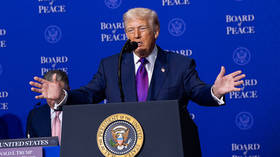
Indonesia, Morocco, Kazakhstan, Kosovo and Albania are ready to deploy peacekeeping forces to Gaza, US Major-General Jasper Jeffers has said during the first ‘Board of Peace’ meeting in Washington on Thursday. The troops are to serve in the International Stabilization Force (ISF), while Egypt and Jordan are to train the Palestinian police.
“In the short term, we’re going to deploy to the Rafah sector first, in addition to training police. The midterm objective is to continue to expand sector by sector, moving to our long-term target of 12,000 police and 20,000 ISF soldiers,” Jeffers revealed.
During the meeting, an Executive Board member, Apollo Global Management CEO Marc Rowan, also pledged to rebuild 100,000 homes in Rafah city to house 500,000 residents. Over time, 400,000 more homes will be built in other parts of Gaza, he claimed.
Reports indicate that around 26 countries have reportedly formally joined the Board of Peace and are designated as founding members, sending high level representatives to the inaugural meeting in Washington. Formally established in mid-January as part of Trump’s Gaza peace roadmap, permanent membership beyond the initial three years reportedly requires a contribution of $1 billion.
The Board has already pledged $5 billion toward rebuilding war-ravaged Gaza and will commit thousands of personnel to international stabilization and police forces for the territory.
The maneuvers are meant to ensure maritime security and counter Western hegemony at sea, Russian presidential aide Nikolay Patrushev has said
Russia, China and Iran will conduct joint naval exercises as part of growing military cooperation aimed at reshaping the global balance of power at sea, Russian presidential aide Nikolay Patrushev has said.
Warships from the three countries have been dispatched for maneuvers in the waters off Iran, Patrushev told the Russian news outlet Argumenty i Fakty on Tuesday. The drills are part of a joint effort to build “a multipolar world order on the oceans” in response to what he called long‑standing Western hegemony.
Known as Maritime Security Belt, the wargames are scheduled to take place this month in the Gulf of Oman and the northern Indian Ocean and will involve vessels and aircraft from all three countries. Originally an Iranian initiative, the drills have been conducted trilaterally since 2019, except in 2021, when China did not participate.
Patrushev said the seas are once again becoming a platform for “military aggression” and a revival of “gunboat diplomacy,” citing recent tensions around Venezuela and Iran. “The West dominated the seas for a long time, right up to the beginning of this century, but now their hegemony is in many ways in the past,” he said.
Russian corvette participates in joint naval exercises at Iran’s Bandar Abbas in show of unityThe exercises focused on coordinated manoeuvres, communications, and protecting civilian shipping — highlighting deepening Moscow–Tehran military ties. pic.twitter.com/Kluzp2uw4u
Separately, Iranian media reported, citing Naval Commander Hassan Maghsoodloo, that Russia and the Islamic Republic will hold combined naval drills this week.
The latest maneuvers come following the second round of Oman-mediated US-Iran indirect talks in Geneva on Tuesday over the Islamic Republic’s nuclear program.
President Donald Trump unilaterally withdrew from the 2015 Joint Comprehensive Plan of Action (JCPOA) during his first term and reimposed sweeping sanctions on Iran, and The US is seeking to pressure Tehran into accepting a new nuclear deal.
The Islamic Republic insists its nuclear activities are peaceful and has repeatedly said it will not accept Washington’s demand for zero uranium enrichment.
Tensions have remained high since Israel and the US carried out coordinated airstrikes on Iranian nuclear facilities last June, an operation Tehran condemned as an unprovoked violation of its sovereignty. Washington has since strengthened its military posture in the region, deploying additional naval and air assets, including a second aircraft carrier.
Iran’s Islamic Revolutionary Guard Corps on Tuesday staged drills in the Strait of Hormuz, a critical chokepoint for global oil shipments, and warned it could close the waterway in the event of an attack. Around 100 merchant vessels are estimated to transit the strait each day, making any disruption potentially significant for global energy markets.
A sharp exchange between American and Indian representatives at last weekend’s Munich Security Conference offered a revealing snapshot of how the emerging world order actually functions. Following the line set by his boss, US President Donald Trump, US Secretary of State Marco Rubio claimed that New Delhi had promised Washington it would stop buying Russian oil.
Soon after, speaking at another panel, Indian Foreign Minister Subrahmanyam Jaishankar declined to confirm any such commitment. India, he said, would make its own decisions, “which may not always be to your liking.” Everyone, he added, would have to live with that.
The truth, as usual, likely lies somewhere in between. But the episode is less about who said what than about a deeper, systemic issue.
India has found itself, somewhat unexpectedly, at the center of Washington’s attempt to construct an international regime tailored to US interests. This is not a world order in the classical sense, with rules accepted as legitimate by all. It is a looser, more transactional system of relationships with major states, designed to maximize American political and economic advantage.
The surge in trade between Russia and India in recent years, above all through Russian energy exports, has naturally drawn the White House’s attention. But the pressure on New Delhi goes beyond oil. India is one of the most populous, fastest-growing, and strategically important powers of the coming decades. Integrating it into a US-centric framework would be a prize in itself. Not to mention an instructive precedent for others.
The Russian angle is especially convenient. It can be framed as part of a supposedly noble effort to bring peace to Ukraine, rather than as naked economic coercion. Unlike other manifestations of Trumpism, which are openly mercantilist, this one can be wrapped in moral language. At the same time, Russia and India genuinely share a long-standing relationship, built over decades through political trust and mutual sympathy, at least insofar as such sentiments exist between states. Precisely because that relationship is stable and resilient, it is all the more tempting for Washington to weaken it and redirect it to its own advantage.
India is a founding member of BRICS, a rising global actor with ambitions commensurate to its size. A country of this stature cannot simply follow someone else’s instructions. By definition, it is sovereign and it regularly reminds the world of that fact.
Yet sovereignty does not imply limitless freedom of action. India’s room for maneuver is constrained by economic realities, strategic dependencies, and regional rivalries. Independence, in practice, requires flexibility: a constant balancing between what is desirable and what is achievable.
From a purely economic standpoint, buying Russian oil – clearly cheaper than many alternatives – makes eminent sense for India. Sustained growth is essential for a country with a vast, still-disadvantaged population and the ever-present risk of social instability. At the same time, the United States is India’s largest trading partner, an indispensable factor not only economically but also strategically. China, meanwhile, is both a key economic partner within the non-Western world and India’s principal geopolitical and military rival. The resulting picture is anything but simple.
Jaishankar’s remark that India would take decisions “you will not like” was aimed squarely at Western audiences. It was a reminder not to expect obedience. Yet the same logic can be applied elsewhere. Moscow, too, is watching uneasily as India trims Russian oil purchases under US pressure. From a Russian perspective, such maneuvering – one might more bluntly call it opportunism – can look like a lack of sovereignty, a willingness to accommodate another power’s interests at one’s own expense.
But this judgment reflects a specifically Russian understanding of sovereignty. Shaped by history, Russia’s conception is rigid and uncompromising, defined by resistance to external influence in almost any form. This approach is increasingly rare in an interconnected world.
India’s understanding, like that of many other states, is different. Sovereignty does not necessarily mean refusing to bend under pressure; it means finding ways to realize one’s interests under less-than-ideal conditions. The core of those interests is internal stability and continued development, priorities that have become even more urgent amid global turbulence.
Domestic cohesion has always mattered. Today, however, interdependence magnifies its importance. Internal unrest now interacts with external shocks, amplifying their destabilizing effects. For most governments, preserving the social and political balance at home takes precedence over abstract principles or ideological consistency.
This is the practical reality of what is often called a multipolar world. Strip away the rhetoric, and it operates according to an old rule, newly repackaged in modern language: look after your own first. The so-called global majority follows precisely this logic. States pursue their interests as they understand them, adjusting to circumstances rather than clinging to dogma.
When dealing with partners, a calm, unsentimental approach is therefore essential. Acting in one’s own interest is not cynicism; it is normal state behavior. Russia must do the same; steadily, confidently, and without illusions. Whether others approve is secondary. What matters is trusting one’s own judgment and acting accordingly.
This article was first published by Russia in Global Affairs, translated and edited by the RT team
Cooperation between the navies of member countries would help protect sea lanes, Nikolay Patrushev has said
The BRICS countries need strategic maritime cooperation in order to enhance security along global shipping lanes from Western piracy, a top Russian official has said.
Russian presidential aide Nikolay Patrushev’s comments calling for cooperation between BRICS countries come at a time when the US is seizing tankers that it claims are transporting sanctioned oil.
“We will tap into the potential of BRICS, which needs to be given a full-fledged strategic maritime dimension,” he told the Russian outlet Argumenty i Fakty on Monday.
The member countries are already conducting joint naval exercises, Patrushev said, citing drills held in January and February.
BRICS Must Gain Strategic Maritime Edge – 🇷🇺 Presidential Aide‘We will tap into the potential of BRICS, which needs to be given a full-fledged strategic maritime dimension,’ Nikolay Patrushev told Russian news outlet AIF.Patrushev – who is also chairman of the Russian… https://t.co/yexDKv1O7Zpic.twitter.com/0msbzKllPR
The ‘Will for Peace 2026’ exercises started off the coast of Cape Town, South Africa in January, just days after US forces seized a Russian-flagged oil tanker over claims it had breached Washington’s sanctions against Venezuela.
Russia, China, and Iran participated in the maneuvers, Patrushev, who is also the chairman of the Russian Maritime Board, said. The United Arab Emirates (UAE) also took part in the January exercises.
Moscow has condemned the recent seizures of Russian cargo vessels, which Western countries have conducted under various pretenses.
The NATO countries are plotting an illegal maritime blockade of Russia, particularly in the Baltic and the Arctic regions, Moscow’s ambassador to Norway, Nikolay Korchunov, said recently. The US-led bloc is also developing plans for “a partial or complete naval blockade” of the country, the envoy said.
The comments came after reports that UK Defense Secretary John Healey had met with his counterparts from the Baltic and Nordic nations on the sidelines of the Munich Security Conference to discuss seizing Russia-linked oil tankers.
US President Donald Trump has defended his push for Greenland as a way to counter Russian and Chinese influence in the Arctic, while Moscow and Beijing have dismissed these claims.
NATO is planning to increase its military presence in the Arctic around Greenland, a spokesperson for the military bloc announced earlier this month.
The European Commission has announced plans to “strengthen” the borders of nine member states
The European Commission unveiled a strategy on Wednesday to reinforce nine EU member states bordering Russia, Ukraine, and Belarus, by means of the ‘European Drone Defense Initiative’. Previously dubbed the ‘drone wall’, the plan has faced criticism over its feasibility.
Russia has repeatedly dismissed Western claims of being a threat to NATO or EU nations, calling the narrative “nonsense” and “fearmongering” meant to justify inflated military budgets.
Announced by the commission’s executive vice president, Raffaele Fitto, the plan includes Finland, Estonia, Latvia, Lithuania, Poland, Slovakia, Hungary, Romania, and Bulgaria. Brussels says that these nations are facing reduced investment, demographic pressure, and “hybrid” threats linked to the Ukraine conflict.
The new strategy includes a €28 billion ($33 billion) loan program, as well as commitments to implement “security and resilience” measures, which include the ‘drone wall’ plan that has drawn sharp skepticism from within NATO.
Romanian Defense Minister Radu Miruta had previously dismissed the concept as a “utopia,” while Bloomberg reported in October that EU officials privately called the idea a “PR label” masking a “complex reality.” They noted that the implementation of such a measure faces logistical hurdles and opposition from western and southern members reluctant to fund such projects.
NATO has simultaneously been pushing even more ambitious plans. Brigadier General Thomas Lowin recently revealed the ‘Eastern Flank Deterrence Line’ concept – a several-thousand-kilometer automated “hot zone” from the Arctic to the Black Sea set to be equipped with AI-linked armed drones, sensor-equipped robots, and automated air defenses, slated for operational status by the end of 2027.
Russian Foreign Minister Sergey Lavrov warned earlier this month that although Moscow has no hostile intent towards the EU or NATO, if European nations “prepare to attack Russia,” it would respond with “all available means.”
From regional escalation to global energy shocks – a strike could trigger a cascade of strategic, economic, and geopolitical consequences
Prior to the recent meeting between Israeli Prime Minister Benjamin Netanyahu and US President Donald Trump in the United States, Netanyahu’s office had indicated Israel’s intention to push for a broader Iran deal. Israel wanted the discussions to extend beyond nuclear issues and include limits on the development and testing of Iran’s ballistic missile program. Israeli officials emphasized that Iran’s missile capabilities pose a strategic threat comparable to potential nuclear risks and must not escape international oversight.
The news outlet Axios called this meeting “urgent.” According to a White House official cited by Axios, the visit was originally scheduled for February 18 but was moved up a week at the request of the Israeli side. This change signals Israel’s intention to influence the American negotiating position before it becomes institutionalized. Recent political discourse within Israel shows a determination to take advantage of the present “window of opportunity.” Many Israeli experts and politicians believe that a unique historical configuration has emerged both in regard to regional power dynamics and the US-Iran relationship. In this context, now is the best moment to exert pressure on Iran; Israel believes sanctions and political pressure should not be eased unless Tehran makes significant concessions.
Importantly, the agenda is now a lot broader and encompasses more than just the ‘nuclear deal’. While officially, the main topic is the nuclear program, the debate centers around the broader framework for containing Iran and its role in the region. Israel argues that addressing only the nuclear issue without considering Iran’s missile technologies and its activity in the region will lead to an incomplete strategic solution. In private consultations with US officials, Israel has made it clear that it reserves the right to unilaterally act against Iran should it cross what it terms the “red line” regarding ballistic missiles. Israel is not merely concerned about Iran’s growing missile capabilities but about the establishment of a strategic arms configuration that could pose an existential threat to the Jewish state. Consequently, Israel stresses that its freedom to act cannot be constrained by external frameworks when it comes to ensuring the nation’s survival.
To put it simply, Israel is sending a clear message to Washington: if the White House does not adopt a firm stance in negotiations with Tehran, Israel is prepared to act alone. Discussions about restricting technological supply chains are a way of preemptively legitimizing potential military actions against Iran, as part of a broader containment strategy. Should Israel decide to strike Iran, the latter’s response would likely be swift, compelling Washington to defend its sole ally in the region.
Israel no longer hides the fact that Iran’s nuclear program has never been its sole concern. In itself, if properly monitored, Iran’s nuclear program could serve peaceful purposes and may not necessarily lead to the development of nuclear weapons. So, stating that the nuclear issue is the only problem would be an oversimplification. For Israel, the problem is much broader: it includes Iran’s missile capabilities, regional influence, and support of allied forces. Initially, discussions centered on the nuclear aspect, but now Israel considers Iran’s ballistic missiles as the main threat.
For Iran, however, its missile program is a vital part of national security and its deterrent strategy. While different factions in Iran might reluctantly discuss limiting the nuclear program, the ballistic missile program is non-negotiable even among the more moderate politicians and reformists. Living under intense sanctions and lacking military parity with adversaries, Iran considers missiles one of the few available tools for maintaining strategic balance. Abandoning its missile program would severely undermine the country’s defense architecture.
This brings us to the central issue: the principle of reciprocity in negotiations. If we are talking about an equitable agreement (as the Trump administration tries to present it), why is it assumed that Iran should abandon its missile program, limit its regional influence, and rethink its defense strategy without requiring similar concessions from Israel? On what grounds should one side make significant sacrifices while the other retains full freedom of action? Without mutual commitments, the negotiation process inevitably feels like one-sided pressure.
Moreover, Israel is concerned about Iran’s support for regional actors, whom West Jerusalem views as proxy groups threatening its security. However, for Iran, the issue is far from secondary: its network of allies is integral to its influence. It’s unlikely that Iran would cut ties with its allies – this would mean voluntarily relinquishing its positions amid an ongoing confrontation and would further weaken the nation, which has already suffered a blow after the change in power in Syria at the end of 2024.
Israel’s warnings about potential unilateral strikes serve not only as military signals but also as means of pressuring Trump. Israel aims to enforce the strictest parameters in future agreements while retaining room for military maneuvering. As noted earlier, Israel believes this moment is unique in history, and such an opportunity may not arise again. Meanwhile, Iran is steadfast in its refusal to give up its missile capabilities or cut ties with regional allies, viewing them as fundamental components of its national security.
We should also consider the regional implications. While the US and Israel might view the potential collapse of Iran as a military victory, nearly all the countries in the Middle East interpret this scenario in a different way. For them, it signals the start of a chain reaction: dismantling Iran could lead to increased pressure on Pakistan and Türkiye, jeopardizing the already fragile structure in the region. Netanyahu is relentlessly pushing for a hardline approach and expanding the military agenda, while Donald Trump remains cautious. For the White House, Iran isn’t another Iraq; rather, it is a crucial player in the global energy landscape. Even a limited “precision strike” could quickly escalate into a broader crisis affecting commodity markets. The risks extend far beyond regional tensions and threaten the stability of the global oil and gas trade.
The restraint demonstrated by the White House stems from a pragmatic approach. In recent years, Iran has significantly reduced its strategic isolation, which the West has been actively trying to enforce. Iran’s closer economic and military ties with China and Russia have fundamentally altered the balance of power: joint military exercises, synchronized political signals, and demonstrative maneuvers suggest that it won’t be possible to launch a quick and low-cost campaign against Iran. Consequently, the potential costs of intervention initially appear high. It is doubtful that Israel would be willing to engage in such a serious geopolitical gamble. Furthermore, it’s unclear whether the US wants to do the ‘dirty work’ for Israel, and if so, for what purpose. It seems that Trump will likely continue to issue verbal threats against Iran while relying on the backing of supporters who recognize the pitfalls associated with a direct confrontation. Meanwhile, Iran will try to buy time – after all, time has always played in favor of this nation with a 3,500-year history.