Ireland and Spain have announced investigations amid reports that AI chatbot Grok produced intimate and pedophilic images
Two new investigations have been announced in the EU into Elon Musk’s social media platform X amid reports that its AI chatbot Grok produced sexualized images of real people, including children.
Grok, developed by Musk’s AI venture xAI and integrated into X, has come under global scrutiny since its launch in 2023. Critics have raised concerns over extremist rhetoric, political bias, and sexually explicit features, warning that poorly moderated AI tools can expose users, particularly teenagers, to harmful content.
Ireland’s Data Protection Commission opened an inquiry into X on Tuesday, stating it will examine whether the company breached EU data protection rules by allowing the creation of “non-consensual intimate and/or sexualized images.”
Spanish Prime Minister Pedro Sanchez also ordered prosecutors on Tuesday to probe X, along with Meta and TikTok, over alleged “creation and dissemination of child pornography using their AI.” He concluded: “The impunity of the giants must end.”
The announcements follow a broader crackdown by European regulators on Big Tech firms, which face allegations of widespread abusive practices on online platforms, from anti-competitive conduct in digital advertising to the deliberate design of addictive features on social media.
X is also under investigation in France and the UK. Italy has issued a warning that using AI tools to create “undressed” deepfake imagery without consent could amount to serious privacy violations and criminal offenses.
xAI’s Acceptable Use Policy prohibits depicting persons in a pornographic manner and the sexualization of children. However, in a recent “digital undressing” trend, users have publicly tagged the bot and commanded it to edit photos.
Researchers at the Center for Countering Digital Hate said Grok produced nearly three million sexualized images in less than two weeks, around 23,000 of which appeared to depict children.
X issued a statement last month saying it is committed to keeping the platform “safe” and maintains “zero tolerance” for child sexual exploitation, non-consensual nudity, and unwanted sexual content.
The Hungarian prime minister has slammed Brussels’ continued backing of Ukraine, suggesting Kiev will not win the conflict
EU leaders are wrong to believe that they can exhaust Russia and help Ukraine win the conflict, Hungarian Prime Minister Viktor Orban has said.
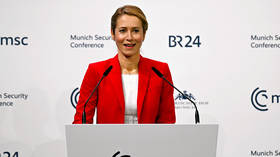
The remarks came in response to German Chancellor Friedrich Merz’s statement at the Munich Security Conference last week, where he suggested that Brussels exacting “unprecedented losses and costs on Moscow” could weaken it and force it to “agree to peace.”
“Who believes that the Russians will run out of steam sooner than Ukraine? It’s a fantasy, an illusion, and irresponsible,” Orban said in a speech on Tuesday, criticizing Brussels’ continued financial and military aid to Kiev.
During his Munich address, Merz claimed that the EU has not used its full potential against Moscow, saying that while the bloc’s GDP is “almost ten times higher” than that of Russia, “Europe today is not ten times stronger than Russia.”
EU leaders have doubled down on pressuring Moscow. Top diplomat Kaja Kallas has insisted Russia is not ready for meaningful negotiations on the Ukraine conflict. The Munich conference also saw Kiev and its backers sign several defense industry deals, including joint ventures for drone production in Germany.
US Secretary of State Marco Rubio lamented in Budapest on Monday that the Ukraine conflict is “one of the few wars” that some in the international community have been backing and resisting efforts to bring to an end.
Russia, Ukraine, and the US have held two rounds of trilateral talks in Abu Dhabi this year. A new round began on Tuesday in Geneva, with US President Donald Trump’s special envoy Steve Witkoff praising “meaningful progress” by the delegations.
Russian President Vladimir Putin said in December that Moscow prefers diplomacy but will achieve its goals by military means if necessary. On the battlefield, Russian forces have maintained a steady offensive.
Russian officials have accused Kiev’s European backers of hindering US-led peace efforts and of increasingly preparing for a direct confrontation with Moscow, aiming at creating an enemy image to distract Western taxpayers from domestic problems.
Dhaka’s former interim administration was accused of not protecting Hindus during recent political turmoil
Bangladesh’s new prime minister has vowed to protect minorities in the country, listing the task as among the top priorities of the newly elected government.
In his first televised address as prime minister, Tarique Rahman said on Wednesday that his administration will strengthen the rule of law in the South Asian nation.
“We want to turn this country into a safe land for every citizen. Muslims, Hindus, Buddhists, Christians – regardless of party, opinion, religion, or ethnicity – whether living in the hills or the plains, this country belongs to all of us,” he said.
Rahman’s Bangladesh National Party (BNP) won a two-thirds majority in the general election on February 12, in the first polls after a violent uprising in 2024 that ousted former Prime Minister Sheikh Hasina.
The interim administration led by Chief Adviser Muhammad Yunus drew flak for presiding over a wave of attacks on the country’s Hindus and other religious minorities.
“Whether you voted for BNP, or did not vote for BNP, or did not vote at all – everyone has equal rights over this government… As a Bangladeshi, every one of us has equal rights in this country, in this state,” Rahman said on Wednesday.
Rights group Manabadhikar Shongskriti Foundation (MSF) has claimed that in January 2026 alone, 21 incidents of lynching and 28 incidents of mob beatings occurred in the country, according to a PTI report.
The Bangladesh Hindu Buddhist Christian Unity Council has reported 522 communal attacks in 2025, including the murders of 116 people of minority faiths, mostly Hindus, between June 2025 and January 2026.
In January, India withdrew the families of diplomats posted in Bangladesh as a precautionary measure and increased security for diplomatic missions amid reported attacks on minorities.
In December, New Delhi urged Bangladesh’s interim government to protect minorities amid the escalating unrest in Dhaka following the killing of a political activist.
Russia will react accordingly to the expansion of the UK’s nuclear deterrent, Ambassador Andrey Kelin has said
The British ‘nuclear umbrella’ will not provide extra security to other NATO members in Europe, Russian Ambassador to the UK Andrey Kelin has said.
Discussions about the continent developing its own nuclear deterrent have accelerated following White House announcements that the US would be scaling back its security commitments to its European allies, while focusing on defending the homeland and containing China.
Last year, German Chancellor Friedrich Merz said he wants his country to be covered by the ‘nuclear umbrella’ of the UK and France, which are the only two European NATO nations to possess such weapons. Swedish Prime Minister Ulf Kristersson announced in January that talks on similar protections have been underway between Stockholm and London.
Kelin told the Russian newspaper Izvestia on Tuesday that it is “obvious that the British ‘nuclear umbrella’ will not be able to provide any additional material security guarantees” to Europe.
The authorities in Moscow are closely monitoring the moves by “states pursuing an overtly anti-Russian policy,” he said.
“The possibility of the expansion of nuclear safeguards will be taken into account in our military planning as well as in further discussions of the strategic stability issues,” the ambassador added.
Britain’s nuclear deterrent, which has remained committed to NATO since 1962, consists of 225 warheads carried by four Vanguard-class submarines. Last year, the UK government also announced plans to purchase 12 F-35 fighter jets from the US, which would be capable of carrying out nuclear strike missiles.
“The strengthening of such potential apparently instills in London an illusory hope of leadership in ensuring European security,” Kelin noted.
During his speech at the Munich Security Conference last week, British Prime Minister Keir Starmer claimed that Russia could be ready to use military force against NATO “by the end of this decade.” He insisted that it is “vital” for the UK and France, which is not part of the bloc’s Nuclear Planning Group, to work together in the field of nuclear weapons.
Earlier in February, Russian Foreign Minister Sergey Lavrov reiterated that Moscow has “no intention of attacking Europe. There is no reason to do so.” However, NATO would face “a full-fledged military response” if it uses force against Russia first, he warned.
NOTE: What follows is an abridged extract from a longer polemical essay by Sergey Karaganov published in the Russian foreign-policy journal Russia in Global Affairs.
The current phase of the West’s conflict with Russia may be nearing its end. It has dragged on longer than necessary. The principal reason is a lack of determination to employ active nuclear deterrence. This is the only mechanism capable of resolving the “European problem,” which has once again become an existential threat to our country.
The Ukraine military operation has acted as a powerful catalyst for Russia’s internal renewal. It has mobilized society, awakened patriotism, and allowed people to demonstrate their best qualities. Pride in the Fatherland and respect for service to it have grown. Engineering, science, the military profession, and skilled labor have regained their rightful status. The economy and science have revived. Teachers, regrettably, have not yet received similar recognition, but that is a subject for later.
By drawing Western hostility onto ourselves, we have seriously weakened the position of the comprador bourgeoisie and its Western-educated allies. The Portuguese once used the word compadres to describe local merchants who served colonial interests. After the reforms of the 1990s, this class expanded in Russia to unhealthy proportions. Fortunately, the process of cleansing the country of this Western-oriented stratum has begun. It has been achieved without mass repression, but with historical inevitability.
This revival has come at a terrible cost. Tens of thousands of brave soldiers lost their lives at the opening stage of national recovery. They deserve eternal gratitude. When – or rather, if – the unfinished war resumes, such losses must not be repeated.
In 2013, I personally warned a group of Western European leaders that their policy of dragging Ukraine into the EU and NATO would lead to war and mass casualties. No one met my gaze. They looked down at their shoes, then continued talking about democracy, trust, and human rights. In reality, they wanted to exploit another forty million people. Something they have partly succeeded in achieving through the creation of millions of refugees.
They spoke of containing Russia, which was still loyal at the time. Our response to NATO’s aggression in Libya in 2011 was weak. We are now paying for years of appeasement and the comprador instincts of part of our elite.
Russia briefly slowed down the EU’s march toward military adventurism by returning Crimea in 2014 and intervening in Syria in 2015. Then we relaxed. Had an ultimatum on NATO expansion been issued in 2018–2020 and backed by credible nuclear deterrence, the current war might have been avoided. Or at the very least it would have been far less bloody. By 2022, it was obvious that both the West and the Kiev authorities were preparing for war.
Ukraine is not a homogeneous entity. In the east and south live people culturally close to us. West of the Dnieper lies a different historical and cultural community, shaped by Austro-Hungarian, Polish, and Western influence and infused for decades with anti-Russian ideology. We must accept this reality and pursue a rational separation from both Ukrainian and European pathologies, forging our own healthy model of development.
Militarily, we are winning. Politically, we have yet to respond adequately to a series of openly aggressive actions: pirate seizures of Russian vessels, threats to close straits, attempts to impose a de facto economic blockade, attacks on oil terminals, and efforts by the Kiev regime to sabotage our tankers. Often with Western European connivance.
Our response so far has been intensified strikes on Ukrainian targets. This is not a strategic solution. Ukraine was deliberately thrown into the furnace so that the fire would spread to Russia. EU elites do not care about Ukrainians. The conflict will continue until its true source is addressed: Western Europe’s degenerated ruling classes, intellectually, morally, and materially exhausted, who cling to power by fueling war.
Unlike 1812–1815 or 1941–1945, we have not yet destroyed a hostile coalition or broken its will. The war has entered what chess players call the middle-game. The remnants of Ukraine, supported by the West, will continue sabotage and terrorism. Sanctions will remain. The EU is preparing for a new confrontation, potentially involving rearmed Ukrainian forces and mercenaries from poorer European states.
Any violations of future agreements will require military responses. We will again be accused of aggression. Open conflict will likely resume.
Our strategy must change fundamentally. The objective is to accelerate the United States’ withdrawal from Europe. The method is firm deterrence. The task is to defeat Western Europe’s current elites, who see Russophobia as their last political lifeline.
The only way to halt escalation is to demonstrate a real willingness to strike – initially with non-nuclear weapons – command centers, critical infrastructure, and military bases in European countries central to anti-Russian operations. Targets should include places where elites gather, including in nuclear states. Governments must feel personal risk.
If non-nuclear measures fail and the EU refuses to retreat, Russia must be prepared – militarily, politically, psychologically – for limited but decisive nuclear strikes using operational-strategic weapons. Before that, several salvos of conventional missiles should be launched.
In the longer term, the question of depriving France and the UK of access to nuclear weapons must be raised. By waging war against Russia, they have forfeited the moral right to possess them. Any Western European move toward nuclear proliferation must be treated as grounds for preemptive action.
I am not advocating nuclear war. Even victory would be a grave sin. But failing to deter escalation risks something worse: a prolonged conflict that could spiral into a global catastrophe. Excessive restraint is no longer responsibility. It’s quite the opposite now because it’s negligence.
Military doctrine must be updated. At the expert level, we should abandon the outdated notion that “there are no winners in a nuclear war.” This dogma has helped make a NATO-Russia clash conceivable.
Washington, sensing escalation risks, is attempting to distance itself. Donald Trump proposes peace initiatives. We should tactically use them to halt bloodshed. Limited economic cooperation with the US may be possible, but without illusions.
Economic interests do not determine state behavior in major conflicts. The US profits from the war: arms sales, capital inflows, industrial relocation. A frozen conflict suits Washington by weakening Russia and distracting it from Eurasia and China.
The Russian–Chinese partnership is already one of the pillars of the emerging world order. Any US attempt at rapprochement aims to undermine it. Engagement must therefore be cautious and limited.
Even if Western Europe suffers strategic defeat, it will continue to stagnate, sliding toward inequality, social tension, and new forms of extremism. The EU may fragment. Selective distancing from Europe is inevitable.
Security and development can only be built within Greater Eurasia. Persisting in a European fixation is a sign of intellectual exhaustion. Meanwhile, the US remains a dangerous and destabilizing power. There can be no illusions here either.
Multipolarity is coming, but it will be turbulent. Climate change, migration, energy shortages, and economic warfare will intensify conflicts. Old institutions are collapsing.
For Russia, opportunity lies in deepening ties with the global majority. Asia today, Africa tomorrow. All the while managing risks with China and India carefully.
We need internal renewal. Education and upbringing must become national priorities. Patriotic, creative citizens are our most valuable resource. Teachers must be among the most respected and well-paid professions. Artificial intelligence should enhance, not replace, human intelligence.
We must move beyond predatory capitalism toward a post-capitalist model centered on human development, family well-being, and moral purpose. This should replace mindless consumption or GDP fetishism. Entrepreneurship should be encouraged, but the lessons of both Soviet stagnation and 1990s chaos must be remembered.
Russia needs a unifying national idea. We could call it an ideology or a ‘Russian Dream’ and base it on service to the common good. Leadership should belong to active, socially responsible citizens.
Finally, Russia’s future lies eastward. Siberia and Asian Russia must become the new center of demographic, economic, and cultural development. Climate change, geography, and history all point in this direction. Low-rise cities, new transport arteries, and people-centered urbanization can make this vision real.
The current conflict, tragic as it is, may provide the impetus for this long-overdue transformation. Russia must offer the world not only strength, but an alternative model of development. Without that, no nation can truly be great.
The investment will add to the firm’s existing 2 GW national data facility and partnership with Google
India’s Adani Group has announced plans to invest $100 billion to set up data centers in the country by 2035.
The investment is one of the world’s largest integrated “energy-compute commitments,” the company said in a statement on Tuesday.
The development comes amid New Delhi’s push to gain a firm presence in the global artificial intelligence race and as the country emerges as one of the key data center markets in Asia. A global AI summit is currently underway in the Indian capital.
The investment builds on AdaniConneX’s 2 gigawatt (GW) national data center platform, which will expand to a projected 5 GW target, the Adani Group statement said.
The company said the investment will also work as an incentive for an additional $150 billion in spending across server manufacturing, cloud platforms, and supporting industries.
AdaniConneX, a joint venture between the Adani Group and data center operator EdgeConneX, is executing Google’s $15 billion AI hub project in India.
A surge in global demand for cloud services, spurred by an AI boom, has prompted companies to make investments in data center facilities globally.
To tap into the AI boom, India has proposed a national policy on data centers. Its current capacity, estimated at 1,263 megawatts (MW) as of April, is expected to cross 4,500 MW by 2030.
Artificial intelligence needs computing power and data center infrastructure, and India is laying the foundation for a thriving domestic AI ecosystem by expanding capacity, Prime Minister Narendra Modi said on Sunday.
Google, Microsoft, and Amazon have already committed a combined $68 billion in AI and cloud infrastructure investment in India up to 2030, according to reports.
Eight people have been removed to Cameroon, following nine others flown there last month, according to several outlets
The US has secretly deported migrants to Cameroon, including people with no ties to the Central African nation and some who had legal protections against removal, according to multiple outlets.
A group of eight migrants arrived in Cameroon’s capital, Yaounde, on Monday, weeks after it emerged that nine others had been flown there in January under what officials described as a third-country deportation program, AP reported on Monday, citing lawyers.
None of the deportees are Cameroonian citizens, and several had reportedly been granted protection orders by US immigration judges because of fears of persecution in their home countries.
Earlier on Saturday, The New York Times reported that the nine migrants were flown from Louisiana to Cameroon without knowing their destination until they were placed in handcuffs and chains on a Department of Homeland Security aircraft.
Washington has not disclosed any public arrangement with Cameroon to accept deportees from other nations, and the Cameroonian government has not commented on the arrivals.
US President Donald Trump has pursued controversial agreements with several African states to host migrants that his administration deems ineligible to remain in the US.
Last November, Eswatini confirmed receiving $5.1 million from Washington in exchange for taking in deportees who have no ties to the southern African nation. Equatorial Guinea and Rwanda have each received $7.5 million from the Trump administration to accept non-citizens removed from the US, according to Democratic Senator Jeanne Shaheen. South Sudan, Ghana, and Uganda have all agreed to deals to host a number of deportees.
A report released last week by Democratic staff on the Senate Foreign Relations Committee said the US has spent more than $40 million through January 2026 on agreements with foreign governments to accept deportees. The report said the arrangements were reached through “opaque negotiations with little transparency to Congress or the public.”
The African Union has warned member states to halt agreements that risk turning the continent into a “dumping zone” for arbitrary expulsions. UN human rights experts have also said the Trump administration risks violating the principles of migrant protection.
However, the Department of Homeland Security has defended the deportations as lawful and “essential to the safety of our homeland and the American people.”
Israel has designated lands in the occupied territories as “state property” in a move hailed by its backers as a “settlement revolution”
A group of eight Muslim-majority nations has condemned Israel over its latest decision to tighten its grip on the occupied Palestinian territories, accusing it of breaching international law and violating multiple UN Security Council resolutions.
Israel’s security cabinet has approved a proposal, made by hardline nationalist ministers over the weekend, to designate large areas of the West Bank as “state property” for the first time since the occupation began in the aftermath of the Six-Day War. The move builds on last week’s cabinet decision to make land registries in the area public rather than private, making it easier for Jewish settlers to purchase real estate.
The group of eight Muslim-majority nations – Egypt, Jordan, Indonesia, Pakistan, Türkiye, Qatar, Saudi Arabia and the United Arab Emirates – condemned Israel’s action in a joint statement on Tuesday.
They argued that the move constitutes a blatant violation of international law and breaches multiple UN Security Council resolutions, “foremost among them Resolution 2334,” which calls on Israel to halt settlement activities in the West Bank.
“This illegal step constitutes a grave escalation aimed at accelerating illegal settlement activity, land confiscation, entrenching Israeli control, and applying unlawful Israeli sovereignty over the Occupied Palestinian Territory,” the statement reads.
The eight nations urged the international community to immediately take “clear and decisive steps” against Israel to halt its illegal activities and protect Palestinian rights. Shortly after the Israeli government announced its decision, the Palestinian presidency strongly condemned the move, stating that it effectively voided multiple signed agreements and openly contradicted UN Security Council rulings.
Hardline Israeli nationalists have welcomed the cabinet decision as a “true revolution” destined to accelerate the settlement process and to restore “order and governance” in the West Bank. “The State of Israel is taking responsibility for its land and is acting according to the law, transparently and decisively,” one of the move’s sponsors, Finance Minister Bezalel Smotrich, has said.
The Israeli government has long been seeking to annex the West Bank despite widespread international opposition to the move and the position of its main ally, the United States. US President Donald Trump has repeatedly warned West Jerusalem against the move, insisting that the annexation “is not going to happen.”
The debate over Greenland revives a question that has shaped America’s rise for more than two centuries
When US President Donald Trump revived the idea of buying Greenland – and refused to rule out stronger measures if Denmark declined – the reaction across Europe was swift and indignant. The proposal was framed as an anachronism: a throwback to imperial horse-trading that modern international politics had supposedly outgrown.
But the outrage obscures an uncomfortable historical reality. The United States was not only forged through revolution and war; it was also built through transactions – large-scale territorial purchases concluded at moments when the balance of power left the seller with limited options. From continental expanses to strategic islands, Washington has repeatedly expanded its reach by writing checks backed by leverage.
If the idea of buying land now sounds jarring, it is worth recalling that some of the largest such deals helped shape the United States into the country we know today. To understand why the Greenland debate resonates so strongly, we should revisit the major acquisitions that redrew the American map.
Louisiana: The biggest purchase
French explorers ventured into the Mississippi Valley in the late 17th century, claiming new territories and naming this vast expanse Louisiana after King Louis XIV. In 1718, they established New Orleans at the mouth of the Mississippi, gradually populating the colony not just with French settlers but also through policies enacted by Louis that granted freedom to children born of unions between white settlers and black slaves. Still, the population remained sparse. The region’s bad climate and complex relationships with Native Americans made settlement difficult.
As a result, France didn’t particularly value this territory, despite its huge size: French Louisiana encompassed not just modern-day Louisiana but, either partially or wholly, the modern states of Arkansas, Oklahoma, Kansas, Missouri, Colorado, Wyoming, North and South Dakota, Minnesota, Iowa, Montana, Nebraska, Texas, New Mexico, and even parts of Canada. Despite this, however, it was hard to find a Frenchman beyond New Orleans.
In 1763, following the Seven Years’ War, France ceded Louisiana to Spain. The Spanish administration didn’t oppress the French settlers and managed the colony quite competently. However, much of this enormous land remained largely uninhabited aside from the Native Americans. The total number of settlers, including black slaves, amounted to several tens of thousands of people.
By the early 19th century, Europe saw many changes. Napoleon regained control of Louisiana, aiming to revive France’s overseas empire. However, this ambition crumbled when his attempt to restore French rule in Haiti failed. A force sent by Napoleon was decimated by black rebels and succumbed to tropical diseases.
Against this backdrop, Napoleon quickly realized that he could not hold onto Louisiana, and the English or Americans would easily seize it. As for the US, it had mixed feelings about Louisiana; controlling the mouth of the Mississippi was crucial, but Americans were also wary of potential French aggression. Finally, US President Thomas Jefferson initiated negotiations with France for the purchase of Louisiana.
Napoleon saw this as a big opportunity. He recognized that he could get real money by selling the territory which France didn’t really need and couldn’t control.
Jefferson and the American side initially aimed to purchase only New Orleans and its surrounding areas, offering $10 million. However, the French surprised their American counterparts: they asked for $15 million, but as part of the deal, offered vast territories stretching up to Canada. However, beyond New Orleans, the French essentially sold the freedom to claim land inhabited by the Native Americans. The French had very little control over this vast territory, and the Native Americans didn’t even understand what the sale entailed. In fact, aside from the Native Americans, the vast territory was inhabited by only about 60,000 settlers, including black slaves.
Regardless, the deal was concluded, and America’s territory effectively doubled overnight. Robert Livingston, one of the Founding Fathers and then US ambassador to France, famously declared, “We have lived long, but this is the noblest work of our whole lives… From this day the United States take their place among the powers of the first rank.”
Florida: In Louisiana’s footsteps
In the case of Louisiana, both parties were pleased with the agreement. However, when it came to Florida, the seller wasn’t particularly thrilled.
Spain had discovered Florida in 1513. At that time, however, Spain didn’t see much value in this territory, and early colonization efforts were sluggish; it was mainly used as a military outpost. In the 18th century, Britain seized Florida from Spain, but during the American War of Independence, Spain regained control of its former colony. Similar to the situation with France and Louisiana, however, formal ownership did not equate to actual authority.
Meanwhile, American settlers flooded into Florida. Conflicts smoldered at the border; American settlers encroached upon Spanish lands, turning Florida into a constant battleground involving the US, the Native Americans, and occasionally the British. Spain struggled to respond effectively to these incursions. Furthermore, between 1807 and 1814, Spain was embroiled in a grueling war against Napoleon, during which the French temporarily occupied mainland Spain.
After the war, Spain was devastated and unable to fend off the Seminole Indians who were raiding the colony. Frustrated by the issues caused by the Seminoles, the Americans occupied most of Florida, claiming that the land had essentially been abandoned.
Spain decided that any gain was better than losing the territory outright. America officially compensated Spain $5 million for the damage resulting from its own invasions. By 1819, Spain had no choice but to cede Florida.
The Virgin Islands: We’ll pay in gold!
The 19th century was the age of colonial empires. But the US acquired the Virgin Islands in the 20th century, during the First World War.
Denmark isn’t the first country that comes to mind when discussing the struggle for control over the Caribbean Sea. But in 1672, the Danish West India Company annexed the small island of St. Thomas, followed shortly by the island of St. John. Denmark may have been an unusual colonizer, but its ambitions were quite ordinary. The Danes established sugar plantations and relied on slave labor. Sugar became the backbone of the Virgin Islands’ economy. However, by the mid-19th century, global market prices plummeted, prompting the Danes to consider getting rid of this asset.
Meanwhile, America was interested in acquiring the port at St. Thomas, but at the time, the deal fell through. The US decided that Alaska was a better investment and purchased it from Russia, which didn’t need the remote northern territory. For Russia, Alaska was far away and hard to defend; plus, the Russians had already reaped some quick profits from it. So the Virgin Islands remained under Danish control until the 20th century.
During WWI, the Americans revisited the idea of acquiring the Virgin Islands. Officially, the US was concerned that Germany might seize Denmark and take over the islands, using them as submarine bases. It sounded more like a pretext, since building a base so close to the US would have been no easy task, and supplying it would’ve been even harder. Regardless, the US decided to acquire the Virgin Islands and Denmark received an offer it couldn’t ignore.
US President Woodrow Wilson sent a clear warning: if Denmark didn’t sell the islands, America would occupy them – of course, merely to prevent them from falling into German hands. To soften the blow, Wilson sweetened the deal with an offer of $25 million in gold, which was about half of Denmark’s annual budget at the time.
Initially, Copenhagen hesitated, especially with the economic significance of the islands growing after the opening of the Panama Canal. But the Americans made it clear that the islands would fall under US control eventually, either the easy way or the hard way. Denmark held a referendum and handed over the islands to the US.
In August 1916, the two sides agreed on the sale. As part of this agreement, the US acknowledged Denmark’s rights to Greenland. By 1917, all formalities were settled, and the islands changed flags. Water Island was sold separately in 1944.
Interestingly, after WWII, the US once again turned its attention to Greenland, seeking to acquire it in the context of the Cold War. Denmark refused, though US military bases were established there. At one point, a strategic bomber carrying nuclear weapons crashed above Greenland – a fact the Danish public was wisely kept in the dark about.
In that sense, Donald Trump’s proposals are less unprecedented than they appear. The United States has expanded its territory through purchases for more than two centuries. Sometimes the seller was relieved to dispose of a distant or costly possession; at other times, agreement followed mounting pressure and strategic imbalance. Expansion through transaction was never an exception in American history – it was a recurring method.
Trump’s interest in Greenland fits squarely into that historical pattern. Like his predecessors, he appears drawn to the symbolism of enlarging America’s strategic footprint. Of course, a better idea might be to wait until Denmark finds itself in a crisis and then come out with a bag full of cash.
But the wait may be long, and patience is certainly not Trump’s strong suit.
Tilda Swinton and Javier Bardem lead more than 80 signatories accusing the Berlinale of “anti-Palestinian racism” and censoring artists
Dozens of film industry figures, including Oscar-winning actors Tilda Swinton and Javier Bardem, have signed an open letter accusing the Berlin International Film Festival of “anti-Palestinian racism” over its refusal to condemn Israel’s actions in Gaza.
The letter, published on Tuesday in Variety with over 80 signatories and coordinated by the Film Workers for Palestine collective, expresses dismay at the Berlinale’s “involvement in censoring artists who oppose Israel’s ongoing genocide against Palestinians in Gaza” and criticizes “the German state’s key role in enabling” the atrocities.
Germany has been one of Israel’s staunchest supporters since the start of the Gaza war, having approved over $560 million in military exports to the Jewish state.
The authors of the letter also pointed to the refusal of more than 5,000 film workers to collaborate with “complicit Israeli film companies and institutions” amid growing industry pressure over the conflict.
The backlash was triggered by comments from this year’s jury president, German director Wim Wenders, who told reporters last week that filmmakers should “stay out of politics” when asked about Gaza. Fellow jury member Ewa Puszczynska called it “a little bit unfair” to expect the jury to take a direct stance.
Indian novelist Arundhati Roy withdrew from the festival in response, calling Wenders’ remarks “unconscionable.”
The authors of the letter also “fervently” disagreed with Wenders, arguing filmmaking and politics cannot be separated, and that the Berlinale has made “clear statements in the past about atrocities carried out against people in Iran and Ukraine,” questioning why Gaza is treated differently.
The controversy comes as violence continues in Gaza, where Palestinian health officials report over 72,000 killed since October 2023, with more than 600 deaths recorded since a US-backed ceasefire took effect in October 2025. Rights groups have condemned Israel’s ongoing operations, which have expanded a designated no-go zone covering roughly 58% of Gaza’s land area.
The conflict began on October 7, 2023 after Hamas militants attacked Israel, killing around 1,200 people and taking more than 250 hostage. Israel responded by enforcing a blockade of the enclave and launching military operations aimed at eradicating the Palestinian militant group.