Home Blog Page 57

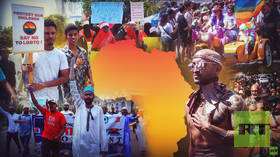
Senegal proposes tougher anti-LGBTQ law

0

Those found guilty of engaging in “acts against nature” will face up to ten years in prison and a maximum fine of $17,953, the country’s PM has said

Senegal’s prime minister has proposed new legislation to toughen penalties for same-sex relations, with those found guilty facing up to ten years in jail.

Same-sex relations are already illegal in the West African country and punishable by up to five years in prison.

In an address to parliament on Tuesday, Ousmane Sonko described homosexuality as “acts against nature” and said critics will “go to their Western masters” to oppose the LGBTQ crackdown.

The prime minister told lawmakers that the draft law will increase the jail term from five to ten years for people who engage in “unnatural acts.”

“If an act is committed with a minor, it will attract the maximum penalty,” he said, adding that offenders could also face fines of up to 10 million CFA francs ($17,953).

“Any public representation… intended to promote homosexuality, bisexuality, or transsexuality… will be punished with imprisonment of three to seven years and a fine.”

Earlier this month, 12 men were arrested and charged with “acts against nature” and the alleged intentional transmission of HIV, amid what rights groups described as a worsening climate of fear in the former French colony.

Human Rights Watch has labeled Senegal’s anti-LGBTQ measures “homophobic,” warning that the proposed legislation could further endanger an already marginalized community.

Same-sex relations are a crime in several African countries. Uganda provoked Western condemnation after passing an anti-LGBTQ law in May 2023 that imposes the death penalty for certain same-sex acts and up to 20 years in prison for the promotion of homosexuality. The US responded with sanctions and removed Uganda from a key duty-free trade program, while the World Bank froze new loans.
Last September, Burkina Faso’s lawmakers passed a law on marriage and family values, effectively banning homosexuality in the West African country. Offenders face penalties including prison sentences and fines ranging from two million XOF (about $3,200) to ten million XOF (about $16,000).

Sonko, who became prime minister in 2024, has repeatedly criticized Western efforts to promote LGBTQ rights, calling them incompatible with Senegalese values. The draft legislation has been approved by the council of ministers and now awaits a parliamentary vote, where the ruling party holds a majority.

You can share this story on social media:

source

Hungary to deploy troops against potential ‘Ukrainian attacks’

0

Budapest has ordered units to guard critical infrastructure sites in areas bordering Ukraine amid the Druzhba oil pipeline standoff

Hungarian Prime Minister Viktor Orban has ordered military units and additional police to guard energy infrastructure sites in his country’s east, citing the threat of potential Ukrainian attacks.

Orban announced the deployment on Wednesday amid the continuing standoff between Budapest and Kiev over the Soviet-era Druzhba pipeline, which until recently carried Russian crude to Hungary and Slovakia via Ukraine.

The pipeline went offline in late January, with Kiev claiming it was damaged in Russian strikes, which Moscow has denied. Both Hungary and Slovakia have accused Ukraine of deliberately withholding supplies for political reasons, threatening retaliation.

Announcing the move, Orban cited intelligence obtained by the country’s security services about the potential attacks and stressed that Hungary “cannot be blackmailed” by Kiev.

“I have ordered reinforced protection of critical infrastructure, troop deployment where necessary, increased police presence, and a drone ban in Szabolcs-Szatmar-Bereg county,” the prime minister wrote on X, referring to the Hungarian region bordering Ukraine.

Orban’s political director, Balazs Orban, claimed that information available to the country’s authorities indicated that Kiev has been “preparing further actions aimed at disrupting the operation of Hungary’s energy system.” 

The deployment comes after Budapest vetoed the latest EU package of sanctions against Russia, as well as a €90 billion ($106 billion) emergency loan for Ukraine. The loan was agreed upon late last year, after Hungary, Slovakia and the Czech Republic opted out of contributing to it financially.

The veto has been condemned by the EU leadership, which accused Orban of bailing on his promise to support the loan scheme and undermining the “credibility of decisions taken collectively.” 

“Any breach of this commitment constitutes a violation of the principle of sincere cooperation,” European Council President Antonio Costa told Orban in a letter.

The Hungarian prime minister shot back at Costa on Wednesday, stating he will not support any pro-Ukrainian moves until Kiev returns “to normality.”

“We take a decision financially favorable to Ukraine that I personally disapprove, then Ukraine creates an energy emergency situation in Hungary, and you ask me to pretend that nothing happened,” Orban told the EU Council chief in a letter.

You can share this story on social media:

source

Former Polish intel chiefs charged over ‘Israeli spyware’ use

0

The ex-heads of Poland’s domestic and military intelligence are being prosecuted for alleged use of the software without proper clearance

The former directors of Poland’s Internal Security Agency (ABW) and the Military Counterintelligence Service (SKW) have been charged for allegedly using Pegasus spyware, the national prosecutor’s office has announced.

After Prime Minister Donald Tusk’s government took over in late 2023, it launched multiple inquiries into the alleged use of the controversial software developed by the Israeli-based NSO Group. The new authorities have claimed the program was widely used by the former Law and Justice (PiS) government to spy on opposition politicians. Former officials, however, have insisted the accusations are politically motivated.

The head of the ABW, Piotr Pogonowski, and the ex-chief of the SKW, Maciej Materka, are both now facing accusations of breaching their official duties, the prosecutor’s office said on Wednesday. The charges, which carry a penalty of up to three years behind bars, are related to the alleged use of Pegasus without proper clearance and “without checking whether this system meets the requirements of information protection,” the prosecution said. Both former officials have denied any wrongdoing and refused to testify, it noted.

Ex-Justice Minister Zbigniew Ziobro has also been implicated in the Pegasus scandal. Last September, he was detained and brought before a parliamentary commission investigating the use of the Israeli-made spyware. He admitted initiating the purchase of Pegasus. Ziobro claimed it was used to “pursue criminals, not political opponents” and was overall a “good decision.” 

Shortly after the hearing, the ex-minister faced 26 criminal charges, including embezzlement of state funds, leading a crime group, and interfering with tender offers. Ziobro had his immunity waived and an arrest warrant was issued in November last year, while he was in Budapest. The politician denied all charges, opting to stay in Hungary and receiving political asylum there early in January.  

First identified in 2016, Pegasus software has been the centerpiece of multiple high-profile scandals worldwide, with officials repeatedly caught using it for questionable goals. The program is designed to target iOS devices and is believed to be capable of call snooping, reading text messages, location tracking, collecting passwords, and other malicious activities.

You can share this story on social media:
source

Trump delivers State of the Union address (VIDEO)

0

The US president lauded the 250th anniversary of a “strong, prosperous and respected” nation

US President Donald Trump has delivered his State of the Union address to a joint session of Congress, using the primetime speech to defend his administration’s record and lay out political and economic priorities ahead of looming midterm elections.

The address – the first official State of the Union speech of Trump’s second term – unfolded against a deeply polarized political backdrop, with Democratic protests and boycotts highlighting divisions in Washington.

Framing his remarks around the upcoming 250th anniversary of US independence, Trump declared that the country had entered a “golden age of America,” telling lawmakers the nation was now “respected again – perhaps like never before.”

Much of the speech focused on the economy, with Trump arguing that inflation had fallen sharply and investment was surging after what he described as a “turnaround for the ages.”

“Our nation is back bigger, better, richer and stronger than ever before,” he said, crediting tax cuts, deregulation and tariffs for renewed growth.

The president also defended his hardline immigration agenda, claiming the United States now has “the strongest and most secure border in American history” and asserting that illegal crossings and fentanyl trafficking had dropped significantly over the past year.

On energy and technology policy, Trump announced agreements requiring major technology companies to supply their own electricity for new AI-driven data centers, saying the move would protect consumers from rising power bills.

Foreign policy featured more briefly but included references to a “new friend and partner, Venezuela” – as well as tensions with Iran, where Washington has increased its military presence while pursuing nuclear negotiations. Trump said the US was seeking strength through diplomacy but warned adversaries that America’s military power had been rebuilt.

“As President, I will make peace wherever I can, but I will never hesitate to confront threats to America wherever we must,” Trump stated.

The speech mixed policy with patriotic moments, including a tribute to Olympic gold-medal-winning hockey goaltender Connor Hellebuyck, whom Trump announced would receive the Presidential Medal of Freedom.

Democrats sharply criticized the address, arguing that the president overstated economic progress and ignored affordability concerns that continue to weigh on voters. In the party’s official rebuttal, Virginia Governor Abigail Spanberger claimed Trump’s “reckless trade policies have forced American families to pay more than $1,700 each in tariff costs.”

You can share this story on social media:
source

South African soldiers deployed to combat crime

0

Families have fled their homes due to violent attacks and threats by “dangerous syndicates,” Gauteng Premier Panyaza Lesufi has said

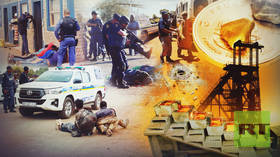
Over 450 soldiers have been deployed to South Africa’s Gauteng province to combat growing illegal mining and gang violence, provincial Premier Panyaza Lesufi confirmed on Monday.

Lesufi made the announcement during the State of the Province Address (SOPA) at the Nasrec Expo Centre in Johannesburg.

Earlier this month, President Cyril Ramaphosa announced that the South African National Defence Force (SANDF) would be deployed to Gauteng to assist law enforcement in tackling illegal miners, known locally as zama zamas. The deployment follows the forced displacement of more than 600 people from the Sporong informal settlement in the West Rand by illegal miners.

Lesufi said the army has already been sent to Sporong and other identified hotspots for illegal mining. ”Madam Speaker, illegal mining has reached intolerable levels in our province. Over 600 families have been targeted, and we see these attacks occurring across the province,” he said.

He said the perpetrators are heavily armed and threaten women and children. “In some instances, residents have fled their homes due to violent attacks and threats. The ongoing illegal mining affects communities in West End, Ekurhuleni, Johannesburg and the Silibenk District.”

“Dangerous syndicates use high-caliber weapons, including AK-47s, to take over illegal mining sites.” Lesufi said the government aims to put a stop to this terror. “We welcome the decisions taken by the President, and I want to announce that we have allocated over 450 soldiers to assist us in stamping out illegal mining and rising gang violence in our province.”

“We urge the President to keep these soldiers for a long period so that our communities can be safe.”

Acting Police Minister Professor Firoz Cachalia confirmed that the National Commissioner of the South African Police Service (SAPS) and the Chief of the SANDF have finalized a deployment plan, set to begin within 10 days and now including the Eastern Cape.

Cachalia made the announcement during a joint sitting of the National Assembly and National Council of Provinces last week on Tuesday, where MPs debated Ramaphosa’s recent State of the Nation Address (SONA). He praised the SANDF deployment to Gauteng and the Western Cape to assist in combating organized crime and illegal mining and confirmed it would extend to the Eastern Cape.

”I can confirm that the National Commissioner of SAPS, General Fannie Masemola, and the Chief of the SANDF, General Rudzani Maphwanya, met yesterday to finalize the deployment plan, which will begin within the next 10 days and include the Eastern Cape,” Cachalia said.

He emphasized that the deployment strategy would draw on lessons from both South African and international experience, respect the mandates of the SAPS and SANDF, and adhere to the Constitution, with the goal of restoring calm and preventing further killings.

Cachalia said he had requested Masemola to take additional steps to strengthen Anti-Gang Units and deploy further specialized units, with a report expected soon. “It will also be critical to strengthen intelligence-driven approaches to dismantle the networks behind organized crime,” he said.

First published by IOL

You can share this story on social media:
source

Macron asks Trump to lift sanctions on EU officials

0

The French president has condemned the “erroneous” restrictions placed on the bloc’s former tech commissioner

French President Emmanuel Macron has asked US President Donald Trump to lift the sanctions he imposed on several European officials, including former EU commissioner Thierry Breton and International Criminal Court (ICC) judge Nicolas Guillou.

Breton, a French citizen who oversaw the EU’s tech regulations, was among five Europeans barred from entering the US for leading “organized efforts to coerce American platforms to punish American viewpoints they oppose,” according to US Secretary of State Marco Rubio.

Judge Guillou, also a French national, was sanctioned over the ICC’s arrest warrants for Israeli Prime Minister Benjamin Netanyahu and former Defense Minister Yoav Gallant on charges of war crimes in Gaza.

In a letter published by La Tribune Dimanche on Sunday and confirmed by the Elysee Palace, Macron argued that the measures were “unjustly imposed” and asked Trump to “reconsider these decisions.”

“The sanctions adopted against Thierry Breton undermine European regulatory autonomy and are based, moreover, on erroneous analyses,” Macron wrote.

“European digital regulation does not, in fact, have any extraterritorial reach and applies without discrimination, on European territory, to all companies concerned,” he added.

The French leader argued that “the sanctions adopted against Nicolas Guillou undermine the principle of judicial independence and the mandate of the ICC.”

The US has long opposed what it considers excessive regulation of social media platforms in the EU, including the bloc’s 2022 Digital Services Act (DSA). Breton played a key role in designing the rulebook that imposes strict moderation requirements on tech companies such as X, Facebook, and Google. US officials have accused the EU of using the law to stifle free speech and censor American social media users.

The letter comes as Macron pushes for restrictions on children’s access to social media. He has said he will discuss the issue directly with Trump.

Last week, the French president dismissed social media platforms’ arguments in favor of free speech as “pure bulls**t,” calling for full transparency in how algorithms shape online discourse.

source

Moscow warns against plot to arm Kiev with nukes

0

British and French leaders have “lost touch with reality,” Russia’s envoy told the UN Security Council

Russia has warned France and the UK that alleged plans to provide Kiev with nuclear capabilities could trigger severe global consequences, accusing the Western European powers at the UN Security Council of pursuing a dangerous escalation in the Ukraine conflict.

Russia’s Permanent Representative to the UN, Vassily Nebenzia, accused Kiev’s European backers on Tuesday of openly prioritizing Moscow’s “strategic defeat” while derailing any prospects for peace in Ukraine.

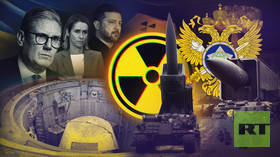
The envoy pointed to an emergency statement issued earlier by Russia’s Foreign Intelligence Service (SVR), alleging that the UK and France are considering transfers of components, technology, or equipment enabling Kiev to develop either a nuclear device or a “dirty bomb.”

“Such plans are not only irresponsible and dangerous but also a direct violation of Article I of the Treaty on the Non-Proliferation of Nuclear Weapons (NPT). That is why the authors of this escapade seek to portray Kiev’s acquisition of nuclear weapons as Ukraine’s own development,” Nebenzia said.

Nebenzia said Moscow views the alleged plot as evidence that British and French leaders, sidelined from the US-led Ukraine settlement process, have “completely lost touch with reality.”

“Russia possesses all necessary means to respond to such developments. However, we hope that there are still enough sane and reasonable people in London and Paris who will be able to restrain their leaders from such inadequate steps,” he added.

Nebenzia’s remarks echoed earlier warnings from Russian Foreign Ministry spokeswoman Maria Zakharova, who said any effort to grant Ukraine nuclear capabilities risks a direct military confrontation between nuclear powers.

Officials in Kiev have repeatedly claimed their country once possessed the world’s third-largest nuclear arsenal and gave it up under the 1994 Budapest Memorandums. In reality, nuclear weapons were present on Ukrainian soil after the collapse of the Soviet Union but remained under Moscow’s control, with Russia regarded as the Soviet Union’s sole legal successor.

Ukrainian leader Vladimir Zelensky threatened to review the country’s non-nuclear status at the 2022 Munich Security Conference, shortly before the conflict with Russia escalated.

Moscow argues that after the 2014 Western-backed coup in Kiev, Ukraine’s new authorities breached the neutrality pledge underpinning its post-Soviet independence by making NATO membership a key foreign policy goal.

source

Russia will respond if Estonia hosts NATO nukes – Kremlin

0

Moscow is not threatening the Baltic state, but will aim its nuclear weapons at it if NATO nukes are deployed there, Dmitry Peskov has said

Russia will aim its nuclear weapons at Estonia if NATO nukes are deployed there, Kremlin spokesman Dmitry Peskov has said, after the Baltic nation’s foreign minister stated that Tallinn would not be opposed to hosting nuclear weapons.

European members of the US-led bloc have discussed expanding their nuclear deterrence as part of a massive military buildup, which has been justified by what Western officials describe as the ‘Russian threat’ – a claim that Moscow has dismissed as “nonsense.”

“We do not threaten Estonia, or any other European country,” Peskov told journalist Pavel Zarubin on Sunday. “But if nuclear weapons are deployed on Estonian territory and are aimed at [Russia], then our nuclear weapons will be aimed at Estonian territory,” he warned, adding that Tallinn “should have a solid understanding of it.”

Earlier this week, Foreign Minister Margus Tsahkna said Estonia is not against the idea of hosting NATO nuclear weapons, adding that the country will be ready if the bloc decides to deploy them there.

Estonia has been one of Ukraine’s top supporters and has pushed for increased defense spending in Europe, citing the supposed threat of a Russian attack. Last year, Russian Foreign Ministry spokeswoman Maria Zakharova called Estonia “one of the most hostile countries,” and accused it of “spreading myths and falsehoods” about Russia.

Estonia is not the first European NATO member to express a desire to acquire nuclear weapons one way or the other. Earlier this month, Polish President Karol Nawrocki suggested that Poland should develop its own nuclear weapons program.

German Chancellor Friedrich Merz told the Munich Security Conference in mid-February that he had discussed EU-level nuclear deterrence with French President Emmanuel Macron. Earlier, a senior MP from his party said Berlin should have access to French and British nuclear weapons.

source

‘Britons deserve better’ – Putin aide on Starmer and Epstein-linked ex-prince

0

Kirill Dmitriev has weighed in on scandals surrounding the UK PM and King Charles III’s brother Andrew

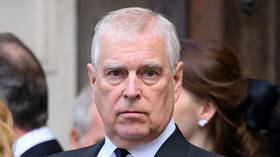
Kirill Dmitriev, aide to Russian President Vladimir Putin, has slammed UK Prime Minister Keir Starmer and former Prince Andrew over scandals involving both the British government and royal family, including allegations linking them to the late sex offender Jeffrey Epstein.

In a post on X on Monday, Dmitriev wrote: “Britons deserve better than Prince Andrew & Starmer.”

Separately, Dmitriev called on Starmer to step down, citing reports he let child sex offenders avoid charges while heading the Crown Prosecution Service (CPS).

“Starmer has to go,” Dmitriev wrote on X.

Starmer led the CPS from 2008-2013, and his record during that period has been heavily criticized due to the grooming gangs scandal involving groups of mostly foreign-origin men sexually exploiting children. The scandal first drew attention in the early 2010s, but Starmer’s government only launched a formal probe in mid-2025, though he repeatedly claimed he had improved CPS handling of such cases during his time there.

However, new reports by the Express and GB News released on Monday claim that while at the CPS, Starmer helped draft and roll out a system where suspected child sex offenders received “warning notices” instead of prosecution.

Citing records, the outlets allege thousands of such notices – civil letters telling adults not to contact specific children but carrying no legal force or immediate penalty – were issued with no follow-up, giving a “dangerous illusion of police action” while letting offenders go free.

The report came after Starmer’s office was rocked earlier this month following the latest US release of Epstein files. The controversy centered on Starmer’s failure to vet former UK envoy Peter Mandelson, who allegedly had close ties to Epstein. Starmer has so far retained his post by publicly apologizing to Epstein’s victims and blaming Mandelson for “lying” about his relationship with the sex offender. Starmer’s chief of staff, communications director, and cabinet secretary were all forced to resign amid the scandal.

The latest Epstein files have also reignited a scandal around the UK royal family, particularly Andrew, younger brother of King Charles III. He was placed under police investigation last week for “misconduct in public office” over claims he shared government secrets with Epstein. The files include an anonymous tip alleging he tortured a six year old and documents corroborating Epstein victim Virginia Giuffre’s claim that she was trafficked to the former prince when she was just 17.

In another X post, Dmitriev, who earlier called Mountbatten-Windsor and other Epstein associates “satanic,” warned that the scandal may herald the “end of the British crown.”

You can share this story on social media:
source

China urges US to scrap all tariffs

0

The call has come from Beijing’s Commerce Ministry after the US Supreme Court struck down most of Donald Trump’s duties introduced last year

China has urged the US to cancel the unilateral tariffs imposed by President Donald Trump following a US Supreme Court ruling that effectively struck down most of the measures.

Trump imposed tariffs on many trading partners early last year, accusing them of unfair trade practices. Most faced a universal 10% baseline tariff, with additional surcharges for large trade imbalances. Late last week, however, the Supreme Court ruled Trump lacked authority to impose tariffs under the 1977 International Emergency Economic Powers Act (IEEPA), effectively voiding most of the measures.

In a statement on Monday, the Chinese Commerce Ministry urged Washington to lift the tariffs, arguing they now violate even US domestic law.

“China has consistently opposed all forms of unilateral tariff increases and has repeatedly emphasized that there are no winners in a trade war,” the ministry said. “The US’s unilateral measures… violate both international trade rules and US domestic law. China urges the US to cancel its unilateral tariff measures.”

US-China relations have been strained for years, particularly over economic and technological issues, but Trump’s tariff hikes last year triggered a full-scale trade war. US tariffs on Chinese goods at one point reached 145%, while Chinese tariffs on US goods hit 125%. In November, a one-year pause in tit-for-tat escalations was reached under which both sides cut tariffs to around 10% in some sectors.

A comprehensive trade deal is reportedly expected to be discussed during Trump’s state visit to Beijing in late March. Some analysts say the Supreme Court ruling strengthens China’s negotiating position given that it curtails the Trump administration’s unilateral tariff authority.

Trump reacted furiously to the ruling, signing an order imposing a temporary 15% global tariff under a different law. According to Trade Representative Jamieson Greer, the administration is preparing alternative legal measures to reimpose permanent tariffs, including trade investigations into “unfair trade practices” targeting major partners. Greer later said the US expects partners that agreed to deals under tariff pressure – including the UK, South Korea, and the EU – to “stand by” their commitments despite the ruling.

US partners expressed mixed reactions to the ruling. The European Commission demanded “full clarity” on US intentions and insisted Washington honor the 2025 agreement capping tariffs. India reportedly delayed a trade delegation headed to Washington aimed at finalizing an interim trade deal, citing “fresh uncertainty” after the court decision and Trump’s angry reaction.

You can share this story on social media:
source