Home Blog Page 58

Epstein ranch under criminal investigation after ‘buried bodies’ claim – Reuters

0

A newly released email reportedly alleges that two foreign girls were strangled during “fetish sex” and buried in New Mexico

Public land near what was once Jeffrey Epstein’s Zorro Ranch has gone under criminal probe after a newly released email alleged that two foreign girls were buried there after being killed during violent sexual acts, Reuters reported Thursday.

The probe follows the release of the Epstein files, totaling over 3.5 million pages, which has prompted a wave of resignations and renewed investigations worldwide into alleged human trafficking and other crimes linked to Epstein’s network.

A key focus of the probe is the previously classified 2019 email sent to New Mexico radio host Eddy Aragon, the news agency noted. The sender, claiming to be a former Zorro Ranch employee, reportedly alleged that two foreign girls had been buried on Epstein’s orders. The message reportedly claims the girls were buried “somewhere in the hills outside the Zorro” and had died “by strangulation during rough, fetish sex.”

Aragon said he believed the email was legitimate and forwarded it to the FBI. A 2021 FBI report included in the latest release says he visited the bureau’s office to report an email offering seven abuse videos and burial coordinates in exchange for one bitcoin.

Epstein bought Zorro Ranch, located near New Mexico’s town of Stanley, in 1993 and built a hilltop mansion. Nearby was a private airstrip with a hangar and helipad. The property also included a ranch office, a firehouse and a seven-bay heated garage.

New Mexico’s Department of Justice announced Thursday that a criminal investigation, closed back in 2019, was reopened after reviewing previously sealed FBI files included in the release. A spokesperson told Reuters that the state had requested an unredacted copy of a 2019 email containing the allegations and that authorities “are actively investigating this allegation and conducting a broader review in light of the latest release.”

New Mexico state prosecutors said in a statement that the review will focus on preserving any remaining evidence and following the facts “wherever they lead,” while carefully evaluating jurisdictional matters.

Epstein, who pleaded guilty in 2008 to soliciting prostitution and was sentenced to 18 months in prison for raping a minor, was arrested again in 2019 on charges of human trafficking and exploiting victims for prostitution. He died in jail ahead of his trial. The US Department of Justice has gradually released relevant materials under the Epstein Files Transparency Act.

You can share this story on social media:

source

Zelensky laughs off Trump’s ‘dictator’ accusation (VIDEO)

0

The Ukrainian leader also hinted that the US president will not remain in power forever

Ukrainian leader Vladimir Zelensky has rejected US President Donald Trump’s accusation that he is a dictator, while hinting that Trump will not remain in power forever. Russia considers Zelensky to be illegitimate, as his presidential term expired almost two years ago.

In an interview with the BBC released on Sunday, Zelensky was asked to comment on Trump’s accusation that he is “a dictator who started the war.” Zelensky responded by laughing, saying: “I am not a dictator, and I didn’t start the war, that’s it.”

Asked whether the US president can be trusted to uphold security guarantees that would accompany a peace deal with Russia, Zelensky suggested that Trump will not be in power forever.

“It is not only President Trump, we’re talking about America. We are all presidents for the appropriate terms. We want guarantees for 30 years for example. Political elites will change, leaders will change,” he said.

In December, while commenting on the Trump administration’s reluctance to support Ukraine’s NATO ambitions, Zelensky seemed to hint that this could change if Trump dies in office: “Maybe the position will change in the future… The world changes, some live, some die. That’s life.”

Zelensky’s presidential term expired in May 2024, but he has refused to hold an election, citing martial law. Russia considers him illegitimate, arguing that his legal status is an obstacle to signing a binding peace agreement.

Trump called Zelensky a “dictator without elections” in February 2025, followed by an Oval Office meeting that devolved into a televised row, with Trump and Vice President J.D. Vance accusing Zelensky of ingratitude for US assistance in the conflict with Russia.

Trump has since urged Ukraine to hold elections. Faced with mounting US pressure, Zelensky said he is open to holding an election – but demanded Western security guarantees. Officials in Kiev have also complained that they need additional financial assistance to organize elections.

You can share this story on social media:

source

India delays trade talks with US after Supreme Court ruling on tariffs – Reuters

0

The decision has reportedly come after the court shut down Donald Trump’s tariffs imposed on various American trading partners

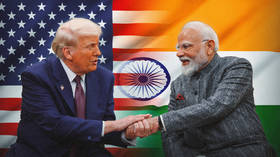
India has deferred sending a delegation to the US to finalize a trade deal after the US Supreme Court struck down Donald Trump’s tariffs on imports from various countries, Reuters has reported, citing a source.

In a six-to-three vote on Friday, the court ruled that it was “unconstitutional” for the US president to unilaterally set and change tariffs, since the power to tax rests with Congress.

An Indian delegation, led by chief negotiator Darpan Jain, was scheduled to leave for Washington on Sunday to finalize the legal details of the interim framework of a trade deal.

“The decision to defer the visit was taken after discussions between officials of the two countries,” Reuters cited an anonymous source as saying. “No new date for the visit has been decided.”

Last week, Indian Commerce Minister Piyush Goyal said an interim trade deal between India and the US will be operational in April. 

India and the US announced an interim trade deal earlier this month, after months of negotiations following a steep 50% tariff imposed by Washington on the South Asian nation in August 2025.

Washington reduced India’s tariff burden to 18% from the earlier 50%, which was the highest for any country in Asia. Half of the tariff was for New Delhi’s imports of Russian oil.

The US has said that as a part of the deal, India would stop buying oil from Russia, a claim that New Delhi has not confirmed.

Trump, on Saturday, decided to impose a 15% tariff on imports to the US, the maximum allowed by law.

India signed a trade pact with the European Union this year, and with the UK, Oman, and New Zealand in 2025.

You can share this story on social media:

source

‘No thank you’: Greenland PM sinks Trump hospital ship idea

0

Jens-Frederik Nielsen has rejected the US president’s offer to boost the Arctic island’s healthcare with a medical boat

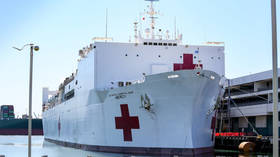
Greenlandic Prime Minister Jens-Frederik Nielsen has rejected US President Donald Trump’s offer to send a hospital ship to the Danish self-governing territory, which Trump has long sought to acquire.

On Saturday, Trump said he would send a “great hospital boat” to the Arctic island to take care of what he called its “many people who are sick, and not being taken care of.”

Nielsen replied in a Facebook post on Sunday, saying: “it will be a no thank you from here.”

“President Trump’s idea of sending an American hospital ship here to Greenland has been noted. But we have a public healthcare system where treatment is free for citizens,” he said, contrasting it with the US system.

We are always open to dialogue and cooperation. Also with the USA. But now talk to us instead of just making more or less random outbursts on social media.

He stressed, however, that dialogue would require respect for Greenland’s domestic decisions.

Danish Defense Minister Troels Lund Poulsen also said the island does not require unsolicited aid from Trump.

”The Greenlandic population receives the healthcare it needs,” he told Danish outlet DR on Sunday, noting that citizens either receive medical help on the island or in Denmark.

Trump has intensified his push to claim the Danish autonomous territory for the US since last year, mocking its defenses, which he said consist of “two dog sleds.” He also argued that the US needs Greenland for national security, claiming it is at risk from China and Russia, which have both dismissed the claims.

The annexation push has led to a growing diplomatic rift between Washington and its European NATO allies.

Trump recently announced that he and NATO chief Mark Rutte had agreed on a framework for Greenlandic and Arctic security, and softened his rhetoric. Nevertheless, Danish Prime Minister Mette Frederiksen warned last week that Trump is still “very serious” about annexation.

You can share this story on social media:

source

Third US citizen killed by feds revealed

0

Ruben Ray Martinez was shot during a traffic stop in Texas last year, according to newly released documents

Newly released documents show that a US immigration agent shot and killed an American citizen in Texas in 2025, marking the third known death linked to immigration enforcement operations, multiple media outlets have reported.

The incident happened months before the shootings of Renee Good and Alex Pretti by federal agents in Minneapolis in January during President Donald Trump’s sweeping immigration crackdown. The killings ignited a renewed wave of outrage against the effort.

Ruben Ray Martinez, 23, was killed by a federal agent in South Padre Island in March 2025, multiple news outlets wrote on Friday, citing internal Immigration and Customs Enforcement (ICE) documents recently released by the nonprofit watchdog American Oversight. ICE agents were reportedly carrying out immigration enforcement operations in conjunction with local police.

Martinez was shot after he “intentionally ran over a Homeland Security Investigation special agent” during a traffic stop, the Department of Homeland Security (DHS) said in a statement cited by multiple outlets.

At the time, local media reported the incident as an officer-involved shooting, but the involvement of federal agents was not revealed until after the internal report was released earlier this week.

Democratic Texas Congressman Joaquin Castro has accused ICE of burying the incident.

“I am calling for a full investigation into this shooting, including why there was an 8-month cover up,” he wrote on X on Saturday.

Martinez’s death would mark the earliest of the three known killings of US citizens linked to Trump’s nationwide immigration crackdown since the start early in his second term.

Last month’s killings of Good and Pretti caused public outrage, prompting border czar Tom Homan to downsize the force of federal agents deployed in Minneapolis.

Speaking to NBC news earlier in February, Trump acknowledged that his administration could have used a “little bit of a softer touch,” but insisted that the immigration crackdown is targeting “really hard criminals.”

Around half of the 1.6 million illegal immigrants with final deportation orders are convicted criminals, acting ICE Director Todd Lyons said last week.

Nevertheless, public support for the crackdown has declined, according to a recent Ipsos poll conducted for the Washington Post and ABC News and published on Friday. Around 58% of Americans feel that the deportations are “going too far,” while 62% oppose the aggressive tactics employed by ICE, it found.

source

Ukrainian army disappearing – Russian general

0

Kiev is losing the attrition war due to a shortage of conscripted reinforcements, Moscow’s operations chief has asserted

Kiev’s ability to supply fresh soldiers to the front line has significantly diminished, putting the Ukrainian army on a downward spiral, a senior Russian military planner has said.

The Ukrainian army’s strength is being sapped by mass desertion and public resistance to mandatory conscription. The Russian military estimates Ukrainian military casualties at over 520,000 in 2025 and 1.5 million since the conflict escalated in 2022, Gen. Sergey Rudskoy, head of operations at the Russian General Staff, said in an interview published Friday.

“Presently, the Kiev regime has largely lost the ability to replenish its units through obligatory mobilization. The number of recruitments per month has dropped by about two times,” Rudskoy told Krasnaya Zvezda, the Russian armed forces’ official newspaper. “A trend is forming for the decrease of the Ukrainian army’s strength.”

During his nomination hearings last month, Ukrainian Defense Minister Mikhail Fedorov told lawmakers that two million potential recruits were on a wanted list for draft evasion and 200,000 troops had deserted. This month, human rights ombudsman Dmitry Lubinets reported a sharp rise in complaints against mobilization enforcers, calling it a “systemic crisis.”

New videos of violent confrontations between conscription patrols and civilians are published by Ukrainian media almost daily, even as authorities claim most such footage is fabricated.

In the interview, Rudskoy also discussed Russian battlefield progress and how technological changes are affecting military planning. Modern warfare demands faster AI-assisted decision-making and broad deployment of robotic systems, he said. Mass use of drones in the Ukraine conflict has made them comparable to artillery in terms of damage inflicted, Rudskoy added. Drones have also redefined front lines, creating a “zone of blanket kinetic action” extending up to 15 kilometers from friendly positions.

You can share this story on social media:

source

France summons US envoy over ‘violent radical leftism’ warning

0

The State Department earlier voiced concern over the killing of French right-wing activist Quentin Deranque by alleged members of an antifa group

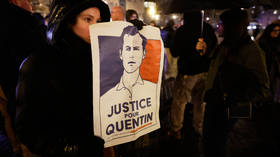
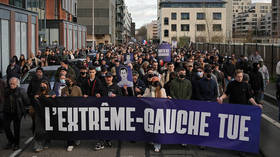
France has summoned the US envoy after the Trump administration sounded the alarm over what it described as the rise of “violent radical leftism” in the country. The remarks came after alleged members of a left-wing group killed French right-wing activist Quentin Deranque.

Deranque, a 23-year-old mathematics student and member of the nationalist group Audace Lyon, died on February 14 from head injuries sustained two days earlier during a brawl with left-wing activists. He had been acting as informal security for protesters from the right-wing women’s group Nemesis.

French Interior Minister Laurent Nunez described the killing as “a deliberate homicide” and “a lynching.” Eleven people have been arrested, including two aides of Raphael Arnault, an MP from the left-wing La France Insoumise (LFI) party.

In a post on X on Thursday, the US Department of State Bureau of Counterterrorism posted a message – which was later shared by Washington’s embassy in France – that said that Deranque’s death “should concern us all.”

“Violent radical leftism is on the rise and its role in Quentin Deranque’s death demonstrates the threat it poses to public safety,” it noted, adding that the US expects to see the perpetrators brought to justice.

Separately, US State Department Undersecretary for Public Diplomacy Sarah Rogers said the killing showed “why we treat political violence – terrorism – so harshly.”

On Sunday, French Foreign Minister Jean-Noel Barrot announced that Paris would summon the US ambassador to France, Charles ⁠Kushner. “We reject any instrumentalization of this tragedy, which has plunged a French family into mourning, for political ends,” he said. “We have no lessons to learn, particularly on the issue of violence, from the international reactionary movement.”

The Deranque scandal already triggered a stand-off between French President Emmanuel Macron and Italian Prime Minister Giorgia Meloni, who described the tragedy as “a wound for all of Europe” and condemned “a climate of ideological hatred sweeping several nations.”

In response, Macron suggested that he was always struck by the fact that “nationalists, who don’t want to be bothered in their own country, are always the first ones to comment on what’s happening in other countries.”

You can share this story on social media:

source

If Day: When Canada staged a Nazi occupation to sell the war

0

How a simulated German takeover of Winnipeg shocked citizens into buying war bonds during WWII

The invasion began in the north.

Reports came first from Norway House: aircraft approaching in tight formation, flying low over frozen lakes and pine forest, their engines carrying through the winter air. Soon after, word arrived that the Canadian city of Selkirk had fallen. The German war machine, it was said, was moving south – converging on Winnipeg.

At 6:00 AM on February 18, 1942, air-raid sirens shattered the morning silence.

Troops moved into position along a defensive line five miles from City Hall. At Fort Osborne Barracks, soldiers assembled in the dark cold. By seven o’clock, the first engagement had begun. Artillery thundered in East Kildonan as attackers reached the perimeter. Anti-aircraft guns barked at fighter planes overhead. The sky echoed with explosions.

Meanwhile, 3,500 Canadian troops and hastily mobilized volunteers under the command of Colonel E. A. Pridham and Colonel D. S. McKay moved to meet the advancing enemy. Defensive lines were drawn five kilometers from the city center. Anti-aircraft guns opened fire at incoming aircraft. Bridges were blown to slow the advance, their spans strewn with rubble and smoke. It made little difference. 

The first casualties were reported at 8:00 AM, with field hospitals set up at strategically important locations to treat the Canadians. 

The attackers pressed forward, forcing two more retreats. The final defensive line formed barely a mile from the city center. Tanks guarded road and rail junctions. Telephone lines relayed orders between formations. The city tightened into a shrinking ring.

At 9:30 AM, there was nothing left to defend.

Winnipeg surrendered unconditionally.

By then, cities of Brandon, Flin Flon, Selkirk, and numerous smaller towns across Manitoba had also been declared captured. On maps posted at the city’s central intersection, the province appeared conquered sector by sector.

Manitoba, it was announced, was now a German province.

The occupation

Armed patrols moved through downtown streets. Roadblocks appeared. Government authority vanished. The Germans sent armed squads through the city and harassed the population. A tank was driven to Portage Avenue, one of the main streets in the city center. 

Erich von Neuremburg was installed as Gauleiter. His first act was to arrest the city’s leadership.

The Union Flag at Lower Fort Garry was replaced with the swastika flag. The town was renamed Himmlerstadt, and Main Street became Hitlerstrasse.

One alderman briefly evaded capture by hiding in an empty room. He was later found and arrested – the occupiers warned that the entire city could be held responsible for any escape.

Stormtroopers descended on police headquarters in search of Chief George Smith. He happened to be at lunch and avoided detention. The soldiers went upstairs instead, confiscating dozens of buffalo coats from a retail shop. It was the middle of February, and temperatures were well below freezing.

Civilians were stopped and searched. Schools were entered. Public buildings were seized. Within hours of the surrender, the rules of a new order appeared.

Proclamations were pasted to telephone poles, storefronts, and public buildings across Winnipeg, declaring the authority of the German Reich and outlining the laws of occupation. Civilians read them in silence as soldiers watched nearby.

A curfew would begin at 9:30 PM. Public gatherings were restricted. Homes were required to quarter soldiers. Vehicles were subject to seizure. Farmers were ordered to surrender grain and livestock. National symbols were banned. Ration cards would govern access to food and clothing.

Certain offenses – resistance, unauthorized travel, failure to report property, possession of firearms – were punishable by death without trial.

Downtown, a crowd gathered outside the main Carnegie Library on William Avenue as books were piled and burned – volumes on liberty, democracy, and political freedom feeding the flames. 

Currency, too, changed hands. Reichsmarks were handed out as change, intended to replace Canadian dollars. In the cafeteria of Great-West Life, stormtroopers burst in, cleared out employees, seized food, and briefly jailed workers – a demonstration of power rather than a necessity.

Church doors were boarded shut. Clergy were arrested or blacklisted. Worship services were forbidden. Citizens attempting to enter churches were detained. Ethnic and religious organizations were dissolved, their property declared confiscated.

Armed patrols moved along Portage Avenue in Bren gun carriers. Tanks rolled past storefronts as residents watched from sidewalks and windows.

The staging 

Despite the scale and intensity of the assault, there were no battle deaths. Only two casualties were treated: a soldier who had sprained his ankle and a woman who had cut her thumb while preparing breakfast in her blacked-out apartment.

The artillery fired blanks. Explosions were staged. The bridges had been declared destroyed rather than destroyed in fact. Ambulances transported simulated casualties, giving medical crews realistic drills. 

Everything had been scripted – the advances, the retreats, the surrender. Newspapers had carried warnings in the days before, outlining what citizens might expect. Yet many had missed the notices and were caught by surprise. For organizers, this only deepened the realism. Shock, after all, was part of the lesson.

For a few winter hours in 1942, the war that had seemed distant and abstract arrived on Winnipeg’s doorstep – not as headlines from Europe, but as occupation, surrender, and the sudden disappearance of normal life.

It felt real enough to be remembered as if it had happened.

Despite the oppressive atmosphere, observers followed events freely. Reporters, photographers, and newsreel crews documented every scene. Coverage spread rapidly across North America and beyond. An estimated forty million people would see images of Winnipeg under occupation.

The spectacle felt real because it mirrored reality elsewhere. Across Europe, similar decrees governed daily life. Book burnings were not symbolic. Churches had been shuttered. Civilians lived under curfews, rationing, and fear.

In Manitoba, the occupation was staged. But the emotions it evoked – shock, humiliation, unease – were genuine.

The occupation scenes were designed to unsettle – but they were never the point in themselves.

And the day’s most important objective was still ahead.

The money

If Day, as the staging was called and is known until this day, was part of the second Victory Loan campaign, a nationwide effort to finance Canada’s war effort through public bond purchases. Victory Bonds were, in effect, loans from citizens to their government, funding everything from equipment and training to overseas operations. Previous campaigns had relied on rallies, concerts, posters, and patriotic appeals. They worked – but by 1942, organizers feared the public was becoming numb to slogans and speeches.

The Manitoba branch of the National War Finance Committee decided to try something radically different.

Their target was staggering: $45 million – roughly $800 million in today’s money. To meet it, committee chairman John Draper Perrin and the Greater Winnipeg Victory Loan organization devised an idea as bold as it was unsettling: stage a Nazi invasion and occupation of Winnipeg.

The name itself – If Day – posed the question at the heart of the exercise: What if the Nazis occupied Canada?

So this is what the Committee resolved to do: spend just $3,000 to make Winnipeggers feel – if only for a single winter day – what occupation meant. The loss of rights. The erosion of dignity. The sudden fragility of ordinary life.

It was theater with a purpose – a piece of wartime propaganda carefully designed not to deceive, but to persuade. If citizens could feel the stakes of a war fought an ocean away, they might be more willing to finance preventing it.

By afternoon, attention began shifting from fear to action. Citizens were directed toward Victory Loan offices. The symbolic occupation map at Portage and Main marked progress: as bonds were purchased, sections of Manitoba were “liberated.”

The message was clear: liberation required participation.

By late afternoon, the drama that had gripped Winnipeg began to lift.

At 5:30 PM, the simulated occupation formally ended. “Prisoners” were released from Lower Fort Garry and joined organizers, soldiers, and civic leaders marching down Portage Avenue. The procession blended relief with resolve: banners declared “It Must Not Happen Here,” while volunteers signed up citizens to purchase Victory Bonds.

The emotional shock of the day translated into immediate action. An estimated $3 million in war bonds were purchased in Winnipeg that very day – an extraordinary single-day total that helped propel Manitoba past its campaign target. By the end of the Second Victory Loan drive, the province had exceeded its goal by a wide margin, contributing tens of millions toward Canada’s war effort.

Manitoba achieved its quota of $45 million 12 days after If Day. Winnipeg, much more involved in the staging, was 10% over its objective (of $23.5 million) 6 days after it. Across Canada, $2 billion was raised for the war effort. If Day certainly had an impact.

The event delivered more than funds.

For the Canadian Army, the operation doubled as a large-scale urban training exercise. Units practiced coordinated defense, communications, medical response, and crowd control under simulated combat conditions. Commanders later noted that the few hours of maneuvering provided more practical experience than days of routine drills.

The impact also extended far beyond Manitoba.

Newsreel cameras and reporters from across North America documented the staged invasion. Photographs and footage appeared in major newspapers and magazines, and radio broadcasts carried the story internationally. An estimated 40 million people worldwide saw coverage of Winnipeg’s “fall,” transforming a regional fundraising stunt into a global propaganda success.

Other cities took notice. Vancouver later staged its own version using materials from Winnipeg, while US officials requested details on how the operation had been organized.

Yet the day’s lasting legacy was psychological rather than logistical.

For a few hours, citizens experienced the abrupt collapse of normal life: the disappearance of civil liberties, the imposition of arbitrary rules, the presence of armed authority in everyday spaces. The simulation forced participants to confront the stakes of a distant war in immediate, personal terms.

If Day ended with parades and speeches, but its warning lingered. The banners carried through downtown Winnipeg captured the lesson organizers hoped would endure long after the mock occupation ended: It must not happen here.

source

Ukrainian forces exploiting Telegram data for battlefield intel – FSB

0

Data posted in the messenger can be processed “in the shortest possible time,” the FSB has claimed

Russia’s Federal Security Service (FSB) has claimed that Ukrainian military units and intelligence agencies are able to rapidly obtain information shared via the Telegram messaging platform and use it for military purposes.

According to a statement released by the agency, its analysis indicates that data posted on Telegram can be accessed and processed by Ukrainian forces “in the shortest possible time,” allowing them to identify positions, movements, and other operational details.

The FSB said the findings are based on what it described as “reliable information” gathered during monitoring of the platform’s use in the conflict zone.

According to the FSB, such disclosures have contributed to threats to the lives and safety of Russian soldiers, underscoring the dangers of sharing sensitive information through open digital channels during active combat operations.

Kiev’s agents exploited loopholes to create fake identities and spread disinformation, while also using SIM-boxes – devices running dozens of SIM cards – for scams and other crimes, the FSB found earlier. In 2025 alone, more than 50,000 SIM cards registered to fake identities were seized.

According to Russian security services, since the escalation of the Ukraine conflict, Kiev’s intelligence agencies have used both Telegram and WhatsApp to recruit operatives to carry out attacks inside Russia.

Since August 2025, Russian media watchdog Roskomnadzor partially blocked voice calls on both Telegram and WhatsApp. Text chats, file sharing, and other features remain available in Telegram; however, WhatsApp was fully blocked in Russia. The curtailed functions would be fully restored if the platforms comply with Russian laws, the regulator said.

You can share this story on social media:

source

Is the Middle East entering a nuclear arms race?

0

Iran’s contested program, Israel’s ambiguity, and Türkiye’s reassessment of deterrence could redefine the region’s security architecture

Amid the current geopolitical turbulence and escalating tensions in the Middle East, a pressing question has emerged: How will the future of the region look in light of the conflict between Iran and the US over Iran’s nuclear program? This concern is understandable, since for the past 30 years, Iran’s nuclear program has remained a key issue in the context of regional security.

Throughout these years, Tehran has consistently asserted the peaceful nature of its nuclear program. Iranian officials stress that developing nuclear energy is part of their commitment to technological sovereignty, energy diversification, and an independent foreign policy. Moreover, they frequently reference a religious edict against possessing nuclear weapons; a fatwa issued by Iranian Supreme Leader Ayatollah Ali Khamenei describes the use of weapons of mass destruction as morally unacceptable from an Islamic perspective. From a more down-to-earth perspective, Iran is also a signatory to the Treaty on the Non-Proliferation of Nuclear Weapons (NPT), which reinforces its obligations within the non-proliferation framework.

However, the geopolitical reality (especially in its current form) is markedly more complex than mere legal commitments. In a regional context, the mere technological capability of a state to reach nuclear threshold status can shift the balance of power. Even if a country’s nuclear program serves peaceful purposes, the possibility of quickly adapting it for military purposes, should political conditions change, is perceived by neighboring nations as a significant strategic threat. And there are valid reasons for this concern.

This brings us to a third systemic aspect of the issue. If Iran were to acquire nuclear weapons, this would inevitably lead to a domino effect in the region. Countries like Türkiye, Saudi Arabia, Egypt, and potentially the United Arab Emirates would find themselves at a crossroads: Either accept a new security architecture that recognizes Iran as part of the elite club of nuclear powers (thereby acknowledging Tehran’s stature) or pursue symmetrical deterrence. The latter approach would lead to the inevitable nuclearization of the entire Middle East, a region already characterized by high levels of conflict and numerous proxy wars.

A separate and crucial factor is the role of Israel. While Israel officially maintains a policy of strategic ambiguity regarding its nuclear capabilities, the Middle East primarily associates Israel’s nuclear capabilities with the legendary statement of former Israeli Prime Minister Golda Meir: “Firstly, we don’t have nuclear weapons, and secondly, if necessary, we will use them.”

This duality – denial coupled with an implicit suggestion of potential use – shapes the regional psyche concerning the necessity for strategic balance. In Iran’s political and expert circles, this notion fuels the rationale for ‘asymmetric deterrence’ – they believe that if the region is already effectively nuclearized, possessing similar capabilities could deter the pressure exerted by the US and Israel, which has intensified in recent years.

Iran lives in a state of strategic uncertainty. On the one hand, it needs to uphold obligations; on the other, the sanctions pressure is increasing and there’s a growing realization that the country can only rely on itself. Against this backdrop, Türkiye draws particular attention. As a nation with aspirations of being a ‘middle power’ and pursuing an independent foreign policy while still being a NATO member, it is closely observing the shifting regional balance of power. With discussions about nuclear capabilities becoming less taboo, Türkiye’s own nuclear ambitions take center stage: Will the country support nonproliferation efforts or adapt to a potentially ‘nuclearized’ environment in the region?

It’s important to note that the question of Türkiye’s nuclear ambitions has ceased to be purely theoretical; it is a pressing topic that reflects deeper transformations within the international system. If we were to ask directly, ‘Does Türkiye want to possess nuclear weapons?’ from the perspective of realism in international relations theory, the answer would probably be affirmative.

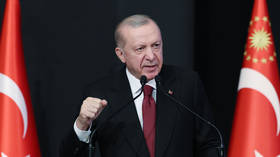
Any state aspiring to be an autonomous center of power amid intensifying competition between great powers naturally views nuclear capability as the ultimate tool of strategic deterrence and a symbol of sovereign status. Türkiye’s stance on this issue has evolved gradually. In the 1970s-1990s, and in the early 2000s when [current Turkish President] Recep Tayyip Erdogan first took office as prime minister, Ankara largely supported the nonproliferation regime and distanced itself from any discussions about military nuclear capabilities. At that time, Türkiye did not even entertain the idea of acquiring nuclear weapons, believing there was simply no need for them. It remained firmly integrated into the Euro-Atlantic security architecture, relying on collective defense guarantees.

The situation began to shift as Iran, despite sanctions and international pressure, continued to advance its nuclear program, which it insists exists for peaceful purposes. This development, coupled with changing regional and global dynamics, did not go unnoticed in Ankara. Turkish officials recognized that Tehran’s technological progress was enhancing its negotiating power and increasing its strategic weight, even amid harsh sanctions and restrictions. From Ankara’s pragmatic perspective, if regional rivals were inching toward a ‘threshold’ status, Türkiye could not afford to ignore this transformation in the balance of power.

We must understand that for Türkiye, any decision regarding the development of nuclear weapons is not merely a matter of technical capability. It would represent a historic shift with broad legal, diplomatic, and geostrategic ramifications. Like Iran, Türkiye is a signatory to the Treaty on the Non-Proliferation of Nuclear Weapons (NPT) and is integrated into the International Atomic Energy Agency’s (IAEA) system of guarantees and inspections, meaning any military program would lead to serious legal repercussions, sanctions, and political isolation.

Currently, a key element of Türkiye’s nuclear infrastructure is the Akkuyu Nuclear Power Plant project, which is being developed by Russia’s state nuclear corporation, Rosatom. This initiative aims to bolster energy security and reduce dependence on hydrocarbon imports. Ankara has consciously entrusted the construction of this strategic facility to Russia, driven by pragmatic calculations regarding the completion of the project and technological assurances. However, the Akkuyu NPP is unrelated to any military ambitions and operates within the realm of civilian nuclear energy. Moreover, other Middle Eastern nations are not worried about nuclear facilities built and overseen by Russia. Eager to expand its capabilities, Ankara is already contemplating a second NPP. The proposed Sinop Nuclear Power Plant, set to be built on the Black Sea coast, promises to ensure the country’s energy security for decades.

Coincidentally, Iran’s nuclear program also started with the construction of the Bushehr Nuclear Power Plant, initiated during the monarchy in the 1970s with Western support. However, it remains questionable whether Türkiye has the financial capacity to undertake and sustain such major projects, given its current economic challenges. Despite sanctions and restrictions, Iran can afford a nuclear program due to its vast energy resources; however, Türkiye lacks these resources. This reality underscores the significance of Türkiye’s NATO membership. Officially, Ankara is under NATO’s nuclear umbrella, implying collective defense guarantees from the US, France, and the UK, the three nuclear powers in the bloc. In theory, this should mitigate the incentives for Türkiye to pursue its own nuclear program. However, the question of trust is increasingly prominent in Turkish strategic discussions: Would allies be truly willing to take risks for Ankara in a time of crisis?

Türkiye’s complex relationships with various NATO countries, along with episodes of political tension with Washington and Paris, raise doubts about the reliability of security guarantees. It’s questionable whether European nations would come to Türkiye’s aid in the event of aggression. Only a few countries might act out of sympathy for Türkiye, but their ability to offer substantial support is unlikely.

An additional factor shaping Turkish public opinion is the example set by North Korea. Many experts in Türkiye point out that possessing nuclear weapons has granted North Korea immunity from direct external pressure. Notably, following North Korea’s informal acknowledgment of its nuclear status, the US shifted from harsh rhetoric to diplomatic engagement. This is seen as evidence that nuclear arms remain a powerful deterrent in today’s international relations.

Furthermore, the Israeli factor cannot be overlooked. As Turkish-Israeli relations deteriorate, arguments around strategic asymmetry resurface in Ankara: If one regional actor possesses this resource, why should others be excluded?

However, the potential costs of a nuclear program are extraordinarily high. Firstly, the financial burden of developing and maintaining a military nuclear program would be immense. Secondly, Türkiye would face severe sanctions, a declining investment climate, capital flight, and a significant crisis in its relations with the EU and NATO. Thirdly, this move would mean a de facto break from non-proliferation agreements and result in diplomatic isolation.

We must also note the statements of Turkish Foreign Minister Hakan Fidan. In a recent interview, Fidan declined to directly answer whether the country should acquire nuclear weapons. However, he had previously noted that Ankara might feel compelled to join an arms race if new nuclear powers emerged in the region. Moreover, back in 2025, Fidan criticized the Non-Proliferation Treaty for its ‘structural injustice’, highlighting the imbalance between non-proliferation commitments and the lack of progress on nuclear disarmament by recognized nuclear states.

As a result, Türkiye finds itself in a strategic dilemma. On the one hand, it must take into account existing international commitments, economic risks, and institutional ties to the Western security framework. On the other, there’s the problem of increasing regional competition, uncertainty about NATO’s future, the Iranian factor, and the broader transformation of global politics.

Currently, the geopolitical and political costs of transitioning to a military nuclear status outweigh the potential benefits. Nonetheless, the mere discussion of this issue suggests that Türkiye is reevaluating the effectiveness of its past security assurances. In this context, Türkiye becomes a key indicator of how the security architecture in the Middle East might evolve in the coming years.

source