The move would be essential for Beijing to turn into a true “financial powerhouse,” the president said
The Chinese yuan must become a global reserve currency, President Xi Jinping has said.
The yuan (renminbi) became the second most-used trade finance currency after the dollar following the escalation of the Ukraine conflict in February 2022, as sanctions targeting Moscow prompted many countries to begin trading with each other in national currencies. However, its role in official reserves remains limited.
Beijing must have “a strong currency, which is widely used in international trade and investment, and foreign exchange markets, and has the status of a global reserve currency,” Xi wrote in an article for the Communist Party’s journal, Qiushi, on Saturday.
The yuan should also be supported by a “powerful central bank,” the president insisted.
According to Xi, these changes are essential if China hopes to become a true “financial powerhouse,” as its current monetary system is “large, but not strong enough.”
Last summer, Chinese Central Bank Governor Pan Gongsheng warned against “excessive reliance” on the US dollar. He stressed the growing influence of the yuan, saying that “in the future, the global monetary system may continue to evolve towards a pattern, in which a few sovereign currencies coexist, compete with each other, and check and balance each other.”
The German Federal Financial Supervisory Authority (BaFin) warned last week that the US dollar’s status as the world’s reserve currency could be challenged as early as 2026 amid funding shortages, geopolitical shocks and growing politicization.
The warning followed the Bloomberg Dollar Spot Index posting its sharpest drop since last April, after US President Donald Trump announced sweeping global tariffs.
Trump earlier dismissed concerns over the US currency’s weakness, saying it is “doing great” and should be allowed to “seek its own level.”
According to IMF data, the dollar accounted for about 57% of global reserves in the third quarter of 2025, the euro for 20% and the yuan for 1.93%.
In November, Russian Finance Minister Anton Siluanov said 99.1% of trade between Moscow and Beijing had already shifted to rubles and yuan in order to reduce reliance on Western financial institutions.
The African country has requested “unique capabilities” to address its security challenges, AFRICOM chief General Dagvin Anderson has said
The US has deployed a “small team” of forces to Nigeria to support efforts against Islamist insurgents, the head of the US military command for Africa (AFRICOM) said on Tuesday.
Speaking at a press briefing, AFRICOM commander General Dagvin R.M. Anderson said the deployment followed discussions with Nigerian President Bola Tinubu on strengthening counterterrorism cooperation in West Africa.
The American team “brings some unique capabilities from the United States in order to augment what Nigeria has been doing for several years,” according to Anderson.
Nigerian Defense Minister Christopher Musa confirmed that a team was operating in the country but gave no further details, Reuters reported.
This marks the first official acknowledgment of US troops on the ground in Africa’s most populous nation since Washington carried out airstrikes against Islamic State militants, including Boko Haram, in the country’s northwest on Christmas Day. It followed weeks of threats by US President Donald Trump over Abuja’s alleged failure to address a “genocide” of Christians.
Nigeria has been embroiled in a security crisis for more than a decade, driven by an insurgency led by Boko Haram and its breakaway faction, Islamic State West Africa Province (ISWAP), along with several other armed gangs.
The government has stepped up efforts to address the crisis, with security forces intensifying military operations against militant groups, while prosecutors have pursued terrorism-related cases linked to major attacks. On Monday, the authorities charged several suspects over a deadly assault in Benue State last June that killed about 150 people.
Abuja had previously rejected any unilateral military intervention on its soil. In December, however, it said it reached a bilateral security agreement with the Trump administration covering intelligence sharing and “other forms of support,” in line with respect for sovereignty.
On Tuesday, AFRICOM commander Anderson described Nigeria as “a great example of a very willing and capable partner who requested the unique capabilities that only the US can bring.”
The move in Nigeria signals renewed US military interest in Africa, where AFRICOM’s former chief, General Michael Langley, said last year the unit was reassessing its presence amid declining influence.
His successor, Gen. Anderson, said he has been traveling across the continent, including to Ethiopia, Kenya, Djibouti, Morocco, and Tunisia, to engage with partners on joint security efforts.
The selloff was triggered after US President Trump tapped Kevin Warsh to chair the Federal Reserve
Gold and silver prices fell further on Monday, extending losses after a sharp reversal of a recent rally that had lifted both to record highs.
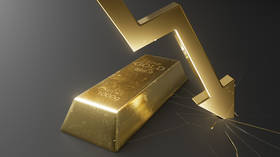
Gold prices plunged 8% to $4,465 an ounce on Monday, breaking a streak of record highs that had briefly pushed the metal to nearly $5,600 last week, before a partial rebound. Silver dropped 7%, following a 30% slide on Friday.
The sell-off was triggered last week after US President Donald Trump said he would nominate former Federal Reserve Governor Kevin Warsh to succeed Fed Chairman Jerome Powell when his term ends in May, pending Senate confirmation. Trump said he had not asked Warsh to commit to rate cuts, calming fears that the central bank could pursue aggressive monetary policy.
Some of the earlier surge was driven by speculative buying from China, with traders pouring hot money into metals markets, Bloomberg reported, pushing metals far beyond historical trading ranges and magnifying the speed and scale of last week’s collapse.
The rally ahead of Friday’s crash generated major gains for Russia that are reportedly comparable to the value of its sovereign assets frozen in the West – around $300 billion. Unlike the frozen assets, Moscow’s gold reserves can be sold or pledged as collateral, restoring significant financial capacity.
Gold rose above $5,500 per ounce in late January, while silver touched an all-time high above $120. Despite the recent pullback, analysts at Deutsche Bank said on Monday they still expect gold to reach $6,000 later this year.
Mohit Kumar of Jefferies said the sell-off in gold appeared to be “an unwind” of a “crowded” trade.
“Gold was one of the most crowded positions, with positioning reaching close to 8 [on a scale of -10 to 10] on our indices last week,” The Guardian quoted him as saying. “Last two days’ move has taken the positioning to just above four. Still on the long side but much less crowded, suggesting that the bulk of weaker hands have been cleaned out.”
Precious metals surged in 2025, with gold posting its biggest annual gain since 1979.
Russia has warned that any Western troops sent to the country would be treated as “legitimate targets” and amount to outside intervention
Kiev and its Western backers have drawn up a plan that envisages military forces from the US and European countries moving into Ukraine to fight Russian troops in the event that Moscow violates a ceasefire being demanded by Vladimir Zelensky, the Financial Times has reported, citing sources.
Russian officials, including President Vladimir Putin, have repeatedly rejected the idea of a ceasefire as a precursor to a peace deal, saying it would only be used by Kiev and its sponsors to rearm and regroup forces. Instead, Moscow has insisted that the conflict needs a permanent peace solution which addresses its root causes. Russia has also categorically ruled out the deployment of Western forces to Ukraine during or after the crisis.
During meetings in December and January, Ukrainian, European, and US officials agreed a “multi-tiered response” to breaches of a possible ceasefire by Moscow, the FT said in an article on Tuesday.
Three people familiar with the matter told the outlet that the counter-measures would come within 24 hours, starting with a diplomatic warning and engagement by the Ukrainian military.
If this failed to stop the fighting, the second phase of the plan would see an intervention by the so-called ‘Coalition of the Willing’, which includes numerous EU nations as well as the UK, Norway, Iceland, and Türkiye, they said.
In case the violation turned out to be extensive and extended beyond 72 hours, it would be met with “a coordinated military response by a Western-backed force, involving the US military,” the sources claimed.
The FT report comes ahead of the second round of talks between Russian, Ukrainian, and US delegations scheduled to take place in Abu Dhabi, UAE on Wednesday and Thursday.
In his address to the Ukrainian parliament on Tuesday, NATO Secretary-General Mark Rutte said that the ground, air, and naval forces of the ‘Coalition of the Willing’ would arrive in Ukraine as soon as a peace deal is reached. NATO countries will also help Kiev “in other ways,” he added.
Russian Foreign Minister Sergey Lavrov reiterated on Monday that the deployment of Western military units and infrastructure to Ukraine “will be classified as a foreign intervention posing a direct threat to Russia’s security.”
Putin warned last September that if any foreign troops arrive in the country, Russia will “proceed from the fact that these will be legitimate targets for their destruction.”
The demonstration was organized by the Patriots party in support of the farming community
French protesters tore up an EU flag during a rally in central Paris at the weekend, calling for the country’s withdrawal from the bloc to protect the farming community from Brussels’ damaging policies.
The demonstration, which drew more than 1,000 people, was organized by Florian Philippot, the leader of the Patriots party, a sovereignist movement campaigning for “Frexit.”
In a video posted on his X account on Sunday, Philippot is seen holding the EU flag alongside a man he described as an “angry farmer.” The pair rip the flag in two and throw it into a cheering crowd, as demonstrators wave French tricolors.
Avec Alexandre Patte, paysan en colère, on se débarrasse du torchon bleu à étoiles ! (vidéo ⤵️)Terminé !Comme un nombre croissant de paysans, il sait que seul le FREXIT sauvera l’agriculture française ! 🇫🇷🇫🇷🇫🇷 pic.twitter.com/krhLgdog5J
“With Alexandre Patte, an angry farmer, we get rid of the blue dishcloth with stars! It’s over!” Philippot wrote. “Like a growing number of farmers, he knows that only FREXIT will save French agriculture!”
The politician argued that almost everyone in France is now suffering because of EU policies. He described the rally as “a national march for France’s exit from the EU and for the restoration of our independence,” as cited by TASS.
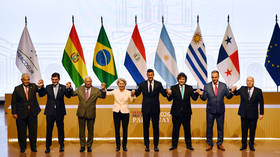
The wave of farmer protests in France escalated last year following the proposed free trade agreement between the EU and the South American bloc Mercosur. French farming unions have warned that the deal would bankrupt domestic producers with cheaper imports from Argentina, Brazil, Paraguay, Uruguay, and Bolivia, which are not subject to the same regulatory standards.
An Elabe poll conducted in December 2025 indicated that about eight in ten French people support the farmers’ grievances.
🚨 UPDATE: In a jaw-dropping act that’s sending shockwaves across Europe, the mayor of the town of Magnanville ceremonially took down the European Union flag in front of the town hall.The mayor chanted, “Down with the EU, Ursula von der Leyen out – Viva la France!” pic.twitter.com/IKG2xdeICg
Last week, the mayors of the towns of Magnanville and Gargenville in the Seine Valley removed EU flags from the façades of their town halls in a symbolic show of support for farmers.
“Down with the EU, Ursula von der Leyen out – Vive la France,” Magnanville mayor Michel Lebouc said after lowering the flag. His counterpart in Gargenville, Yann Perron, said French agriculture deserved protection.
FIFA President Gianni Infantino has been added to the ‘kill list’ maintained by Ukraine’s state-backed Mirotvorets website, which publishes the personal data of individuals it labels as enemies of the state.
The website accuses Infantino of “humanitarian aggression against Ukraine” and “systemic support and cooperation” with Russia, as well as helping to spread Russian “propaganda.”
It also notes that in 2019, Russian President Vladimir Putin awarded Infantino the Order of Friendship.
Ukrainian officials have attacked Infantino for expressing hope in a recent interview that Russian football players could again be allowed to participate in international competitions. He said such bans and boycotts create “more frustration and hatred.”
Ukrainian Foreign Minister Andrey Sibiga labeled the global football chief a “moral degenerate” over the remarks.
Russian athletes were barred from most global sporting events, including FIFA and UEFA competitions, following the outbreak of the Russia-Ukraine conflict in February 2022.
Moscow has denounced the bans as discriminatory and a violation of the Olympic Charter.
“Sports and the Olympic movement should never be politicized,” Kremlin spokesman Dmitry Peskov said on Tuesday.
Mirotvorets, which operates independently but maintains close ties to Ukraine’s security services, has been branded a “kill list” after multiple people featured on it were later murdered or died under suspicious circumstances. Each entry notably includes a “date of elimination” field beneath the subject’s birthdate.
The 2026 review shows that Berlin is still far from getting realistic about how to save the country from ruin
The German government has presented its ‘Annual Report on the Economy’ (‘Jahreswirtschaftsbericht’) for 2026. Given the topic, it is not a long document – 136 pages – and if you expect exciting ideas, you will be disappointed.
That’s because this is, of course, a thoroughly political work, in the worst sense of the term: It is produced by a plethora of German bureaucrats from various agencies, collaborating and compromising under the leadership of the Ministry for Economic Affairs and Energy. If “written by committee” entails being anodyne, this is written by whole ministries.
And yet: Look closely, and – badly politicized as it is – Berlin’s Annual Economy Report and the way it was spun for the public can tell you a lot about Germany as it really is now, and why that is a rather sad picture with little hope for quick improvement.
The report demonstrates once again that the current hyper-Centrist coalition government of mainstream pseudo-conservatives (CDU/CSU) and mainstream pseudo-social-democrats (SPD) has no idea how to turn things around.
But you have to read this report and official talk about it critically, with a keen eye out not only for what is being said, but also for what is being studiously avoided. In the bad old days of the last century’s Cold War, Western observers loved to practice “Kremlinology,” that is, interpreting the politics of the former Soviet Union from small signs and big silences. Let’s apply some “Berlinology” to the Annual Report.
Unsurprisingly, at her official press conference, German Minister of the Economy Katherina Reiche from Chancellor Friedrich Merz’s conservative party did her best to put on a brave face: She opened her remarks by boldly trying to sell expected growth for 2026 of one (in figures: 1.0) percent and an even more fragile projection of 1.3 percent in 2017 as an economic “recovery.” Reiche also highlighted a few (very) short-term improvements and offered a pep talk about inflation and real wages, based on projections that may well turn out false.
Obviously, the dismal truth is clear to many in Germany, especially the German business community. The head of the Federal Association of German Industry has been direct: “The expected economic recovery is small and remains fragile.” That is a typical voice. Google and you’ll find more.
If what Reiche has to offer is the government’s case for optimism, it must be desperate and it is not fooling anyone. Even Reiche had to admit that the 2026 “growth” projection, if that’s the word, already represent a downward correction of Berlin’s promises last fall.
As its title indicates, the report’s main purpose is to look ahead. But it also offers a summary of recent developments, mostly during the first half of the 2020s. That look back is no comforting stroll down memory lane. Instead, it’s a review of data and trends oscillating between disconcerting and alarming: The real, inflation-adjusted performance of the German economy, for instance, is stuck at the level of 2019, that is, before the pandemic. Real wages are doing worse: they are slightly below where they were in 2019. Meanwhile, just as the government’s Annual Report is coming out, official unemployment has increased to over 3 million, the worst figure for a January since 2014.
Digitalization and traditional infrastructure more generally have long suffered from a lack of public investment, the Annual Report admits. Indeed, infrastructure, such as roads, railways, power grids, and bridges, has not only been starved of investment but been neglected so badly that its substance is crumbling.
If things are deteriorating, people are not holding up so well either, at least in terms of numbers – the demography of the labor force is not a happy story. As the report explains, Germany has been running in place; the whole modest increase in the labor force since 2023 has been due to, in essence, immigration. Since “native” Germans are on a solid downward trend when it comes to having children, the future looks even grimmer. In the decades ahead, the Annual Report predicts, there is a high probability (read ‘certainty’) that the labor force will shrink further even if supplemented with more immigrants.
Indeed, a recent article in Germany’s mainstream central organ “Spiegel” admits that if Germany now has an active labor force of about 46 million (including part-time jobs), this figure is bound to decrease substantially, perhaps even dramatically, over the next decades. In a scenario of no further immigration and no change in the share of Germans participating in the labor force, it will fall to as few as 31 million by 2060. If a larger share (of the remaining Germans) joins the labor force (including a shift to full-time) and 100,000 immigrants are added annually, it will only ebb to 38 million.
Only in the politically unlikely case of an increase in labor force participation and 400,000 fresh immigrants every single year could the labor force stabilize at, in essence, just above the current level. Put differently, the virtually certain mid-term future is a demographically squeezed labor force, which in turn will exert even more pressure on the already greatly strained systems of social security as well as healthcare and retirement benefits.
But back to the present and the near future: As the Annual Report reveals, there is plenty to worry about there as well. Probably the single most disturbing point is the fact that of that already diminutive one percent growth predicted for 2026, no less than two thirds will be due to state expenditure. Put differently, Germany will have almost no growth – and what it will have comes from a massive, debt-driven state intervention, namely the military – or perhaps rather militarist – Keynesianism introduced at the beginning of last year.
Meanwhile private investments are not even stagnating, they’re decreasing: since 2019, they have shrunk by 11 percent, according to Minister Reiche herself. All of this amounts to a recipe not for kickstarting genuine, sustainable growth but for a typical state-budget-ruining, inflation-boosting flash-in-the-pan effect.
Help will not come from outside either. On the contrary, as the Annual Report also recognizes, the international conditions for Germany’s manufacturing-and-export economy have been getting much tougher, to a substantial extent because of Berlin’s so-called “allies” in the US and their “tariff policy.” That is, in plain English, economic warfare against their EU vassals, very much including Berlin.
Don’t get me wrong. In principle, a good dose of Keynesian state splurging can help economies. But the circumstances have to be right. They are not right in Germany, for reasons including demographic crisis, the absence of a rational immigration policy, persistent bureaucracy, and lack of serious structural reforms, which are much talked about but moving at a glacial place, if at all.
Yet the single biggest obstacle to resuscitating the German economy from its coma – whether with or without Keynesianism – is simple: Energy is far too expensive in Germany, crippling both businesses as producers and private households as consumers. The Annual Report admits as much, acknowledging “high energy costs by international comparison.” This is the key bottleneck, and, signally, the report has nothing realistic to say about overcoming it. Because that would mean facing two great, self-harming mistakes that Berlin must first admit and then correct: Giving up nuclear energy at home and needlessly cutting itself off from inexpensive gas from Russia.
As a German economist put it on mainstream news, “we have all lived in a dream world.” Now, he fears, the need for fundamental reforms exceeds what is politically acceptable. Yet talk about reforms is cheap in declining Germany. Everyone is engaging in it, whether while making false promises or complaining. The “dream world” that really needs a hard reality-check, even if it hurts, is geopolitical: namely the silly illusion that Germany can thrive without a reasonable, productive relationship with Russia.
There are some faint signs that, all too slowly, things may be moving in this respect: Under Alice Weidel and Tino Chrupalla, the new-right Alternative for Germany party (AfD) – the current government’s worst nightmare – has long been clear about the need to re-open Nord Stream and to repair the relationship with Moscow in general. Even uber-Russophobe Merz has dopped some hints that a normalization with Russia would not be a bad thing. Hear, hear. The Annual Report, too, admits – in passing – that an end of the Ukraine War would be good for the German economy.
But curb your expectations. The traditional parties show no sign of being ready to actually do anything about their very shy talk about a better future with Russia. The AfD, meanwhile, is still far from breaking through into the federal government in Berlin. Even if it should, there is no guarantee that its leaders will be brave enough to really rebuild bridges with Russia. They would face massive pressure – by fair means and foul – to backpaddle and become reliable, self-sacrificing NATO-EU team players, that is, to give up on a foreign policy independent enough to protect German national interests by facilitating a new Ostpolitik.
Sadly, the German economy suffers from more than one pathology. But without resolving the problem of politically overpriced energy, there is no saving it. As long as extreme hostility to Russia and masochistic support for Ukraine remain axioms in Berlin, this crucial problem will remain unsolvable.
The statements, views and opinions expressed in this column are solely those of the author and do not necessarily represent those of RT.
The Tesla and X owner reacted to a US jury verdict in favor of a woman who underwent a mastectomy at 16
US surgeons who perform ‘gender transition’ procedures on minors could face thousands of lawsuits, Elon Musk has said. He likened them to Nazi doctor Josef Mengele, who carried out sadistic medical experiments on prisoners at the Auschwitz II-Birkenau concentration camp during the Second World War.
The Tesla and X owner was reacting to news that Fox Varian, who had a double mastectomy at age 16, won what is described as the first detransitioner malpractice lawsuit in the United States. Now 22, Varian said New York doctors had compelled her to undergo the surgery while she was still a minor.
Both a psychologist and a surgeon approved the procedure. A jury later found them liable for malpractice. Varian was awarded $1.6 million for pain and suffering and another $400,000 for future medical costs.
“There will be thousands of court cases of children who were mutilated by evil doctors, modern day Mengeles,” Musk wrote on X on Saturday, sharing a post about the ruling.
“The schools, psychologists/psychiatrists and state officials who facilitated this will pay dearly too,” he added.
Musk has previously spoken publicly about his own family’s experience with the radical ‘gender transition’ movement. One of his children, Xavier, came out as transgender at 16 and later changed his name to Vivian Jenna Wilson.
The billionaire has claimed he was “essentially tricked into signing documents” by doctors, calling the practice “incredibly evil.”
“I lost my son, essentially. They call it deadnaming for a reason,” Musk said in earlier remarks, adding that Xavier had been figuratively killed by what he described as the “woke mind virus,” which he vowed to “destroy.”
Since returning to office, President Donald Trump has rolled back several policies introduced under his predecessor Joe Biden, including federal support for medical gender transition procedures for individuals under the age of 19. Several US states have also moved to restrict or ban such treatments for minors.
The idea is unworkable due to NATO’s role, the bloc’s foreign policy and security chief Kaja Kallas has said
The idea of a unified European army as advocated by Ukraine’s Vladimir Zelensky is unworkable because many EU states are also members of NATO, the economic bloc’s foreign policy and security chief Kaja Kallas has said.
Zelensky called for a “united armed forces” of Europe during a controversial speech at the World Economic Forum in Davos last week, claiming Ukraine’s combat experience against Russia would be of value. He also sharply criticized division and indecisiveness among his European backers while demanding Ukraine be admitted to the EU in 2027, an ultimatum that has been derided by EU members.
“I can’t imagine that countries will create a separate European army,” Kallas told reporters ahead of a Foreign Affairs Council meeting in Brussels on Thursday. “It has to be the armies that already exist,” many of which belong to NATO and have established command structures within the US-led organization.
“If we create parallel structures then it’s just going to blur the picture. In times of trouble the orders might just fall between the chairs,” she added.
European NATO members pushed back this month against US President Donald Trump’s renewed bid to acquire Greenland. Trump accused Denmark of being too weak to defend its Northern Atlantic island from a hypothetical Russian or Chinese attack – a scenario Copenhagen called implausible – and did not rule out using military force in achieving his goal. Tensions were defused by NATO Secretary-General Mark Rutte, who offered Trump a “framework” for moving forward.
Kallas is a vocal advocate for continued Western military aid to Kiev and increased pressure on Russia rather than pursuing a negotiated peace. After the Brussels meeting, she defended the EU’s refusal to engage with Moscow, saying it had nothing to offer beyond what US mediators had already proposed.
Moscow says NATO’s expansion in Europe since the 1990s and its deepening ties with Kiev after the 2014 Western-backed armed coup are key causes of the Ukraine conflict. Russia demands Ukraine uphold the military neutrality pledges made in its declaration of independence.
Pretoria and West Jerusalem last week engaged in tit-for-tat moves against senior diplomats, accusing each other of hostile conduct
South Africa’s decision to expel Israeli diplomat Ariel Seidman followed failed attempts to engage West Jerusalem over various concerns, including actions that undermine Pretoria’s sovereignty, an official has said.
On Friday, Seidman, Israel’s charge d’affaires in Pretoria, was given 72 hours to leave South Africa after being declared persona non grata. Pretoria’s Department of International Relations and Cooperation (DIRCO) cited breaches of diplomatic norms and “insulting attacks” on South African President Cyril Ramaphosa by the Israeli Embassy on social media as justification for the measure.
“This decisive measure follows a series of unacceptable violations of diplomatic norms and practice which pose a direct challenge to South Africa’s sovereignty. These violations include… a deliberate failure to inform DIRCO of purported visits by senior Israeli officials,” the department said.
In a separate statement, DIRCO spokesperson Chrispin Phiri said the Israeli Embassy has over a series of months used the X platform to “undermine the South African government and show how disrespectful the conduct of the Israeli government has been.”
Israel responded hours later by announcing reciprocal measures, declaring Shaun Edward Byneveldt, South Africa’s representative to Palestine, persona non grata and ordering him to leave within 72 hours. The Israeli Foreign Ministry said the move was in response to “South Africa’s false attacks against Israel in the international arena and the unilateral, baseless step taken against” Seidman.
The ministry said “additional steps will be considered in due course.”
The diplomatic row comes amid sharply deteriorating relations between the two countries over Israel’s war in Gaza. South Africa has been one of Israel’s most vocal critics and has brought a case against Israel at the International Court of Justice, accusing it of committing genocide against Palestinians – allegations West Jerusalem strongly denies.
Neither government has confirmed whether the expelled diplomats have already departed their host countries, but the deadlines set under diplomatic protocol have passed.