Kiev’s fight against Russia allows the Hungarian prime minister to “grow his belly” instead of an army, the Ukrainian leader has said
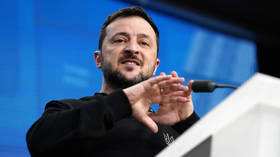
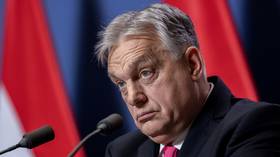
Ukraine’s Vladimir Zelensky has launched yet another personal attack on Hungarian Prime Minister Viktor Orban, telling him that thanks to Kiev, he can “think about how to grow his belly” instead of building a capable army. The two have long been at odds due to Budapest’s refusal to support Ukraine.
Zelensky made the remarks at the Munich Security Conference on Saturday, arguing that Ukraine is defending the entire EU from Russia. “It’s Ukrainians who are holding the European front. Behind our people stands an independent Poland and the free Baltic states,” he claimed.
“And even one Viktor can think about how to grow his belly, not how to grow his army to stop Russian tanks from returning to the streets of Budapest,” he said, referring to the 1956 Soviet incursion into Hungary to suppress a popular revolt.
The insult elicited applause from a mostly pro-Ukraine and pro-EU crowd, which tends to have a dim view of Orban due to his opposition to numerous policies of the bloc.
Responding on X, Orban did not address the insult directly, but suggested that Zelensky’s remarks “will greatly help Hungarians see the situation more clearly,” particularly regarding Ukraine’s ambitions to join the EU.
“This debate is not about me and it is not about you. It is about the future of Hungary, Ukraine, and Europe. This is precisely why you cannot become a member of the European Union,” he said.
Last month, Zelensky took another jab at Orban, telling the World Economic Forum in Davos that “every Viktor who lives off European money while trying to sell out European interests deserves a smack upside the head.”
The Hungarian prime minister called Zelensky “a man in a desperate position,” while hinting that the Ukrainian leader has shown ingratitude. “The Ukrainian people, of course – despite your carefully chosen insults – can still count on us to continue supplying your country with electricity and fuel.”
Orban has declined to support Ukraine’s military effort, arguing that the aid would only impede peace settlement. Hungary has also opposed Kiev’s push to join the EU and NATO, arguing the move would draw the bloc into a direct conflict with Russia.
Prosecutors allege that Nikhil Gupta was directed by an Indian government official to kill the founder of Sikhs for Justice
An Indian citizen has pleaded guilty to plotting the murder of a US-based Sikh separatist, the US Office of the Southern District of New York said on Friday.
Nikhil Gupta admitted to paying $15,000 to a person he believed was a hitman to kill Gurpatwant Singh Pannun, the founder of Sikhs for Justice (SFJ).
New Delhi considers SFJ, which advocates for the secession of the Indian state of Punjab to form an independent country called Khalistan, to be a “terrorist” group.
“Nikhil Gupta plotted to assassinate a US citizen in New York City,” US attorney Jay Clayton said on Friday. “He thought that from outside this country he could kill someone in it without consequence, simply for exercising their American right to free speech. But he was wrong, and he will face justice.”
Gupta was arrested in June 2023 in the Czech Republic and later extradited to the US.
He pleaded guilty to murder-for-hire, conspiracy to commit murder-for-hire, and conspiracy to commit money laundering charges, all of which carry a combined maximum prison sentence of 40 years.
Indian National Pleads Guilty in US to Failed Murder Plot Against Gurpatwant Singh Pannun Nikhil Gupta, 54, has pleaded guilty in a New York federal court to three charges tied to a plot to kill the SFJ leader.Gupta was arrested in June 2023 in the Czech Republic and later… pic.twitter.com/5c7wwsuX1s
US prosecutors claim that Gupta was directed by an Indian government official to carry out the plot to murder Pannun, who regularly makes violent threats to India on social media. India has denied any role in the alleged plot to murder the separatist.
Pannun’s SFJ is among several Khalistan outfits banned by the Indian government that primarily operate outside India in countries with significant Sikh diasporas.
Pretoria’s primary goal this year is to tackle organized crime, which is the most immediate threat to the country’s democracy, President Cyril Ramaphosa has said
South African President Cyril Ramaphosa on Thursday announced the deployment of the National Defense Force (SANDF) to combat gang violence and illegal mining in the Western Cape and Gauteng provinces.
In his 2026 State of the Nation Address (SONA), Ramaphosa declared organised crime as the most immediate threat to the country’s democracy and outlined comprehensive plans to strengthen the fight against criminal networks.
“Our primary focus this year is on stepping up the fight against organised crime and corruption, and we will do so using technology, intelligence and integrated law enforcement.
”We will tackle organised crime by consolidating intelligence at national level, identifying priority syndicates and deploying handpicked multidisciplinary intervention teams focused on dismantling criminal networks,” he said.
Ramaphosa also said in strengthening the fight against gang violence and illegal mining, he will be deploying the SANDF to support the police.
”I have directed the Minister of Police and the SANDF to develop a technical plan on where our security forces should be deployed within the next few days, in the Western Cape and in Gauteng to deal with gang violence and illegal mining.”
Parliament will be informed about the deployment and related costs. ”We have to act to rid our country of gang violence,” said Ramaphosa.
His announcement on the deployment of the SANDF came hours after Acting Police Minister Firoz Cachalia hinted at a possible SANDF deployment, when he was speaking to the media earlier in the day when asked about plans to tackle gang violence on the Cape Flats.
Ramaphosa also told the nation that the government was implementing an integrated strategy to address the root causes of crime through coordinated interventions across society. “We are going to tackle gun crimes by streamlining legislation and regulations on licensing, possessing and trading and firearms and ammunition. We will increase enforcement of existing gun laws.”
The President promised to put more boots on the ground through the recruitment of 5,500 police officers, in addition to the 20,000 new officers announced in previous SONAs. He added that they were addressing the threat posed by the infiltration of illegal and counterfeit goods to South African jobs and industry.
”We are establishing a National Illicit Economy Disruption Program that brings together key state agencies and other stakeholders, including the private sector, through the effective use of data analytics and artificial intelligence.
“We will be targeting high risk sectors like tobacco, fuel, alcohol and other counterfeit goods.”
Ramaphosa said the Madlanga Commission of Inquiry and Ad Hoc Committee in Parliament have exposed rampant corruption within SAPS and Metro police departments. “We can’t tolerate this,” he said, adding that the investigations on matters arising from the Madlanga Commission will be conducted swiftly by the newly appointed task team.
The State Security Agency will re-vet the top brass of SAPS and Metro police officers. “The vetting process will include lifestyle audits as well as we have successfully done with previous commissions. We will use the recommendations of the Madlanga Commission to make far-reaching changes,” he said.
Ramaphosa said they were determined that the commission’s findings and recommendations will lay the basis for a fundamental reform of the criminal justice system. “We are confident that these efforts will succeed, because the great majority of police officers are dedicated to upholding the law and diligently serving the people of South Africa.”
Earlier Ramaphosa urged the nation to draw its strength from the values as articulated in the Constitution. “Our strength comes from our determination and resolve. It comes from our creativity and inspiration as we navigate this new world,” he said.
According to Ramaphosa, South Africa was stronger than it was a year ago. “Our economy is growing again. While we have experienced four consecutive quarters of GDP growth, we know that it has to grow much higher and much faster to meet our social and economic challenges.”
Ramaphosa also said the government has brought an end to loadshedding and was building a more dynamic and resilient energy system. “We have made achievements in improving the performance of our ports and freight rail lines, steadily increasing the volume of goods that we move in and out of our country.”
The president added that the work done to rebuild key institutions from state capture is showing results. “The South African Revenue Service is once again a world class tax authority. The Investigating Directorate continues with this work and is making progress in the prosecution of those who need to be prosecuted,” he said. However, Ramaphosa said despite the progress being made, there were still challenges to be faced.
“Although we are moving forward, we must not claim any easy victories. We are still far from where we need to be.” He noted that for too many people, life remained hard, that jobs were scarce and opportunity was out of reach. “South Africans are worried about violent crime and corruption. They are concerned at the state of local government and its inability to deliver basic services in many parts of the country.”
But Ramaphosa said the Constitution calls on the government to work towards a society in which every South African has a fair chance to make a better life for themselves.
Russian cosmonaut Andrey Fedyaev flew with Crew-12 alongside NASA and European Space Agency astronauts
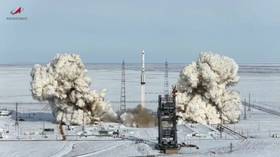
A SpaceX Dragon spacecraft has successfully docked with the International Space Station (ISS), delivering a multinational mission that includes Roscosmos cosmonaut Andrey Fedyaev.
Crew-12 lifted off atop a Falcon 9 rocket from Cape Canaveral Space Force Station in Florida on Friday. The reusable Dragon capsule Freedom docked with the station’s Harmony module about 34 hours later, completing its journey to the orbital outpost. Other crew members include NASA astronauts Jessica Meir and Jack Hathaway, who serve as commander and pilot, as well as European Space Agency astronaut Sophie Adenot.
“With that gentle contact, we have bridged the legacy of humankind’s continuous presence in space. It has been more than 25 years at this very site,” Meir radioed after docking. “The International Space Station is more than a structure, it is a promise kept. Decades in the making, built by nations, sustained by trust and partnerships, and powered by science, innovation and curiosity.”
“As we look back at Earth through these windows, we are reminded that cooperation is not just possible, it is essential. Up here there are no borders and hope is universal,” she added.
The astronauts are expected to remain aboard the ISS for about eight months, conducting scientific research, maintenance, and technology demonstrations in low Earth orbit. Their arrival restores the station to a full seven-person complement after an earlier expedition returned ahead of schedule due to a medical issue.
Russia and the US continue to cooperate on ISS missions under a cross-flight agreement signed in 2022. The arrangement allows Roscosmos cosmonauts to fly aboard Crew Dragon spacecraft while NASA astronauts travel on Russia’s Soyuz capsules.
Following the launch, NASA Administrator Jared Isaacman said preparations are underway for talks with Roscosmos Director General Dmitry Bakanov, adding that the meeting will take place “at the earliest opportunity.”
“There is a lot that we need to accomplish together in the years ahead,” he said, adding that there is “certainly a lot of opportunity for good conversation.”
Isaacman also said he plans to attend the Soyuz MS-29 launch scheduled for summer 2026.
Americans care about flight safety, not what the crew “looks like or their gender,” the US transportation secretary has said
The US Department of Transportation (DOT) has issued a sweeping mandate requiring all commercial airlines to formally commit to merit-based hiring for pilots, explicitly barring the use of race or sex as factors in recruitment.
The directive, delivered via a new Federal Aviation Administration (FAA) Operations Specification (OpSpec), demands that carriers certify they have terminated any diversity, equity, and inclusion (DEI) practices in pilot selection. Airlines that fail to comply face the threat of federal investigation.
“When families board their aircraft, they should fly with confidence knowing the pilot behind the controls is the best of the best,” Transportation Secretary Sean P. Duffy said in a statement on Friday. “The American people don’t care what their pilot looks like or their gender – they just care that they are the most qualified man or woman for the job.”
FAA Administrator Bryan Bedford stressed that the rule is fundamentally about safety.
“It is a bare minimum expectation for airlines to hire the most qualified individual when making someone responsible for hundreds of lives at a time,” Bedford said. “Someone’s race, sex, or creed has nothing to do with their ability to fly and land aircraft safely.”
The Trump administration’s focus on aviation hiring practices intensified following a deadly midair collision of an Army Black Hawk helicopter and American Airlines regional jet that killed 67 people last January, just days after President Donald Trump took office. In the aftermath, Trump publicly blamed DEI hiring practices at the FAA, which he alleged were inherited from the previous administration.
While the FAA has already dismantled its internal DEI offices and raised performance standards, “allegations of airlines hiring based on race and sex remain,” according to the DOT. The new OpSpec is designed to close that gap by forcing transparency from the airlines themselves.
The mandate aligns with Trump’s wider campaign to purge DEI initiatives from the federal government and its regulated industries.
The Department of War recently announced a “line-by-line” review of its contracts with small businesses, which Secretary Pete Hegseth described as “the oldest DEI program in the federal government” and a “breeding ground for fraud.”
Estonia’s soaring electricity prices have made processing new stocks uneconomical, ERR has reported
Estonia has run out of dry firewood in the middle of an unusually cold winter, according to the news portal ERR, which added that the shortage is exacerbated by soaring electricity prices, which have made processing new stocks uneconomical.
The current winter has brought some of the lowest temperatures seen for around a quarter century, with overnight lows falling to minus 15 degrees Celsius (5 F).
“At the moment we only have fresh wood; we don’t have any dry left,” sawmill owner Taavi Rada told ERR. He also explained that following several mild winters, demand for seasoned firewood had been too low to justify maintaining large dry stocks.
Local resident Tarmo Kamm, who has dried firewood for over 30 years, told the outlet that seasoned wood had become too expensive, leading people to opt for cheaper green supply.
However, burning unseasoned wood, which has a high moisture content, produces excessive smoke while generating significantly less heat. Firewood typically must dry up to two years to reach optimal moisture levels below 20%.
ERR also attributed the shortage to people buying supplies in advance. Last February, the Estonian government recommended citizens stockpile essential items including “heating materials,” citing potential power outages as the country prepared to decouple from the Russian electricity grid as part of the EU nations’ effort to cut long-standing energy links with Moscow.
The Baltic states claimed that dependency on the Moscow-controlled network creates a threat if Russia were to weaponize its electricity supply and disconnect them from the grid. Such fears have never materialized.
When the decoupling was carried out, electricity prices in Estonia and its Baltic neighbors Latvia and Lithuania nearly doubled.
Rising electricity prices have inadvertently contributed to the firewood shortage, ERR noted.
“The electricity price is so high that right now there’s no point in sawing and splitting using electricity. I can saw in advance with a [petrol] chainsaw, but I still have to split with electricity. It’s a four-kilowatt motor – you do the math,” Kamm told ERR.
The Ukrainian leader has sunk to new lows with his attacks on the Hungarian PM, Adriel Kasonta has told RT
Ukraine’s Vladimir Zelensky’s personal remarks about Hungarian Prime Minister Viktor Orban at the Munich Security Conference were “childish” and unbecoming of a head of state, political risk consultant and lawyer Adriel Kasonta has said
The controversy stems from remarks made by Zelensky on Saturday, in which he mocked Orban’s physique while claiming that Ukraine is fighting to protect the entire EU from Russia.
“It’s Ukrainians who are holding the European front… And even one Viktor can think about how to grow his belly, not how to grow his army to stop Russian tanks from returning to the streets of Budapest,” Zelensky said.
The comment was met with applause from the largely pro-Ukraine and pro-EU audience in Munich, but critics argue that the insult was unbecoming of a “serious” leader.
Speaking to RT, Kasonta described the Ukrainian leader’s behavior as that of a “desperate man” resorting to the antics of his former comedy career on one of the world’s most important political stages.
“He’s trying to take his tricks from the comedian past into the public fora like the Munich Security Conference – turning this previously very important gathering of Western leaders or world leaders discussing important issues related to world security into a farce,” he said.
Kasonta argued that spectacles like Zelensky’s are alienating global observers.
“This security conference is observed around the world and countries outside of the Western hemisphere are just scratching their heads and wondering why instead of discussing important issues related to this war-torn world that we are living in currently, we are simply allowing leaders like Mr. Zelensky to turn it into a big circus,” he said.
Orban, who has refused to send weapons to Ukraine and blocked EU funds for military aid, responded to the insult on X with characteristic coolness, suggesting that Zelensky’s words would “greatly help Hungarians see the situation more clearly.”
“This debate is not about me and it is not about you. It is about the future of Hungary, Ukraine, and Europe. This is precisely why you cannot become a member of the European Union,” Orban wrote.
Orban previously dismissed Zelensky’s rhetoric as the behavior of “a man in a desperate position” and has accused Brussels and Kiev of “declaring war on Hungary.”
The US secretary of state made the remark at the Munich Security Conference while trying to bridge the rift caused by the diverging policies of Washington and Brussels
The US may be unable to prevent EU bureaucrats from destroying Western civilization, Russian President Vladimir Putin’s envoy Kirill Dmitriev has suggested.
The remark came in response to US Secretary of State Marco Rubio’s speech at the Munich Security Conference, where he sought to ease tensions between Washington and Brussels after a year of strained transatlantic relations. Rubio insisted that despite differences, the US and Europe “belong together,” and if Washington’s policies that angered Brussels – from tariffs and NATO spending demands to the Greenland bid – may seem “a little direct and urgent,” it is because “we care deeply” about the future of the EU and the West in general.
In a post on X on Saturday, Dmitriev said the bloc’s sprawling bureaucracy and poor policy choices would impede US plans to “renew and restore” Western civilization.
“The US cares deeply and tries to prevent EU bureaucrats from destroying Western civilization,” Dmitriev wrote. “But EU bureaucrats are highly focused and skilled at destroying it through false narratives, migration, warmongering, and economic decline. It’s unclear who wins.”
The US cares deeply and tries to prevent EU bureaucrats from destroying Western civilization.But EU bureaucrats are highly focused and skilled at destroying it through false narratives, migration, warmongering, and economic decline.It’s unclear who wins. https://t.co/HkZeXarrqBpic.twitter.com/s01qzQhaUK
Dmitriev’s tone appeared mocking toward both the US and EU. To illustrate his point, he linked a short clip of the arm-wrestling scene from Over the Top (1987) starring Sylvester Stallone.
The Trump administration’s new National Security Strategy slammed the EU for poor policy choices, warning of a risk of “civilizational erasure.” Rubio echoed parts of the criticism but reframed it as shared failures by both European and American authorities since World War II. He invoked the common “adversaries and rivals” narrative, stressing that the US and EU must stand united against unnamed powers that allegedly built welfare states and hard power while the West faltered.
While Rubio did not identify these alleged adversaries, Trump has defended his push for Greenland as a way to counter Russian and Chinese influence in the Arctic. EU and NATO officials have also portrayed Russia as a threat, claiming it could strike Europe after the Ukraine conflict, and have launched military initiatives framed as deterrence against Moscow.
Russia has dismissed claims it threatens Europe as “nonsense” and baseless fearmongering used to justify inflated military budgets. Both Russia and China, the latter of which has no strategic role in the region, have also rejected claims they threaten Greenland.
Karol Nawrocki has said he is a “strong supporter of joining a nuclear project,” citing a perceived Russian threat
Poland needs to develop its own nuclear weapons program, President Karol Nawrocki has suggested, citing a perceived ‘Russian threat’.
NATO’s European members have long cited what they claim to be the specter of Russian aggression to justify their massive military buildup. Moscow has dismissed such claims as “nonsense” and baseless fearmongering.
Speaking to Polsat News on Sunday, Nawrocki said he is a “strong supporter of Poland joining the nuclear project.”
“We need to act in this direction so that we can begin work,” the Polish president stated, adding that he does not know whether Warsaw would actually pursue this endeavor.
Poland is a party to the Nuclear Non-Proliferation Treaty, which recognizes only five nuclear-armed states: China, France, Russia, the US, and UK.
Meanwhile, talk of obtaining nuclear weapons is no longer taboo in Germany. The topic is increasingly discussed by the media and gaining “advocates among politicians, MPs, the military officials and experts,” Russian Ambassador to Berlin Sergey Nechaev told RIA Novosti on Friday, calling the trend highly concerning.
Kay Gottschalk, a lawmaker from the right-wing AfD party, said last month that Germany “needs nuclear weapons,” arguing that European nations could no longer rely on American protection. He stated that the recent tensions between the US and its European allies over Greenland proved that Washington’s interests are “fundamentally different from ours.”
Last July, International Atomic Energy Agency chief Rafael Grossi said that Germany could build a nuclear bomb “in a matter of months,” but noted that the scenario was “purely hypothetical.”
In December, Japanese media quoted a senior adviser to Prime Minister Sanae Takaichi as suggesting that the country should consider developing its own nuclear deterrent. The remark drew a sharp rebuke from China.
Russian Security Council Deputy Chairman Dmitry Medvedev said last month that some countries may conclude that acquiring nuclear weapons is the only way to guarantee self-defense and sovereignty amid growing global instability.
“A range of nations have the technical capacity to run a military nuclear program, and some are pursuing research in this area,” he said.
Apart from the five permanent UN Security Council members, India, Pakistan and North Korea also possess nuclear arsenals, while Israel is widely believed to have undeclared capabilities.
The US is reshaping the world, while the EU applauds and tries to keep the old system on life support
If this year’s Munich Security Conference proved one thing, it’s that nobody involved has done any reflection on the lessons of last year. The Americans continued to berate their European ‘allies’, while the Europeans resorted to comic-book catchphrases to defend a dying world order.
Running from Friday through Sunday, this year’s conference was always going to center on the widening gulf between the US and EU. Conference Foundation President Wolfgang Ischinger spelled this out in a report published before the summit, accusing US President Donald Trump of taking a “wrecking ball” to the post-WWII liberal order. As such, he wrote, “the United States’ evolving view of the international order” would be the focus of almost every discussion in Munich.
Rubio doubles down
“We in America have no interest in being polite and orderly caretakers of the West’s managed decline,” US Secretary of State Marco Rubio declared in his keynote speech on Saturday. Over the next 20 minutes, Rubio laid out a vision of the US and EU uniting to rebuild the empires of old, unconstrained by climate policy, “anti-colonial” sentiment, and “mass migration that threatens the cohesion of our societies.”
“We are heirs to the same great and noble civilization,” he told the Europeans, calling on them to join the US in seizing critical mineral supply chains, dominating markets in the Global South, and foregoing UN resolutions for direct intervention around the world.
European leaders, who spent the year leading up to the conference condemning the US aggressively self-interested foreign policy, now applauded as Rubio reminded them that it was the US – and not the UN – that bombed Iran and kidnapped Venezuelan President Nicolas Maduro.
The US does not want an alliance “paralyzed into inaction by fear – fear of climate change, fear of war, fear of technology,” he told them. “We want an alliance…that does not allow its power to be outsourced, constrained, or subordinated.”
The Kaja Kallas calamity continues
As the EU’s chief diplomat, Kaja Kallas delivered the closest thing to an official response to Rubio. “Contrary to what some may say, woke, decadent Europe is not facing civilizational erasure,” she offered in her closing statement on Sunday. Europeans, she claimed, are “dusting off our capes, pulling on our boots, revving up our engines” to meet three goals: expanding the EU, fighting so-called “Russian imperialism,” and securing new trade deals.
Over the weekend, Kallas called on the EU to defend the “rules-based international order” that the US apparently has no interest in preserving. However, while Rubio could back up his statements with hard power, Kallas could only rely on catchphrases. During a discussion on Israel’s ceasefire violations in Gaza, for instance, she called for a system of rules in which “if you are breaching these rules, you should be held accountable,” without explaining how this could happen
One statement in particular showcased the divide between Rubio’s hard-nosed realism and Kallas’ world of fantasy narratives: “Europeans, assemble!” she said from the podium on Sunday, borrowing the phrase from Marvel’s ‘Avengers’.
A nuclear Europe
German Chancellor Friedrich Merz took a darker tone than Kallas. “The international order based on rights and rules…no longer exists,” he said on Friday. Faced with this reality, he called for a remilitarization of the EU, in which the German military is the “strongest conventional army in Europe.” This remilitarization is aimed squarely at Russia, he said, vowing to keep backing Ukraine in its “brave resistance against Russian imperialism.”
French President Emmanuel Macron delivered a similar message, declaring that “Europe has to become a geopolitical power,” strengthening its forces and its military industrial complex to “increase pressure on Russia.”
Merz and Macron both referenced nuclear weapons, with Macron announcing that he had been in talks with Merz and a “few other European leaders” on developing a joint nuclear doctrine. The French president said that he would reveal more details “in a few weeks’ time.”
Both Macron and Merz did not much more than pay lip service to the idea of peace talks with Moscow. Macron urged European leaders to draw up a set of post-conflict “rules of co-existence” with Russia, but while France has opened technical diplomatic channels with Moscow, Kremlin spokesman Dmitry Peskov has stressed that nobody in Paris has reached out for high-level talks.
Zelensky lowers the tone
Vladimir Zelensky’s speech offered few surprises: the Ukrainian leader compared Russian President Vladimir Putin to Adolf Hitler, adding that he views any territorial concessions to Russia as a form of appeasement. He also demanded more weapons from the Europeans, more sanctions on Moscow, and claimed that his military is preventing the fall of “an independent Poland and the free Baltic states.”
Zelensky took multiple jabs at Hungarian Prime Minister Viktor Orban, whose opposition to funding the conflict with Russia has made him the target of repeated attacks from the Ukrainian leader. “Viktor,” he said during his speech, only thinks “about how to grow his belly – not how to grow his army to stop Russian tanks from returning to the streets of Budapest.”
Dear Volodimir @ZelenskyyUa,Thank you for yet another campaign speech in support of Ukraine’s accession to the European Union. It will greatly help Hungarians see the situation more clearly.There is, however, something you misunderstand: this debate is not about me and it is… https://t.co/2xixBgMcnu
In follow-up remarks thanking Ukraine’s European donors, he again called out Orban, saying that he has “forgotten the word ‘shame’.”
Orban responded on X, saying Zelensky’s comments demonstrate why Ukraine “cannot become a member of the European Union.” He added that the Ukrainian leader’s rhetoric will “greatly help Hungarians see the situation more clearly.”
The bottom line
Change comes slowly at the Munich Security Conference. In the year since US Vice President JD Vance told the Europeans that they shouldn’t count on American support if they keep censoring their citizens and opening the floodgates to mass immigration, both sides have hardened their positions. Rubio’s speech demonstrated that the US will pursue its objectives with or without European help, while Kallas continued to appeal to a system that even European leaders like Merz and Macron are now pronouncing dead.
The rest of the world looks on in exasperation. Putin used the platform of Munich in 2007 to condemn the so-called “rules-based international order” as a “pernicious” system that would ignite conflict across the world before “destroy[ing] itself from within.” This year, Saudi Arabian Foreign Minister Faisal bin Farhan Al Saud interrupted an argument between Kallas and US ambassador to the UN Mike Waltz to point this out.
”The fact that this conversation is now finally at the forefront is certainly a reflection of a Eurocentric view,” he said. “Many of us have seen the breakdown of that rules-based order and the reality that might makes right well before. It’s something that a lot of us have believed for well over a decade.”