Home Blog Page 60

US wants India to buy Venezuelan oil – envoy

0

Washington has been using trade talks to persuade New Delhi to give up on Russian supplies

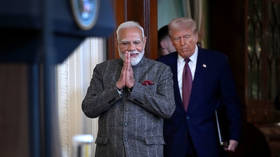
The US is in “active negotiations” with India, which it hopes to persuade to import oil from Venezuela instead of Russia, the American ambassador in New Delhi has said.

The US issued licenses to two trading houses to distribute oil produced in Venezuela after kidnapping the Latin American nation’s leader, Nicolas Maduro, in early January and reaching a supply deal with interim president Delcy Rodriguez.

Washington has been using the ongoing trade negotiations to persuade New Delhi to give up on Russian oil supplies. India and China became the main buyers of the crude after the US and EU imposed sanctions on Moscow over the escalation of the Ukraine conflict in 2022.

US Ambassador Sergio Gor told journalists in New Delhi on Friday that “the [US] Department of Energy is speaking to the [Indian] Ministry of Energy” about buying Venezuelan oil, and “we’re hoping to have some news of that very soon.”

Earlier this month, US President Donald Trump signed an executive order eliminating the 25% tariff imposed on India last August over importing Russian oil. Trump claimed that he did so because New Delhi “agreed to stop” deliveries from Moscow.

“On the oil, there’s an agreement… We have seen India diversify on their oil. There is a commitment. This is not about India. The US doesn’t want anyone buying Russian oil,” the ambassador said.

New Delhi never confirmed that it had promised Washington it would abandon Russian oil. Indian Foreign Minister S. Jaishankar said during the Munich Security Conference last week that his country’s leaders pursue “strategic autonomy” and make decisions in the energy sector that “they feel are in their best interest,” based on an analysis of costs and risks.

Moscow also said that it has no information about India putting Russian crude deliveries on hold. Russian Foreign Ministry spokeswoman Maria Zakharova told journalists on Wednesday that oil purchases are driven by commercial feasibility. “I think that neither we nor you have a reason to believe that India has revised its approach,” she stressed.

Earlier in February, Russian Foreign Minister Sergey Lavrov accused the US of using “coercive measures that are incompatible with fair competition” in its push to control the main international energy routes and “dominate the world economy.”

You can share this story on social media:

source

UK police arrest Epstein-linked ex-Prince Andrew

0

Andrew Mountbatten-Windsor, formerly known as Prince Andrew and brother of King Charles, has reportedly been arrested by UK police on suspicion of misconduct in public office. It comes after he was found to be closely associated with convicted pedophile financier Jeffrey Epstein. 

On Thursday, British outlets reported that unmarked police cars and plainclothes officers had arrived at the ex-Prince’s residence and taken him into custody. According to reports, authorities suspect Mountbatten-Windsor of sharing sensitive information with Epstein while he was a UK trade envoy. 

The reported arrest, which comes on Mountbatten-Windsor’s 66th birthday, marks the first time a member of the royal family has been arrested by police in recent history.

Thames Valley Police have confirmed that an investigation has been opened and that they have arrested “a man in his sixties from Norfolk on suspicion of misconduct in public office and are carrying out searches at addresses in Berkshire and Norfolk. The man remains in police custody at this time.” 

“We understand the significant public interest in this case, and we will provide updates at the appropriate time,” Assistant Chief Constable Oliver Wright told the media.

The arrest comes after the release of the Epstein files, totaling over 3.5 million pages, which has triggered a wave of resignations across several countries.

In the UK, the political fallout has been severe, with three senior officials in Prime Minister Keir Starmer’s government stepping down, and Andrew being stripped of his titles by the King.

You can share this story on social media:

source

Gunmen kill dozens in Nigeria

0

Suspected Lakurawa attackers have targeted several villages in a coordinated assault

Armed Islamist bandits have raided communities in Kebbi state in Nigeria, killing at least 34 people, according to local news agencies. 

Gunmen believed to be members of the Lakurawa group targeted villages in coordinated raids that took place on Wednesday from morning through the afternoon, according to the Daily Post. Residents were reportedly caught off guard when the assailants stormed the communities and opened fire.

Kebbi Police Public Relations Officer Bashir Usman stated that the suspected assailants invaded the district in order to rustle cattle, but “during the attack, residents of Mamunu, Awasaka, Tungan Tsoho, Makangara, Kanzo, Gorun Naidal and Dan Mai Ago mobilized in response to the invasion,” which led to the deaths, The Punch newspaper reported.

Security sources cited by Vanguard said 16 people were killed in Mamunu, five in Awashaka, three in Masama, and two each in five other villages. 

Security forces were later deployed to the affected communities to protect survivors and block possible escape routes used by the attackers. 

Nigeria’s northwest region has been plagued by an upsurge in mass kidnappings carried out by armed gangs who use forest hideouts. The groups have attacked villages, schools, and places of worship.

As part of ongoing counterterrorism efforts in northwestern Nigeria, the military said in January that troops rescued more than 60 hostages and killed two Lakurawa militants during separate operations in Kebbi and Zamfara states. Army spokesman Lieutenant Colonel Olaniyi Osoba stated that forces carried out a raid on a suspected hideout in Zamfara’s Munhaye forest following intelligence that civilians were being held there. 

Earlier last month, more than 160 worshippers were abducted from two churches in Kaduna stated, but the state’s police commissioner, Muhammad Rabiu, dismissed the reports as a “falsehood” being spread “to cause chaos.”

The Lakurawa group combines banditry and Islamist ideology in its activities and operates in northwestern parts of the country, mainly in Kebbi and Sokoto states. Although it has recently been linked to Islamic State-Sahel Province (ISSP), which is gradually moving towards the borders of Nigeria, Lakurawa is largely autonomous.

You can share this story on social media:

source

Zuckerberg testifies in social media addiction trial

0

The Meta boss has claimed that Instagram doesn’t hook kids, but internal documents suggest otherwise

Meta CEO Mark Zuckerberg has rejected allegations that his Instagram platform deliberately targets children and damages their mental health, in a trial that could open the floodgates to a wave of judgments against the social media giant.

Zuckerberg took the stand in a Los Angeles courtroom on Wednesday. The plaintiff in the lawsuit, a 20-year-old California woman known as ‘Kaley’, alleges that she developed anxiety, depression, and body dysmorphia after becoming addicted to Instagram, YouTube, and other social media platforms as a pre-teen.

Alphabet, which owns YouTube, is also named as a defendant in the case, while TikTok and Snap settled with Kaley out of court. Dozens of parents who blame these platforms for their children’s mental health problems or death by suicide attended the trial, and around 1,600 similar lawsuits are pending.

Zuckerberg denied deliberately designing Instagram to keep users scrolling, but was presented with internal documents revealing that Meta judged average time spent on the platform as a “milestone” for success. He also denied targeting preteen users in contravention of Instagram’s ban on under-13s. Again, he was shown internal documents that cast doubt on his defense.

“If we want to win big with teens, we must bring them in as tweens,” read a slide in a 2018 presentation. Another document from 2015 showed how an estimated 30% of 10-12-year-olds in the US were using Instagram, while another revealed that Meta aimed to increase the amount of screen time 10-year-olds spent on the platform.

Zuckerberg claimed that he did not “remember the context” of the latter document, and admitted that it is “very difficult” to prevent under-13s from lying about their age to set up accounts. Instagram only began requiring users to enter a date of birth in 2019. Previously, users were simply asked to confirm that they were over 13.

Meta’s lawyers argued that Instagram’s features – including ‘beauty’ filters mimicking the effects of plastic surgery – do not cause mental health issues by themselves. Kaley’s issues, they claimed, stem from her troubled childhood. In a statement released on Wednesday, a company spokesperson said that “the evidence will show she faced many significant, difficult challenges well before she ever used social media.”

However, Meta’s own researchers found that teens who claimed Instagram made them feel bad about their bodies were shown more “eating disorder adjacent content” than those who did not, Reuters reported in October. Just under half of US teens feel that social media use has a “mostly negative” impact on their mental health, a Pew Research survey found last year.

The Meta lawsuit comes amid a wider push for regulation of social media companies in the West. Multiple European countries – including France, Greece, and Spain – have announced plans to ban social media use by children younger than 15 or 16. These bans have been bundled with legislation punishing platforms for “hate speech” and “disinformation,” a move that the US has fiercely condemned.

source

Delhi AI summit marred by Indian university’s claim to Chinese robot

0

The private institution had initially said the mechanized dog had been developed by its center

The global artificial intelligence summit in New Delhi has been marred by an Indian university’s claim that it developed a commercially-available Chinese robot.

On Tuesday, a Galgotias University professor told state-backed broadcaster DD News that someone at the private institution had developed a mechanized dog, and displayed it at its stand at the AI Impact Summit.

The university faced a backlash after internet users identified the robot as the Unitree Go2, sold by China’s Unitree Robotics. It walked back the academic’s claim and apologized for the confusion.

“One of our representatives, manning the pavilion, was ill-informed,” the university said in a statement. “She was not aware of the technical origins of the product and in her enthusiasm of being on camera, gave factually incorrect information even though she was not authorized to speak to the press.”

The institution’s pavilion has reportedly been removed from the summit venue.

Twenty world leaders, including French President Emmanuel Macron and Brazilian President Luiz Inacio Lula da Silva, as well as an array of technology company heads, are attending the summit.

Google  CEO Sundar Pichai, Qualcomm’s CEO Cristiano Amon, OpenAI’s CEO Sam Altman, Microsoft President Brad Smith, and AMI Labs Executive Chairman Yann LeCun are all slated to attend the summit.

The India AI Impact Summit is being envisaged by New Delhi as a platform to position the country as a global hub for artificial intelligence.

You can share this story on social media:

source

Match Officials for Ghana Premier League Matchday 23

0


Match Officials for Ghana Premier League Matchday 23 – SoccaNews


error: Content is protected !!


source

Elon Musk’s X appeals ‘biased’ EU fine

0

The social media platform has accused Brussels of “systematic breaches” of its rights

Elon Musk’s X platform has filed an appeal against a €120 million ($141.5 million) fine handed down by the EU for alleged breaches of its Digital Services Act (DSA). Musk has accused the EU of deliberately targeting his platform over its refusal to censor users.

Three appeals were filed in the EU’s Court of Justice this week: two by X and its AI subsidiary, and one by Musk himself. Back in December, the European Commission addressed the first non-compliance fine issued under the DSA.

The commission claimed that X breached the DSA’s transparency requirements, and that its provision of blue verification checkmarks to paying users is a “deceptive” practice.

“This EU Decision resulted from an incomplete and superficial investigation, grave procedural errors, a tortured interpretation of the obligations under the DSA, and systematic breaches of rights of defence and basic due process requirements suggesting prosecutorial bias,” X’s Global Government Affairs team said in a statement on Friday.

Musk has accused the EU of deliberately trying to shut down X, claiming in 2024 that he was approached by the commission and offered an “illegal secret deal.” The billionaire claimed that he was told “if we quietly censored speech without telling anyone, they would not fine us.”

When the fine was issued in December, Musk called for the abolition of the EU. The US State Department sanctioned five EU officials in response, including former Internal Market Commissioner Thierry Breton, who in 2024 threatened Musk with legal action if he broadcast an interview with then presidential candidate Donald Trump on X. US Secretary of State Marco Rubio called Breton and his colleagues “activists,” who “coerce American platforms to censor, demonetize, and suppress American viewpoints.”

Documents published by the US House Judiciary Committee last month revealed that the EU used the threat of DSA fines to compel multiple social media platforms to suppress political content, including “anti-migrant” posts and “populist rhetoric.”

X is facing dozens of investigations in Europe, including parallel EU, UK, French, Irish, and Spanish probes into explicit images generated with its Grok AI bot.

You can share this story on social media:

source

Kiev wants to sell billions of dollars worth of weapons – official

0

Ukraine is heavily dependent on Western military assistance and constantly demands more aid

Ukraine expects to reap billions of dollars in revenue from weapon exports this year, a senior Kiev official has told Reuters.

Kiev had halted all weapons exports after the escalation of the Ukraine conflict in 2022 and has relied greatly on military assistance from its Western backers.

Local arms producers have been authorized to make deals and the government plans to introduce an export tax on their profits, David Aloian, the deputy secretary of the Ukrainian National Security and Defense Council has said in an interview published on Friday.

Last month, Ukraine’s Vladimir Zelensky complained that Kiev’s European donors are not moving fast enough to finance a scheme to buy US-made weapons for the country. By late December, the Western nations had committed $4.3 billion under the plan but the Ukrainian leader stated that the progress was “insufficient.”

Now, Kiev plans to allow its domestic armaments industries to sell their products to the very nations that supply Ukraine with military aid. According to Aloian, Germany, the UK, the US and the Nordic nations are among those most interested in buying Ukrainian weapons.

“Taking into account ready-made products, spare parts, components, and services that can be provided, [the export potential] amounts to several billion dollars,” the official said, adding that Ukraine’s future exports could even exceed pre-conflict levels.

According to Aloian, a state commission handling the licensing process already approved dozens of export licenses from arms manufacturers. The official, who is himself a member of the commission, maintained that none of the applications involved “ready-to-use” weapons. He said that at least one Middle Eastern nation was interested in buying drones and heavy vehicles from Ukraine.

Earlier this month Zelensky announced plans to open nearly a dozen weapons export centers across Europe this year, naming naval drones and anti-tank weapons among potential exports.

Moscow has long maintained Kiev is fueling the global arms proliferation through the black market. Mali’s Prime Minister Abdoulaye Maiga has accused Kiev of supplying kamikaze drones to terrorists.

source

Meloni ally quits state TV job following Olympic gaffes

0

The head of the sports division of Italian state broadcaster RAI has stepped down after a gaffe-filled commentary during the Olympics opening ceremony, the company announced on Thursday.

Paulo Petrecca has faced anger from the network’s journalists even before the latest embarrassment due to his reported close ties with Italian Prime Minister Giorgia Meloni, who had already been accused of turning news channels into “TeleMeloni.”

During the live RAI coverage of the Olympics opening, seen by more than nine million people, Petrecca mixed up the venue, mistook Italian actress Matilda De Angelis for US singer Mariah Carey, and confused International Olympic Committee president Kirsty Coventry for the daughter of the Italian president.

Petrecca’s departure followed nearly two weeks of protests from reporters in response to the controversy. Many journalists had also begun to withhold their bylines from their Olympic coverage in protest.

RAI’s leadership has dealt “enormous damage to the image and reputation of the company” that the sports boss’ resignation will not fix, journalists’ union Usigrai said in a statement on Thursday. Unlike Petrecca, the broadcaster’s top leadership has not taken responsibility, it stressed.

The union is set to resume striking once the Games are over.

Stefano Graziano, leader of the Democratic Party group on the RAI oversight commission, has welcomed the news chief’s resignation, but said it “came too late.”

Petrecca is the emblem of ‘TeleMeloni’ and of the government’s approach to prioritizing political affiliation and proximity over merit and the valorization of professional skills.

This approach has ultimately “weakened the authority” of both RAI and the rest of Italy’s media, he said.

Even before the recent controversy, Petrecca reportedly feuded with his studio’s editorial staff, who had rejected his plans, citing huge spending and over-reliance on outsourcing.

The Italian opposition has argued that despite his resignation, RAI is still stacked with other Meloni appointees, according to ANSA news agency. The Italian prime minister’s right-wing government has rejected the criticism, arguing that the broadcaster was long dominated by the center-left.

You can share this story on social media:

source

Prof. Schlevogt’s Compass No. 42: America’s hidden ledger of decline – Industrial erosion quantified

0

Seven million jobs lost, manufacturing’s share halved – America’s Dutch disease in numbers, the cost of flying too high.

The dollar’s reserve-currency privilege underwrites low-cost US borrowing and persistent deficits while a structurally overvalued currency hollows out the nation’s industrial core, masking deep systemic imbalances beneath a veneer of easy foreign financing.

The numbers tell a clear story of an American-style Dutch disease: In a pathology emblematic of mismanaged abundance, relentless foreign demand for dollars functions as a perpetual resource windfall, structurally elevating the currency and steadily corroding, most conspicuously, US manufacturing.

The arithmetic of erosion: America’s Dutch disease in figures

Manufacturing employment in the US peaked at 19.6 million in 1979 and stood at 12.6 million at the beginning of 2026, a loss of 7 million jobs. This amounts to a drop of nearly 36 percent, reflecting decades of structural transformation rather than a short business cycle.

Concurrently, manufacturing’s share of GDP, measured by its value added, shrunk even more dramatically, sliding from 22 percent in 1979 to 9.5 percent by Q3 2025. This is equivalent to a decline of 12.5 percentage points, amounting to a roughly 57 percent reduction in manufacturing’s relative economic weight. In contrast, the private service sector expanded to 73 percent of the economy by Q3 2025.

US manufacturing survives and even thrives in pockets, but it has become markedly less central to the economy’s structure, commanding a far smaller share of employment and national income than it once did.

It bears noting that while manufacturing’s relative weight has diminished substantially, its real output, as measured by the Federal Reserve’s industrial production index, has roughly doubled since 1979. Yet this does not invalidate the diagnosis of structural hollowing-out; it refines it.

Over recent decades, US production has become increasingly capital-intensive, globally fragmented, and structurally less resilient. Imported intermediate goods now account for a far larger share of American manufacturing than in the 1970s, as firms have dispersed critical stages of industrial activity offshore, forging increasingly global value chains.

In the process, domestic supplier networks thinned, industrial ecosystems weakened, accumulated process know-how eroded, and strategic capabilities migrated offshore, while investment in advanced manufacturing capacity lagged, even as the financial sector and asset markets thrived.

Rising measured output, then, can create an illusion of strength in the aggregate data. As for the US, beneath this statistical sheen lies a steady erosion of domestic industrial density. The vaunted productivity gains reflect automation, scale efficiencies, and foreign sourcing rather than a broadening and deepening of the industrial base at home.

The Icarus lesson: The sky is vast – but not forgiving

The etiology and pathology of the Dutch disease, the paradoxical curse of being blessed with resources, lays bare a hard truth: Whether it is oil, gold, aid money, or even a blockbuster firm, economic monocultures are fragile; prosperity left undiversified has an insidious way of sabotaging the future it appears to secure.

Easy revenues structurally elevate the currency, crowd capital and labor into the ascendant sector, and encourage rent-seeking over diversification, leaving a country dependent on a single, narrow, and dominant income base. Once the exuberance subsides, ostensibly robust prosperity reveals its systemic brittleness. This dynamic is now well understood, yet the temptation to dismiss it as a process of benign specialization persists.

The dollar’s ascent to global supremacy reveals the dilemma of asymmetric success, Dutch style. On the strength of the global dollar, a single star “product” tantamount to a gift from heaven, the US attained unparalleled financial depth and reach, projecting the influence of its capital markets across the international system.

Yet as monetary power expanded, the nation grew steadily less competitive in goods production, much as resource windfalls buoy headline prosperity in commodity states even as they relentlessly wear down the industrial base beneath the surface.

The unwinding of America’s manufacturing is neither mysterious nor accidental. It reflects a multi-decade confluence of policy commitments and market incentives that privileged a strong dollar, open capital markets, and consumption-led growth over industrial density. The cumulative costs of the subversive hollowing-out that has unfolded are not merely economic; they verge on the existential.

The world’s preeminent power, in this respect, evokes Icarus, a figure at once overreaching and ill-prepared. Exultant in his rise toward the heavens, the son of Daedalus flew too near the sun on wings of wax, only to plunge into the sea as the wax dissolved – nature reasserting its limits.

Like Icarus, America soared on wings of monetary supremacy, only to discover that unchecked ascent and neglected limits can transmute triumph into its own undoing.

The parable of failed transcendence endures: Every unsecured bid for hegemony carries wax in its wings; vaulting ambition, untempered by measure and restraint, only hastens the inevitable fall.

[Part 5 of a series on the global dollar. To be continued. Previous columns in the series:

source