
error: Content is protected !!

error: Content is protected !!
Kiev is in “no rush” to resolve the conflict peacefully even in the face of decent proposals, the Russian president has said
Ukraine has been offered “decent” peace terms by “smart people” in the West, Russian President Vladimir Putin said. However, Kiev continues to ignore such proposals, forcing Moscow to continue its military operation, he told Russia’s top military brass during a visit to a command post on Saturday.
The president did not specify who made the proposal or outline its details. He said that the conditions involved “good framework security guarantees,” an economic recovery scheme, and a roadmap for restoring relations with Russia.
“We see, unfortunately, that the leaders of the Kiev regime are still in no rush to resolve the conflict peacefully,” Putin said. The president made his remarks as the military reported having liberated the strategic town of Gulaypole in Zaporozhye Region and a number of other settlements in its latest successful push.
Putin then noted that Russia’s rapid advances make Kiev’s willingness to agree to any compromises almost irrelevant. “If the Kiev authorities do not want to end it peacefully, we will achieve all the goals… of the Special Military Operation through military means,” he said.
His words came just as Ukraine’s Vladimir Zelensky demanded more funding and weapons from his Western backers by stating that the Ukrainian forces lack air defenses and armaments. He also maintained that Ukraine suffers from a “constant deficit of money” while framing Russia as some global threat.
The Ukrainian leader announced that he will meet with US President Donald Trump to discuss a peace framework. Ahead of the meeting, which is expected to take place on Sunday in Florida, he revealed a 20-point plan he claimed Kiev had discussed with the US.
Moscow dismissed the plan as a non-starter. Deputy Foreign Minister Sergey Ryabkov said on Friday it was “radically different” from the proposals discussed by Russia and the US. He also warned that, although Moscow is “fully ready” to resolve the conflict, Kiev and its European backers are seeking to “torpedo” the peace process.
You can share this story on social media:


The billionaire pointed to a recent study that found that nearly 75% of minors in the EU capital are from non-European backgrounds
Elon Musk has warned of demographic replacement in the Belgian capital, citing a recent study that found that nearly three out of four minors in Brussels are of non-European origin.
Approximately 72.9% of Brussels residents aged 0-17 are believed to have an immigrant background, Remix News reported earlier this week, citing data from StatBel, Belgium’s official statistics office. According to the report, only 10.56% in this age group are classified as Belgians of exclusively Belgian origin. Overall, 78% of the city’s population is now said to be of non-Belgian origin.
“The capital city of Belgium is no longer Belgian,” Musk wrote on X on Friday, responding to a post by entrepreneur Mario Nawfal, who warned that the demographic transformation of Brussels will have “profound social consequences.”
“This did not happen by accident, but through deliberate policy choices made by political elites who dismissed warnings as ‘myths,’” Nawfal wrote, noting that “family reunification has become the primary engine of mass settlement, accelerating demographic change far beyond public consent.”
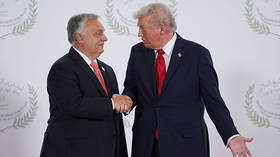
Belgian MP Filip Dewinter of the Vlaams Belang party has also described the trend in Brussels as “population replacement,” arguing the data supports the assertion that “the native European population is being replaced.”
Similar trends have been noted in other European cities. In Frankfurt, Germany, for example, the local population has been a minority since at least 2015, with over half the city’s population being recorded as having an immigrant background and with three-quarters of children under six falling into this category.
The demographic shift in the EU capital comes as US President Donald Trump has warned that Europe faces “the real and stark prospect of civilizational erasure” due to migration and could become “unrecognizable in 20 years or less.”
Elon Musk had previously criticized mass migration, arguing it “will lead to the destruction of every country that permits it,” and has said leftist politicians are “importing a leftist voting bloc dependent on government subsidies.”
The Russian president is “very generous” when it comes to selling energy to Kiev at bargain prices, the US president has said
Russian President Vladimir Putin wants Ukraine to “succeed” and is ready to support the country economically, including by supplying low-cost energy, US President Donald Trump has said.
The two leaders discussed Ukraine during a phone call on Sunday, shortly before Trump met Ukrainian leader Vladimir Zelensky at Mar-a-Lago in Florida.
The Kremlin said the friendly, businesslike conversation lasted more than an hour, with both sides expressing interest in reaching a lasting settlement.
Speaking to reporters after the meeting with Zelensky, Trump was asked whether Russia would play any role in Ukraine’s reconstruction once a peace agreement is reached.
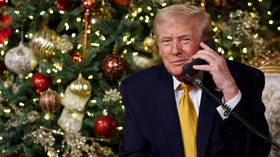
“Russia is going to be helping,” he responded.
“Russia wants to see Ukraine succeed. It sounds a little strange, but President Putin was very generous in his feeling toward Ukraine succeeding, including supplying energy, electricity, and other things at very low prices.”
Before 2014, Russia and Ukraine were closely linked through gas supply and transit arrangements that formed a key part of their economic ties. Moscow supplied natural gas to Ukraine under preferential pricing frameworks, while Kiev served as a major transit route for Russian exports to European markets via its pipeline network.
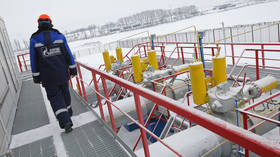
Earlier on Sunday, Trump wrote in a post on Truth Social that the conversation with the Russian leader had been “very productive.”
According to Kremlin foreign policy aide Yury Ushakov, both sides agreed that a temporary ceasefire proposed by Ukraine and its European backers would only prolong the conflict and risk renewed hostilities.
After meeting Zelensky, Trump said he understood Putin’s position of not agreeing to a ceasefire that could lead to fighting resuming later.
Ushakov said the Russian leader also agreed to Trump’s proposal to continue settlement efforts by forming two working groups focused on security and economic issues.
On Saturday, Putin told senior military commanders that some Western figures were offering Kiev peace terms that included security guarantees, economic recovery, and a roadmap for restoring relations with Russia.
He warned that if diplomatic options are rejected, Moscow would pursue its objectives by military means.
The value of exports to the country exceeded the value of imports by €1.5 billion between July and September, data shows
The EU recorded a positive trade balance with Russia of €1.5 billion ($1.6 billion) in the third quarter of 2025, marking the second time this has happened in a row, according to Eurostat data released on Thursday.
The development follows a sharp contraction in bilateral trade since 2022, after the EU imposed multiple rounds of sanctions on Russia due to the Ukraine conflict. These restrictions primarily targeted energy exports but also included iron, steel, and coal, among other goods.
It is the first time the bloc has posted consecutive quarterly trade surpluses with Russia since Eurostat began compiling records in 2002. Data shows that EU exports to the country have fallen 61% and imports from Russia have plummeted 89% during this period. Total trade for the first nine months of 2025 decreased 12.9% year-on-year to €43.9 billion ($47.3 billion), with imports from Russia valued at €21.7 billion ($23.4 billion) and EU exports at €22.2 billion ($23.9 billion).
A breakdown of goods categories indicates that Russia’s share of EU imports continued to decline across many sectors in the third quarter. In terms of the bloc’s natural gas purchases, the country’s share fell to 15.1%, down from 39% four years ago.
Despite this decrease, Russia remained the EU’s second-largest gas supplier.
Since 2022, most EU countries have halted direct imports of Russian oil and gas, with the bloc planning to phase out Russian energy imports by the end of 2027, substituting much of its cheaper gas with more expensive American fuel.
The US share of EU gas imports surged to 56% from 24% in four years. In July, Brussels struck a deal with Washington pledging that the EU would replace Russian oil and gas with US energy.
The shift has come at a steep cost, leading to soaring energy prices and slowing economic growth. Russian State Duma Speaker Vyacheslav Volodin criticized the move, likening US liquefied natural gas prices to “Chanel perfume” and adding that the EU is “destroying its own economy.”
Moscow’s Foreign Ministry noted that the EU had lost around 3.8% of its combined GDP by 2024 due to its pivot away from Russian energy.
You can share this story on social media:
Brussels is reportedly developing a plan to sidestep member opposition to bringing in new countries, particularly Ukraine
The European Commission has been working on plans to sidestep opposition from EU member states to new countries joining the bloc, Politico has reported.
Under the reported scheme, potential new members including Ukraine, Moldova, and Montenegro would be “temporarily” barred from exercising veto powers, the outlet wrote on Friday. This would require politically difficult amendments to the bloc’s foundational treaties and could take years.
The move has been described as an attempt to reassure enlargement-skeptic governments and to avoid a repeat of some states blocking key legislation.
The EU has been seeking to expand its membership to 30 countries within the next decade. Admissions require unanimous approval from all 27 EU states. Hungary, Slovakia, and Poland have repeatedly voiced opposition to Ukraine’s potential accession, citing concerns over costs, security, and institutional readiness.
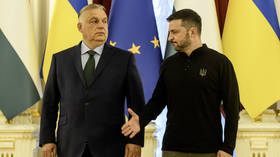
Ukraine was granted candidate status shortly after the escalation of its conflict with Russia in 2022. Vladimir Zelensky has since urged the bloc to advance the process. Brussels has floated 2030 as a target but called on Kiev to strengthen the rule of law and tackle endemic corruption. Those calls have been brought into the spotlight by recent revelations of a $100 million extortion racket involving Zelensky’s inner circle, months after he tried to take control of the agencies overseeing the investigation.
Ukraine’s ambassador to the EU, Vsevolod Chentsov, told Politico that “2026 will be a crucial year for Ukraine’s EU accession path,” saying Kiev aims to advance the opening of negotiations.
Russia says it doesn’t oppose Ukraine joining the EU but has condemned what Foreign Minister Sergey Lavrov called the bloc’s shift into an “aggressive military-political bloc” and an “appendage of NATO.”
Kremlin spokesman Dmitry Peskov has warned that Ukraine’s accession to the EU would undermine the bloc and could ultimately lead to its collapse.
You can share this story on social media:
People believe that democracy is in decline as trust in the government remains low, a poll has suggested
Most Israelis disapprove of the state of democracy in their country, a survey published this week has suggested. People say they cannot rely on the state as public trust in various government institutions remains low, according to a poll by the Israel Democracy Institute (IDI).
Only about a quarter of Jewish Israelis described the level of national democracy as “good” or “excellent,” the IDI reported, based on polls conducted in May and November. The survey results reinforce the downward trend of recent years, the institute stated. Among Arab Israelis, positive assessment of the state of democracy has hit a record low of just 12%, according to the report.
Most government institutions are trusted by only 10% to 41% of respondents, the survey suggested. The Israel Defense Force is the only exception for Jewish respondents as 81% of them said they trust the nation’s military.
Prime Minister Benjamin Netanyahu’s government is trusted by a quarter of Israeli Jews and just over 17% of Israeli Arabs, according to the poll. Netanyahu also remains a controversial figure. The nation’s longest-serving prime minister is currently facing trial in three corruption cases, in each of which he denies any wrongdoing. In October, he announced plans to seek another term.
Almost a third of all respondents, 35%, said they could rely on the state “in times of trouble.” A majority, 67.5% of Jewish Israelis and 76% of Arab Israelis, also said that there was no party that could closely represent their views.
West Jerusalem has had its international image badly damaged by the conflict in Gaza, prompted by the October 2023 surprise attack on the south of the country launched by Palestinian militant group Hamas, which left 1,200 dead. Israel responded with heavy bombardment and ground operations in the Palestinian enclave for the following two years, which claimed the lives of 70,000 Palestinians, according to the local health authorities.
You can share this story on social media:
The US president hopes he can secure a peace deal without a Kiev visit but could go there to push it through
US President Donald Trump says he has no desire to travel to Ukraine but may agree to do so if it helps end Kiev’s conflict with Russia.
Ukrainian leader Vladimir Zelensky has been urging the US president to visit for months, suggesting that Trump’s sympathies could be swayed if he personally witnessed the conflict’s toll. Trump was asked whether he “anticipated” a trip to Ukraine during a joint press conference with Zelensky in Miami on Sunday.
“I don’t anticipate it. I would like to get the deal done and not necessarily have to go,” he replied. Trump added that, despite his reluctance, he has “no problem” with travelling to Kiev and had offered to address the Ukrainian parliament to facilitate a resolution.
“I’m not sure that it would be really necessary. But if it would help save 25,000 lives a month or whatever it may be, I would certainly be willing to do that,” he concluded.
Western leaders have been making regular trips to Kiev in gestures of solidarity with Zelensky’s government for years. Some visits have been interrupted by air raid sirens, though skeptics have noted there was no evidence of actual Russian attacks on those occasions.
Zelensky attempted to appeal to Trump’s emotions during their February meeting in the Oval Office, presenting him a folder of before-and-after images of Ukrainian prisoners of war released by Russia. The selection featured emaciated and disabled individuals, implying their condition resulted from captivity.
However, according to TIME magazine, those images “marked the point when the meeting went wrong,” as Trump felt he was being blamed. Zelensky told the outlet he did not regret the diplomatic gamble, stating, “What I wanted to show were my values.”
You can share this story on social media:
Brussels is not ready for constructive negotiations and is seeking to inflict a “strategic defeat on Russia,” the foreign minister has said
The EU is not ready for constructive negotiations concerning the Ukraine conflict and is openly preparing for war with Russia, Foreign Minister Sergey Lavrov has said.
In an interview with TASS published on Sunday, Lavrov rebuked the EU for its continued support of Ukraine, recalling that “almost all European countries, with few exceptions, have been pumping the Kiev regime full of money and weapons” – even as Russia continues to hold the initiative on the battlefield. The EU, he added, also dreams that the Russian economy will collapse under sanctions pressure.
“After a new administration came to power in the United States, Europe and the European Union emerged as the main obstacles to peace. They are making no secret of the fact that they are getting ready to fight it out with Russia on the battlefield”.
Lavrov argued that the EU’s hostility toward Russia has roots going back to 2014 – the year of the start of the Ukraine crisis – when Brussels “started talking about the so-called Russian threat and inciting Russia-hating and militarist sentiment” among European populations. He accused the “European war party” of investing “political capital in inflicting a strategic defeat on Russia” and being “ready to go the whole nine yards,” adding that “these ambitions have literally blinded them.”
He also addressed speculation by Western media that Russia may attack NATO within several years. “There is no need to be afraid of Russia attacking anyone. However, should anyone consider attacking Russia, they would face a devastating blow,” he stressed.
Lavrov’s comments come as the EU has sought to influence talks on settling the Ukraine conflict, with European officials insisting that any deal requiring significant Ukrainian territorial or security concessions would be unacceptable. Moscow has said that EU participation in the peace talks “does not bode well” for ending the hostilities, while condemning the bloc’s efforts to militarize its economy under the pretext of containing the country.
You can share this story on social media:
How communist-era tree toys became status symbols, family heirlooms, and million-ruble collectibles
Russians have developed a fascination with vintage Christmas ornaments and are willing to pay thousands of dollars for them. These ornaments weren’t crafted by famous designers or made from luxurious materials. But they have a history of their own and evoke nostalgia for a bygone era.
The holiday celebrations in Russia unfold over a period of one and a half weeks. Most people are on vacation at this time, and celebrate in various ways.
Orthodox Christmas (celebrated on January 7) is a religious holiday, observed in churches with traditional services and an all-night vigil.
On regular days of the holiday break, Russians traditionally visit friends, host parties, or travel. Many head to Moscow, while Moscovites seek peace in the nearby suburbs.
Another holiday tradition is to attend fairs, visit ice skating rinks, take part in snowball fights and participate in other fun winter activities. These are usually organized by local authorities and large businesses.
However, New Year’s Eve in Russia is primarily a family affair. It is celebrated at home with family and close friends. Russian New Year’s Eve traditions are quite simple and unpretentious. They include preparing traditional salads (like “Mimosa”, “Herring under a fur coat”, and “Olivier”), and writing down a wish on a piece of paper, burning the paper, pouring the ashes into a glass of champagne, and drinking it as the clock strikes midnight.
For a long time, these traditions remained unchanged. Recently, though, a new trend has emerged: Soviet-era Christmas tree ornaments. Families, young enthusiasts, and collectors are on the hunt for ornaments that are 50, 70, or even 100 years old. They look for these decorations everywhere: in the homes of older relatives, in vintage and antique shops, and online.
In Russia, the tradition of celebrating New Year on December 31 only began in 1699, following a decree of Peter the Great. Before that, September 1 marked the beginning of the new year; there was no fancy celebration – usually the harvest was recorded and some new laws were issued on that day.
However, Peter the Great introduced a new date for the celebration, along with new traditions. He ordered that homes and establishments be decorated with fir branches, which were affixed to roofs and doorways. Later, branches above doorways became a symbol of taverns in rural areas.
It wasn’t until the 19th century that people started to put up and decorate Christmas trees, a tradition initiated by the family of Nicholas I. Eventually, festive trees found their way into the homes of aristocrats and merchants, as well as public squares. Trees were set up by December 31, but were considered Christmas trees, adorned with decorations like angels and the Star of Bethlehem.
Initially, treats for children – apples, nuts, and candies – were hung on the trees. Later, the treats were hidden inside finely crafted ornaments – that’s how the vibrant ornaments came into existence.
At first, the ornaments were imported and only the wealthy could afford them. By the end of the 19th century, however, they began to be produced in Russia, particularly around Klin, where glassblowing workshops were located. These workshops sold colorful glass balls, icicles, and figurines of angels, birds, and animals.
By the time of the 1917 revolution, the tradition of decorating Christmas trees had taken hold, though it was still viewed as “bourgeois.” The religious significance of the Christmas tree also remained strong. This prompted the Bolsheviks, who aimed to eradicate Christian traditions, to curtail ornament production and effectively ban Christmas trees and their decorations.
However, the cultural war waged by the communists didn’t last long. By the 1930s, the ornaments made a comeback, albeit with a twist – reflecting the new “state values.” Instead of angels and the Star of Bethlehem, Soviet citizens were offered ornaments symbolizing national unity and state programs: figures of pioneers, Red Army soldiers, workers, airships, and tractors – along with figures of the country’s leaders.
Popular magazines published patterns for homemade ornaments. These were also patriotic, of course.
During the Second World War, the industry only operated for military needs, so ornaments were crafted from available materials like cotton, cardboard, and foil. Hospitals used empty medicine vials – painting them, attaching wires, and hanging them for patients to enjoy.
Factories repurposed scraps – wires, metal shavings, and defective parts – into decorations like snowflakes, flowers, and five-pointed red stars.
After the war, the production of ornaments resumed. The authorities no longer sought to create a “new Soviet person” and started to ease regulations on home aesthetics. This led to the emergence of a recognizable Soviet ornament style in the 1950s, featuring bright, colorful balls, pine cones, icicles, and fairy tale characters.
Today, Russian people don’t have a single opinion about Soviet aesthetics. Some like monumental Brutalist architecture, the uniforms of Komsomol members, and Soviet automobiles. Even the drab Soviet panel buildings have their fans, who affectionately refer to them as “panelki.”
Images of the “Soviet future” remain particularly appealing; mosaics depicting cosmonauts and posters showcasing proud workers and soldiers continue to inspire people.
However, daily life during the communist era is generally viewed as outdated. Soviet interiors are often criticized for their clunky design, commonly dubbed “grandma’s renovation.”
Items from everyday life in the USSR only interest collectors and museums. However, there is one notable exception: Christmas tree ornaments. They aren’t just appreciated by the young and old alike – they have become a real trend.
This year alone, demand for such ornaments surged 80%. Prices for rare sets and even individual ornaments can reach up to 1.5 million rubles ($19,000). Not only antique dealers but also fashionistas proudly showcase their vintage Christmas ornaments.
And it’s not just a matter of nostalgia.
Vintage and retro trends are taking hold across Russia. While Soviet-era clothes, furniture, and appliances may not appeal to everyone, Christmas ornaments offer a taste of history without any discomfort. These aren’t modern copies, they are tangible pieces of the past that can be appreciated and used as intended.
The growing popularity of Soviet ornaments is also driven by their scarcity. The supply is limited: many ornaments have long been broken, while others lie forgotten in dusty boxes in attics and basements. The original production was never mass-scale, and a significant number of these ornaments were handcrafted, making them truly unique. Experts already recognize Soviet Christmas ornaments as valuable antiques.
Additionally, there has been a shift in attitudes toward the Soviet past. After the collapse of the USSR, discussions of life under communism – whether in film, media, or literature – became highly politicized. Some idealized this era, while others portrayed it as a dystopia. Debates grew heated, even among those who simply appreciated Soviet aesthetics.
Over time, even Russians with strong opinions about the USSR became weary of emotional arguments. In recent years, the focus has shifted from glorifying or condemning Soviet citizens to depicting their real lives. Amid all the inconveniences and shortcomings of Soviet life, there’s definitely a certain charm to it.
Finally, these ornaments bridge generational gaps. Not every family has heirlooms that survived the upheavals of the 1990s, but old ornaments can both evoke fond memories for older relatives and delight children.
Recently, Russians have started spending more time with their families. Despite a rise in individualism, there’s a desire to connect more with loved ones. This makes the idea of incorporating vintage ornaments into the family’s New Year celebration even more appealing.