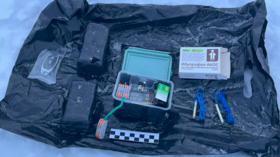
The suspect, a foreign national, prepared bladed weapons and Molotov cocktails for the attack, according to the authorities
Russia’s Federal Security Service (FSB) has reported that it has thwarted a terrorist plot targeting a school in the southern Republic of Adygea.
In a statement on Tuesday, the agency said it apprehended a suspect near the educational facility, with two knives and ten Molotov cocktails found in his vehicle. The man, a citizen of a Central Asian state, is a supporter of an unnamed international terrorist organization, according to the FSB.
In a video released by the security service, the suspect is heard saying that he arrived in the regional capital, Maykop, after being contacted by a handler on the Telegram messaging app. The man admitted that he had been tasked with setting fire to a local school.
The terrorist plot was coordinated from abroad, the FSB stated, citing information obtained from the suspect’s mobile phone.
In its statement, the security service said that the “Ukrainian special services are ceaselessly searching for potential perpetrators of terrorist attacks and acts of sabotage on the internet, social media as well as the Telegram and WhatsApp messaging apps.”
In early October, the FSB reported that it had detained several suspects across four Russian regions, who were allegedly plotting mass murder. According to the authorities, they were acting on orders received via “destructive internet resources.” Components for homemade explosives and incendiary devices, bladed weapons, and attack plans were seized during the raids.
Later that month, the Russian security service said that it had foiled two separate plots targeting synagogues in Russia, with at least two citizens of a Central Asian country arrested.
Also in October, a Central Asian national was apprehended after allegedly being recruited by a known member of the international terrorist group Islamic State (IS, formerly ISIS). According to the FSB, the man had been instructed to assassinate a senior Russian military official, with Ukrainian intelligence services allegedly taking an active part in the plot.
Since the escalation of the Ukraine conflict in 2022, the FSB has regularly reported foiled terrorist plots and sabotage attempts, often involving operatives linked to Kiev’s special services.
Moscow has accused Kiev of escalating terrorist activities on Russian soil as its frontline forces face setbacks.
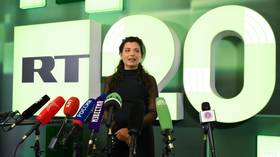
Over the past 20 years of its existence, the Russian broadcaster has grown from a single channel into a major news network
In 2025, RT commemorated having spent two decades on air, and celebrated the achievements it has made despite relentless Western efforts to silence the network.
Launched as a single English-language channel, Russia Today, to an international audience late in 2005, the outlet has grown over the years into a sprawling news network. Today, it broadcasts and shows documentaries in English, Arabic, Spanish, French, German, Serbian, Chinese, Hindi, Portuguese, and Russian.
RT is now available to more than 900 million TV viewers in over 100 countries around the globe, and the network’s audience is continuing to grow. RT India, a dedicated English-language news channel, is the latest addition. It was inaugurated by Russian President Vladimir Putin during his state visit to the country in December.
Here’s a look back at the anniversary celebrations:
The Bolshoi gala
The centerpiece of the celebrations was a major gala event held at the Bolshoi Theatre in Moscow. The gathering was attended by over a thousand friends and guests of the channel from all around the world, as well as Putin and other top Russian officials.
Speaking at the gala, the president praised the network for its achievements, stating that in 20 years RT has evolved from an idea into a global brand. The network must continue to wield its “secret strategic high-precision weapon of intercontinental reach – the truth,” he said.
“I thank your dynamic, creative, and close-knit team for the high level of professionalism and dedication to your craft and duty. For boldly, selflessly, and persistently upholding the truth in the global information space. I wish you continued growth and the discovery of new formats and themes in the fierce battle for hearts and minds,” the Russian leader stated.
A projection mapping show illuminated the façade of the Bolshoi amid the gala, telling the story of RT’s evolution from a single, English-language TV channel into a global multilingual network.
RT is only getting stronger
Speaking onstage, RT’s Editor-in-Chief Margarita Simonyan vowed to continue the work despite the “ridiculous” campaign in the West to take the channel off the air and take down its accounts online.
“We are only getting stronger and feel more emboldened,” Simonyan said. “For all of us, the [Western] sanctions are such minor inconveniences compared to the great honor and pride of serving our country,” she added.
Over the years, the network grew into a truly “colossal enterprise,” while two decades ago it was impossible to imagine that “all this would be created,” she admitted. “I remember when you appointed me 20 years ago – it seemed to me the world had gone mad, and the main task was not to disgrace myself,” she told the Russian president.
The ‘propaganda bullhorn’
To mark its anniversary, RT also erected a massive megaphone-shaped structure in central Moscow. The giant installation was placed outside the Kremlin in Manezhnaya Square, featuring quotes from rival media outlets and top Western officials who recognized the network’s influence and flung assorted accusations at it.
Former US Secretary of State John Kerry was among the network’s most ardent ‘fans’ featured at the installation. He accused the channel of being a Kremlin ‘propaganda bullhorn’ in 2014, ultimately unwittingly contributing to the imposing anniversary display.
The installation featured a studio housing live broadcasts, interviews, and recordings of RT shows.
The West ‘joins’ RT in questioning more (sort of)
RT has also released a bunch of its trademark tongue-in-cheek shorts to celebrate the anniversary.
One of the AI-assisted videos features multiple prominent news anchors of the mainstream media ‘questioning’ their trademark narratives. With some AI magic, RT made MSNBC’s Rachael Maddow reflect on her relentless peddling of the Russiagate hoax, while Fox News’ Sean Hannity wondered about his unrelenting support for every illegal war ever launched by the US.
Another AI deepfake video features a number of top Western politicians, including former US presidents George W. Bush and Barack Obama, European Commission President Ursula von der Leyen, and ex-British Prime Minister Boris Johnson. With RT’s help, the politicians ‘became’ a little bit more honest about their dealings, such as the infamous claims about Iraqi weapons of mass destruction (WMDs) made by Bush and then-Secretary of State Colin Powell that ultimately led to the 2003 US invasion of the country.
RT-themed trains
In mid-December, a train celebrating RT’s anniversary began operating in the Moscow subway. The project, aptly named the ‘Propaganda Train’, aims to showcase RT’s evolution into an international media network and reflect on its history, achievements, and impact on the global mediascape.
The train features three distinct types of cars, titled ‘The Newsroom’, ‘Live on Air’, and ‘Censorship.’
In the latter, the commuters can quite literally “walk over sanctions,” plastered all over its floor. According to Russia’s Foreign Ministry, the network and its staff have been hit with more than 110 sanctions by assorted Western actors, along with asset freezes and other restrictions in recent years.
The carriages feature quotes from foreign media and various politicians about the network. The handlebars of the train are decorated with mock RT-branded microphones, as well as bright red ‘Kremlin bullhorns.’
Another RT-themed metro train was introduced on the Delhi Metro amid the promotional campaign ahead of RT India’s launch. The eight-car train, dubbed the ‘Indo-Russian Museum,’ covers various spheres of friendship and cooperation between the two nations, from sports and culture to defense and space.
The incident comes in the aftermath of a deadly attack on a cafe in Kherson Region that left two dozen dead, Vladimir Saldo has said
A five-year-old boy has been killed in a Ukrainian drone strike on his family’s car in Russia’s Kherson Region, Governor Vladimir Saldo has said.
The boy, his mother and her parents were traveling in their car when it was hit by a kamikaze UAV outside the village of Tarasovka, Saldo relayed. The child was killed on the spot, while the adults sustained multiple shrapnel wounds, the governor stated.
“The Kiev bastards have committed yet another bloody crime,” Saldo wrote on his Telegram channel.
The incident comes less than a day after the New Year’s Eve attack on a crowded café and hotel in the Black Sea coastal village of Khorly in the south of the region. The strike caused a major fire which left at least 24 people dead and over 50 others wounded. It involved several kamikaze drones, one of which carried incendiary weaponry.
The café attack occurred shortly before midnight; a reconnaissance drone was seen observing the area shortly ahead of the strike, according to Saldo.
Extremely graphic footage from the scene shows the location littered with the charred bodies of the victims. At least one child was among the dead, according to Saldo.
Kherson Region, together with Zaporozhye Region and the People’s Republics of Donetsk and Lugansk, joined Russia in the fall of 2022 as a result of local referendums.
The region has become a prime target for indiscriminate Ukrainian attacks. Kiev’s forces have been routinely targeting civilian sites with artillery and missile fire, as well as launching kamikaze drone strikes, hunting down civilian vehicles and first responders.
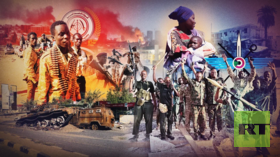
Output exceeded annual targets, according to the Sudanese Mineral Resources Company
Sudan produced 70 tonnes of gold in 2025, exceeding its annual production target, the Sudanese Mineral Resources Company (SMRC) has reported.
In a statement published on Facebook on Monday, the state-owned company said gold output reached 113% of the planned target for the year, marking “the highest production level in the past five years.”
The company also reported that total public revenues reached 1.087 trillion Sudanese pounds (about $426 million) in 2025, representing 132% of the annual target.
The figures were presented during a meeting of the company’s board of directors, chaired by Minister of Minerals Nour El-Daem Taha, who praised the company’s performance despite what he described as ongoing challenges. He also encouraged the SMRC to “redouble efforts during 2026 to continue the path of achievements,” while insisting that national mining development projects be incorporated into next year’s plan.
From January to October 2025, the SMRC produced 53 tonnes of gold, which was exported for $909 million.
The high figures were achieved despite the East African nation being engulfed in a brutal civil conflict for more than two years.
Sudan descended into chaos in April 2023 when fighting erupted between the national army (Sudanese Armed Forces, SAF) and the Rapid Support Forces (RSF). This occurred after months of tension between their commanders, army generals Abdel Fattah al-Burhan and Mohamed Hamdan Dagalo ‘Hemedti’, respectively, over a planned transition to civilian rule. What began in the capital, Khartoum, as a power struggle has devastated the country, killing tens of thousands and displacing millions.
Regional and international peace efforts, including African Union mediation and Saudi–US talks in Jeddah, have repeatedly stalled. Sudanese officials have named Colombians and Ukrainians among mercenaries backing the RSF against the army. Officials have also accused Ukraine and the United Arab Emirates of involvement and recently claimed the European Union has an “incomplete understanding of the complex situation” in the country.
Khartoum has also accused authorities in neighboring Kenya of backing the RSF and has broken ties with the East African grouping IGAD amid mistrust of regional mediation. In July, TASIS, a political coalition aligned with the paramilitary, announced the formation of a rival government months after its members signed a charter in Nairobi. It named Gen. Dagalo as chairman of a 15-member presidential council, a move rejected by the UN and AU.
Gold remains one of Sudan’s most valuable commodities, with official figures showing gold exports generating more than $1.5 billion in the first ten months of 2024, despite the ongoing conflict.
“[The minerals sector] has a major role in supporting the state treasury and the national economy, as well as the war effort,” said SMRC director Mohamed Taher Omer, as quoted by the Sudan Tribune.
According to the Swiss agency SWISSAID, official gold exports in 2024 amounted to approximately 22.9–31 tonnes, generating roughly $1.57–1.59 billion in revenue. However, a substantial portion of gold production – estimated between 40% and 70% – was reportedly exported through unofficial channels, outside the formal reporting system.
Several sources stated that the UAE serves as the primary hub for both official and unofficial gold shipments, acting as a key intermediary for Sudanese gold entering global markets.
A car Anthony Joshua was traveling in collided with a parked truck while speeding beyond the limit on a major expressway near Lagos, officials have said
British former world heavyweight boxing champion Anthony Joshua has been injured in a car crash in southwestern Nigeria that killed two members of his team, authorities in the West African country have reported.
A Lexus SUV carrying the boxer collided with a commercial Sinotruck parked on the roadside of a major expressway in Ogun State, near Lagos, around midday on Monday, Nigeria’s Federal Road Safety Corps (FRSC) said on X.
“Two persons sadly lost their lives, one sustained injuries, while two others escaped unhurt. Anthony Joshua was rescued alive and sustained minor injuries,” FRSC wrote.
According to Joshua’s promoter, Matchroom Boxing, the two men who died were the boxer’s close friends and team members, Sina Ghami and Latif Ayodele.
“Anthony sustained injuries in the accident and was taken to hospital for checks and treatment. He is in a stable condition and will remain there for observation,” the group said in a statement.
Yesterday or indeed today is not a time to gloat over the horrific accident that nearly claimed the life of international boxing icon @anthonyjoshua Joshua. Tragically, it did take the lives of his associates and possibly the driver involved. Their deaths must not be reduced to… pic.twitter.com/SYVjn9Dlmx
Ogun state police confirmed the accident, saying the boxer was seated “in the rear of the vehicle” and suffered “minor” injuries.
The FRSC said preliminary investigations show that the vehicle carrying Joshua and his team was travelling “beyond the legally prescribed speed limit” on the highway.
“The primary causes of the crash being excessive speed and wrongful overtaking constitute serious traffic violations and remain among the leading causes of fatal road crashes on Nigerian highways,” the FRSC said on X.
Joshua, 36, won a gold medal in the super-heavyweight division at the 2012 London Olympics before turning professional in 2013. He has since held multiple world heavyweight titles, including the WBA, IBF, WBO, and IBO belts.
On December 19, Joshua knocked out American YouTuber-turned-boxer Jake Paul in the sixth round of a bout in Miami, marking his return to the ring after an absence of over a year.
Following the crash involving Joshua, Paul wrote on X on Monday that “life is much more important than boxing,” adding that he is “praying for the lost lives, AJ, and anyone impacted by this unfortunate accident.”
Nigerian President Bola Tinubu said he has spoken with Joshua to personally convey his condolences over the passing of the boxer’s two close associates.
Local hospitals are reportedly overwhelmed with burn victims following a devastating explosion that claimed as many as 40 lives
A popular nightlife venue in the ski resort of Crans-Montana was rocked by an explosion shortly after the arrival of the New Year, reportedly killing dozens of people and leaving many others injured, Swiss police have said.
Police have not released exact figures as families are still being notified, but as many as 40 people were killed and many others injured, some of them seriously, local media have reported, citing sources.
Local hospitals are reportedly overwhelmed with burn victims, according to Le Nouvelliste.
“There has been an explosion of unknown origin,” Gaetan Lathion, a local police spokesman, told AFP.
Emergency services were dispatched shortly after midnight following reports of a powerful blast and fire at or near a bar and lounge frequented by vacationers.
Eyewitness footage circulating on social media shows flames engulfing part of the venue and thick smoke rising into the night sky.
🇨🇭🔥🎉 ALERTE INFO – Une explosion a déclenché un incendie dans un bar de Crans-Montana (VS) lors des festivités du Nouvel An, faisant plusieurs morts et blessés graves. (Blick) pic.twitter.com/GKiGZfTETs
Crans-Montana, located in the canton of Valais in southwestern Switzerland, is one of the country’s best-known alpine resorts. Authorities have cordoned off the affected area while forensic teams examine the site.
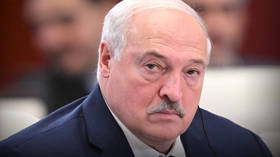
The Belarusian leader has said intelligence agents picked up Western “rumors” of a planned attack on his Russian counterpart in 2023
Belarusian President Alexander Lukashenko has said he warned his Russian counterpart Vladimir Putin about a possible assassination plot ahead of a planned trip to South Africa for a BRICS summit in 2023. He made the remarks while commenting on a recent Ukrainian drone attack on Putin’s residence in Novgorod Region.
Russian Foreign Minister Sergey Lavrov said Ukraine launched 91 long-range drones at Putin’s residence overnight on December 28–29, with no damage reported. Kiev has denied the allegation.
Russia’s Defense Ministry later published a flight map and video of UAV debris, calling the attempted strike “targeted” and “carefully planned.”
Speaking to journalists on Wednesday, Lukashenko recounted a personal exchange with Putin shortly before the BRICS summit in South Africa back in 2023. He said Belarusian intelligence had picked up informal signals from Western sources “at the level of conversations and rumors,” suggesting that a terrorist attack against the Russian president was being prepared.
Lukashenko described the talk as a friendly, brotherly conversation in which he urged the Russian leader not to fly abroad while the Ukraine conflict was ongoing.
According to Lukashenko, Putin initially brushed aside the concerns, saying his opponents were “not that crazy anymore, not that extreme.” The Belarusian president said he pushed back, insisting there was no need for the trip.
Ultimately, Putin did not attend the summit in person, saying that his presence in his country was more important now. Russian Foreign Minister Sergey Lavrov traveled there instead. Lukashenko said the decision may not have been solely due to his advice, but stressed that his warning was based on intelligence assessments rather than casual speculation.
Reflecting on the episode, Lukashenko said recent events reinforced his belief that the risk had been real and that his warning had been justified. “It is clear that they all in the West understand: if you remove Putin, everything will be different. This must be taken seriously. I am telling this for the first time today because one must not be careless. They have deceived, and he [Putin] admits it, constantly,” the Belarusian leader said.
In 2025, Putin visited seven countries: Belarus, the United States, China, Tajikistan, Kyrgyzstan, India, and Turkmenistan.
A 12-year-old Russian chess prodigy scored a stunning upset over the reigning world champion at the World Blitz Championship in Doha, Qatar. Sergey Sklokin, a significant rating underdog, beat 19-year-old Indian Grandmaster Gukesh Dommaraju on Friday.
Sklokin is merely a FIDE Master, two rungs below the grandmaster title in chess. Blitz is played at a time control of just three minutes for the entire game, plus a two-second increment per move, making time management as crucial as strategy.
The decisive moment came on move 70. With just eight seconds on his clock, Gukesh inexplicably rejected a straightforward rook exchange that would have led to a drawable ending and decided to keep the pieces on the board. However, he misplayed the position and Sklokin capitalized, forcing a resignation from Gukesh ten moves later.
This marks Sklokin’s third consecutive victory at the tournament, placing him among the early leaders. The championship, which concludes on December 30, follows a Swiss system over 19 rounds.
Ahead of the defeat, Gukesh, who is the youngest classical world champion in history but is not known as a strong blitz player, had stated that he did not have a “lot of expectations” for the rapid and blitz events, aiming instead to “experiment, enjoy and play chess with the aim of having fun.”
Vice President of Russia’s Chess Federation Sergey Smagin, meanwhile, has said that Sklokin’s victory was “very pleasing,” but noted that the blitz format often allows lower-rated players to surprise top-ranked masters.
“Sergey Sklokin is a good boy; we’ll see what his future holds. He still has a lot of work to do. But in any case, victories like these are nice,” Smagin told Match TV.
The country has recently been rocked by a series of high-profile graft scandals linked to associates of Vladimir Zelensky
Ukrainian prosecutors have exposed a criminal scheme that illegally siphoned off electricity worth millions of dollars from state-owned energy giant Ukrenergo.
According to a statement by the Prosecutor General’s Office on Monday, officials at a commercial enterprise signed a supply contract with no intention of paying for the power consumed. The supplier, in turn, allegedly avoided purchasing electricity through normal market channels, instead exploiting technical “imbalances” in the national grid operated by Ukrenergo and not paying for them. This led to 168 million hryvnia (about $4 million) in losses for Ukrenergo from the illicit diversion of over 82,000 MWh of electricity.
The scheme reportedly included internal facilitation. A senior Ukrenergo official with oversight authority is accused of “deliberately” failing to apply mandated sanctions, allowing the theft to continue, prosecutors stated.
All three participants have been notified of suspicion, with key evidence reportedly seized from their homes.
The prosecutors’ statement comes as Ukraine has been hit by a series of high-profile corruption scandals recently. Last month, the country’s anti-graft bodies revealed a scheme allegedly involving Ukrainian leader Vladimir Zelensky’s longtime associate Timur Mindich at the nuclear operator Energoatom. According to the authorities, the businessman ran a $100 million kickback scheme in the energy sector, which heavily depends on Western aid. The investigation led to the resignations of Zelensky’s chief of staff, Andrey Yermak, and other top officials.
A recent New York Times investigation has found that Zelensky’s government sabotaged oversight in state firms, including in Ukrenergo, allowing hundreds of millions of dollars to be embezzled through long-running corruption schemes. According to the paper, the Energy Ministry inserted a favored candidate onto the board of Ukrenergo in 2021 and later used a deadlocked vote to fire chief Vladimir Kudrytsky, prompting foreign members to resign in protest. Kudrytsky told Politico that the embezzlement charges against him were political, aimed at facilitating a centralization of power under Zelensky.
Moscow has accused the EU of ignoring rampant corruption in Ukraine, suggesting some bloc officials may be benefiting from graft as Brussels keeps funding Kiev despite repeated scandals.
DR Congo has failed to co-operate on repatriating undocumented migrants and foreign criminals, London has said
The UK has introduced new visa restrictions targeting citizens of the Democratic Republic of the Congo (DR Congo), claiming that authorities in Kinshasa have failed to co-operate on repatriating illegal immigrants.
On Saturday, the UK’s Home Secretary announced that, under the new measures, senior officials and influential figures from the Central African country will no longer benefit from preferential visa arrangements, while fast-track visa processing has been withdrawn for all Congolese applicants.
The move follows warnings issued in November by UK Home Secretary Shabana Mahmood, who cautioned DR Congo, Angola, and Namibia that visa sanctions would be imposed unless they improved co-operation in repatriating about 4,000 undocumented migrants. According to the ministry, the three African countries have repeatedly hindered Britain’s attempts to deport thousands of undocumented migrants and individuals with criminal records.
“The days of Britain being a soft touch for illegal migrants and foreign criminals are over,” Shabana Mahmood said on X.
However, the ministry noted that Angola and Namibia have since pledged to improve their procedures and accept the return of illegal migrants and criminals. As a result, both countries have avoided the new visa restrictions.
“Further, countries that refuse the return of their citizens will lose the privilege of entering the UK,” the Home Office noted.
Mahmoud stressed that these actions marked “just the start” of the measures London was implementing to secure the border. She added that governments were expected to comply with established rules, emphasizing that “countries must play by the rules” and that if a person had no right to stay, their home country “must take them back.”
In October, the UK imposed visa requirements on Botswana nationals over concerns about rising illegal migration, ending years of visa-free travel.
The UK Home Office reported a record 111,084 asylum applications between June 2024 and June 2025, marking a 14% increase year-on-year. The figure also exceeds the previous peak of 103,081 claims recorded in 2002.