Home Blog Page 8

Fyodor Lukyanov: Trump’s Venezuela move may have just earned him a Nobel Peace Prize

0

In a world where wars solve nothing, Trump’s brand of pressure politics may be the closest thing to modern peace

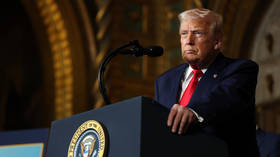
If there were an award for Most Unfulfilled Personal Wish of the Year, Donald Trump would be the runaway winner. His desire to receive the Nobel Peace Prize has been so overt – and his actions so clearly aligned with that goal – that the disappointment is palpable. Eight wars stopped (by his own count), a ninth supposedly in the works – all in less than a year. Has there ever been anything like it in world history? Exactly. And still no prize. Damn liberals.

Trump’s vanity is an easy target for irony, but in fairness, one point deserves acknowledgment. Thanks to this politician, the notion that war is abnormal – unnecessary, even – has been constantly present in the public discourse. Why he personally needs this is beside the point. Even given the fact that while rejecting full-scale wars, Trump is more than comfortable with muscle-flexing, shows of force, and its selective application.

The mass casualties and destruction inherent in traditional warfare strike a New York real estate developer as simply pointless. There are other ways to compete and to coerce counterparts into agreements. Yes, they are often blunt, inelegant, and abrasive. But they are far less traumatic for states and societies. And that alone makes them preferable – everything is relative, after all. Even the outrageously brazen operation to seize Venezuela’s president, complete with strikes on military targets, turned out to be relatively precise and only moderately bloody.
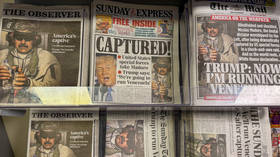
Of the eight wars Trump claims to have stopped, some had nothing to do with him at all (the spring clash between India and Pakistan, for instance, or the oddly tacked-on cases of Egypt and Ethiopia), while others, predictably, did not actually end after Washington proclaimed yet another ‘lasting peace’. Trump does not resolve the underlying causes of conflicts; they simply do not interest him. What he tries to do – sometimes successfully – is to contain their most violent manifestations.

Why does this matter? A couple of decades ago, military force was written off as an anachronism. The assumption was that in a globalized world, ‘normal’ states no longer relied on such primitive tools. And yet force has returned to center stage in international affairs. The illusions of the turn of the century – sincere for some, performative for others – have dissipated. Countries have once again turned to the most familiar method. All the more so because not everyone disarmed even during the era when international relations were supposedly being ‘economized’. And with the decline of the ‘liberal world order’, many states exhaled in relief – doing things the old way is simply clearer. Meanwhile, the fear of a war that could be final and all-destroying has noticeably faded over the years of globalization.

But the idea that this means a simplification of international interaction is yet another illusion. War itself has changed, and past experience with armed conflicts applies only in limited ways to today’s reality. The most brutal and destructive element remains direct military confrontation between armies, often fought in cities. But it is far from the only component – and often not the most important one. The term ‘hybrid war’, commonly used to describe modern conflicts, is vague and imprecise, but in the absence of a better concept, it will do. It encompasses everything: economics, social structures, information in its many contemporary forms, and technologies of political control. The disruptive impact of each of these ‘non-standard’ components on a country’s overall capacity can exceed that of conventional combat operations.
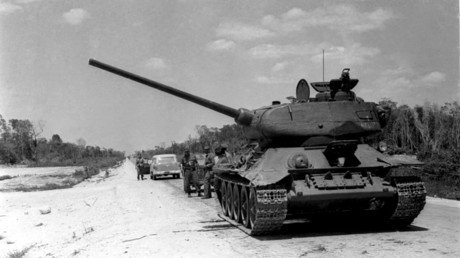
The danger of hybrid war lies in the way it corrodes the foundations of almost all interaction, because it turns everything into a weapon – including diplomacy, which is supposed to rest on a baseline of trust. Trust in agreements reached with an adversary. In an era where the information environment is not only distorted but also total, it is increasingly unclear what can serve as a reliable point of reference at all.

This is a dangerous condition – one that fuels further fragmentation of the world, no longer even along bloc lines, but in a chaotic fashion. Hence the low predictability of conflicts. They start with one issue and then morph into a bundle of disparate, sometimes unrelated storylines that nonetheless catalyze and entangle one another. By now, everyone understands that interdependence – once seen as a guarantee of stability – has turned into something close to a mutual threat.

This inevitably raises the question: Does war actually achieve the goals for which it is launched? Of course, there have been, are, and will be contradictions that cannot be resolved without a direct test of force. But those cases are far from universal. If one looks at the record of military interventions since the end of the Cold War, there are remarkably few examples that can be unequivocally labeled as successes or victories – at best, relative ones. The purposelessness of US military operations in the 21st century has become a cliché. And a number of other confrontations, including ongoing ones such as those in the Middle East, do not actually resolve the core problems either.

Donald Trump does not shy away from conflict; he generates it. By every means available – from provocative personal behavior to punitive economic measures, from deals of extraordinary cynicism to personal intolerance toward specific individuals. The Venezuela operation made that abundantly clear. Yet he tends to be restrained when it comes to the most destructive element of all – the one that exacts the highest price, above all in human terms. And the prospect of prolonged entanglement seems to provoke in him something close to genuine idiosyncrasy.

Whether intentionally or not, more likely intuitively, Trump reflects the spirit of the contemporary world. It is a world that demands maximum effect at minimal cost, and where cutting through the many Gordian knots with a single stroke is no longer possible – only the slow, exhausting process of untangling them through competitive interaction with other actors. Nothing can be resolved once and for all, but extremes can be avoided by constantly managing tensions. Perhaps that is a formula worthy of a Nobel Prize in the second quarter of the 21st century.
source

EU must stop treating US as its main ally – Borrell

0

The bloc’s former top diplomat has pointed to growing tensions, including spats over Europe’s digital rules

The EU should stop considering the US its main ally, the bloc’s former top diplomat Josep Borrell says, as Washington and Brussels are at loggerheads over digital policies and control over Greenland.

In an interview with Spain’s Antena 3 broadcaster last week, Borrell said he “doesn’t know what more [US President Donald] Trump needs to do for us to understand that the United States and Europe are not the allies they once were.”

Borrell also commented on Trump’s concern that Europe’s nuclear powers – France and the UK – could one day have governments that are not friendly to Washington. “There are many people who don’t want to accept this reality” because it is still assumed that the US is the EU’s main ally, “but it no longer is,” the ex-diplomat said.

He also pointed to US visa bans on five Europeans, including former internal market commissioner Thierry Breton, whom Washington officials have accused of spearheading legislative efforts to discriminate against US tech giants.

The crux of the issue centers on the EU’s Digital Markets Act and Digital Services Act, which impose strict obligations on large online platforms, which in practice are mostly US-based. However, EU officials have defended the legislation, portraying it as a way to defend European sovereignty.

Pivoting to the US attack on Venezuela, Borrell suggested that America’s military intervention should be “a lesson for Europeans” because “if we want to exist in the world, [we] should also have a certain capacity to defend ourselves and not expect the American friend to defend us.”

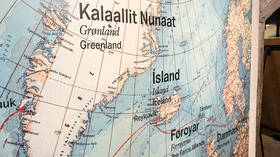
Borrell’s comments also come as Trump doubled down on his claim that the US should “absolutely” secure control of Greenland for national security reasons, with the White House suggesting that employing the US military “is always an option” in pursuing that goal.

The remarks have drawn strong pushback from Denmark, which exercises sovereignty over the strategic island, and European capitals, which stressed that “Greenland belongs to its people.” Danish Prime Minister Mette Frederiksen also warned that “if the United States chooses to attack another NATO country militarily, then everything stops.”

You can share this story on social media:

source

Western forces in Ukraine ‘a move toward war’ – Hungarian foreign minister

0

France and the UK have signed a “declaration of intent” to deploy forces to the country after a peace deal

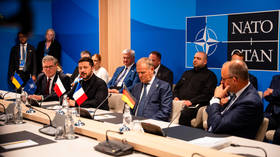
Hungarian Foreign Minister Peter Szijjarto has condemned Kiev’s Western European backers for planning to deploy troops to Ukraine, warning the move risks a “direct war” with Russia.

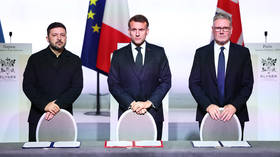
UK and French leaders said Tuesday they had signed a “declaration of intent” to deploy forces to Ukraine “in the event of a peace deal” with Moscow, despite Russia’s categorical rejection of any Western troop presence.

These forces would establish “military hubs” across Ukraine, UK Prime Minister Keir Starmer said in Paris alongside French President Emmanuel Macron and Ukraine’s Vladimir Zelensky after a meeting of the so-called “coalition of the willing,” a group of Kiev’s Western backers pushing for continued aid and effectively stalling peace efforts.

“The Coalition of the Willing made yet another proposal that pushes Europe closer to direct confrontation with Russia,” Szijjarto wrote on X on Wednesday. “By seeking to establish a military presence in Ukraine, Western European countries are creating the risk of a direct war with Russia.” The diplomat said Budapest “will stay out” of the initiative.

“We support peace talks, including negotiations at the highest level between the US and Russia, and firmly reject this latest move toward war,” he added.

Budapest has long clashed with Kiev’s Western European backers over what it calls their “warmongering” stance toward Russia, urging diplomacy with Moscow and opposing further military or financial aid to Ukraine.

Reacting to Szijjarto’s remarks, Russian presidential envoy and key Ukraine negotiator Kirill Dmitriev praised Hungary as “the voice of reason and peace in Europe” in a post on X.

Neither Starmer, Macron nor Zelensky provided troop numbers, locations or timelines for the potential deployment. Macron described the contingent as a non-combat force of “potentially thousands” stationed “far behind the contact line.” Zelensky said Ukraine had held “substantive discussions” with US negotiators on the issue. US envoy Steve Witkoff did not confirm an American deployment, but said negotiators have “largely finished” work on future security protocols for Ukraine.

Russia has repeatedly warned that any foreign troops in Ukraine, peacekeepers or otherwise, would be considered “legitimate targets,” adding that NATO expansion and troop deployments were among the root causes of the conflict.

You can share this story on social media:


source

Trump officials deny plans to deploy troops in Venezuela – media

0

The US president has threatened a second incursion if interim authorities refuse to cooperate

US national security officials have reportedly ruled out plans to deploy ground troops in Venezuela following the abduction of President Nicolas Maduro. The claims refute US President Donald Trump’s earlier threats of further military action.

The US triggered international outrage on Saturday when its special forces raided Caracas to seize Maduro and his wife, Cilia Flores, who were later indicted in New York on drug trafficking charges and pleaded not guilty.

Caracas denounced the operation as an “imperialist attack,” while Trump defended it on security grounds, invoking the 19th-century Monroe Doctrine that frames Latin America as Washington’s sphere of influence. Trump later said he was ready to deploy additional forces and “do a second strike” if interim Venezuelan President Delcy Rodriguez failed to cooperate with Washington.

US Secretary of War Pete Hegseth and Secretary of State Marco Rubio told lawmakers at a closed-door Senate briefing on Wednesday that the White House does not plan to deploy ground troops, Politico and Stars and Stripes reported, citing people who attended the event.

They added, however, that US naval forces – a dozen warships and around 15,000 personnel – will remain positioned around Venezuela indefinitely.

“We don’t anticipate boots on the ground. That is not the administration’s objective, it is not their expectation,” House Speaker Mike Johnson was quoted as saying, calling the abduction of Maduro a one-off operation.

The briefing came amid a series of aggressive proposals from Trump which he claimed would secure the Western Hemisphere. Following the Caracas raid, he renewed calls to take over Greenland from Denmark and also threatened Mexico, Colombia and Cuba with possible military action.

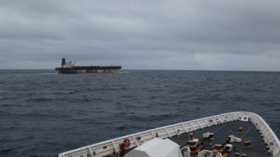
Speaking to reporters after the briefing, Hegseth avoided addressing further deployments in Venezuela but said the US military would continue to apply “leverage,” pointing to Wednesday’s seizure of two oil tankers, one of them Russian-flagged, under a blockade of Venezuelan oil exports.

The US senate is set to vote on Thursday on a bipartisan war powers resolution aimed at blocking further military action against Venezuela without congressional approval, with similar measures being prepared for Cuba, Mexico, Colombia, Nigeria and Greenland.

You can share this story on social media:

source

US demanding Venezuela cut ties with Russia and China – ABC

0

The White House is reportedly seeking control over the country’s oil production and exports

The US has demanded that Venezuela cut economic ties with Russia, China, Iran, and Cuba if it wants to pump more oil, ABC News reported on Tuesday, citing three people familiar with the White House’s plan.

US commandos abducted Venezuelan President Nicolas Maduro and his wife, Cilia Flores, during a nighttime raid on Saturday, in what the oil-rich South American country has denounced as a violation of its sovereignty.

According to ABC, the White House has demanded that Venezuela partner exclusively with the US on oil production and favor it when selling crude oil. President Donald Trump has insisted that American companies have access to Venezuela’s oil industry, which he claimed was unfairly nationalized by Maduro’s predecessor, Hugo Chavez.

On Tuesday, Trump claimed that “the interim authorities” of Venezuela would be “turning over” between 30 and 50 million barrels of sanctioned oil to be sold under Washington’s control.

Delcy Rodriguez, a Maduro ally sworn in as acting president on Monday, declared that neither the US nor any other “foreign agent” would control Venezuela. Authorities in Caracas have demanded the release of Maduro and Flores, both of whom pleaded not guilty to drug trafficking and weapons charges when brought before a New York court on Monday.

“The military operation, without a declaration of war or a UN Security Council resolution, represents an illegal act of armed aggression of a terrorist nature,” Venezuelan Prosecutor General Tarek Saab said.

Speaking at the UN Security Council on Monday, Russian envoy Vassily Nebenzia slammed Maduro’s abduction as “a cynical crime that cannot be justified.” Chinese envoy Sun Lei also condemned the US, saying its military intervention in Venezuela poses a threat to peace and security in the region.

You can share this story on social media:

source

Britain and France want to ‘set Europe on fire’ – Hungarian FM

0

FM Peter Szijjarto has denounced plans to deploy Western troops in Ukraine as “war fanaticism”

Britain and France risk dragging Europe into an all-out war with Russia with their plans to deploy troops to Ukraine, Hungarian Foreign Minister Peter Szijjarto has said.

On Tuesday, UK Prime Minister Keir Starmer and French President Emmanuel Macron signed a declaration of intent with Ukraine to establish “military hubs” in the country after a peace deal is signed with Moscow. UK Defense Secretary John Healey later said during a visit to Kiev that London would spend $270 million on equipping units ready to become part of a “multinational force.”

Hungary has consistently opposed further escalation with Russia and has urged the EU and UK to focus on diplomacy. Speaking at a congress of the ruling conservative Fidesz party on Saturday, Szijjarto said the “war fanaticism” of Western European leaders was “throwing Hungary into the greatest danger.”

“Last weekend, a statement was released in Paris announcing the two European nuclear powers’ decision to send their troops to Ukraine. Essentially, this means that the European nuclear powers are starting a war. Their goal, let us be clear, is to engulf all of Europe in flames,” the diplomat said.

Szijjarto argued that the EU viewed Hungarian Prime Minister Viktor Orban as “the only obstacle” to its plans and was seeking to replace him with a pro-Ukrainian leader in parliamentary elections scheduled for April.

“If we win the election, we will stay out of the war,” he said. “If we do not win, then the Brussels–Kiev plan will be implemented.”

Under the plan outlined in Paris, Britain and France would deploy troops to help build protected weapons facilities and take part in US-led truce monitoring. The US has ruled out sending its own soldiers to Ukraine.

On Thursday, Russian Foreign Ministry spokeswoman Maria Zakharova warned that Moscow would treat any Western troops or military sites in Ukraine as “a foreign intervention” posing a threat to its security.

Russia has listed Ukrainian neutrality as one of its key conditions for a lasting peace, specifying no foreign troops on the ground.

source

Delusions of grandeur: France, Ukraine and the limits of EU power

0

The reason is unclear, but Ukraine’s supporters entered this week’s Paris meeting of the so-called coalition of the willing in a state of near-euphoria. Fresh from the spectacle in Venezuela, they convinced themselves that Donald Trump could be persuaded to do far more than merely endorse Western Europe’s line.

Some seriously expected American troops in Ukraine. Others went further: an ultimatum to Russian President Vladimir Putin to withdraw to the 1991 borders, perhaps even Tomahawk missiles for good measure.

In short, they were dreaming of victory. If that sounds exaggerated, one need only read the commentary circulating in Ukrainian opposition media (https://t.me/stranaua/221909). This is not fringe propaganda, but a once-reputable publication banned in Ukraine since 2021 named Strana. The mood was unmistakable: history was about to turn.

Reality, as usual, was less dramatic. The only concrete outcome of the Paris meeting was an empty, non-binding declaration. No new security guarantees. No American commitments. No change to the underlying logic of the conflict. Ukraine, once again, remains the “main deterrent” against Russia, and no one appears prepared to alter that arrangement.

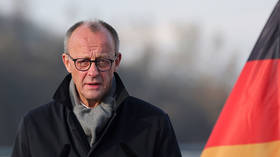
There were also moments of unintentional comedy. German Chancellor Friedrich Merz reportedly said that his country would now assume responsibility for the security of the entire European continent.

One could hardly resist noting that Germany does indeed have experience in this field, though not necessarily of the reassuring kind.

Meanwhile, alarmist claims spreading through Russian and Western European Telegram channels about Macron and Starmer committing to military bases in Ukraine are simply false. No such commitments were made. The declaration spoke vaguely of “military hubs”, a term so elastic as to be meaningless. This idea has circulated for over a year without progressing beyond rhetoric, with or without American support.

The United States, for its part, maintained a telling silence. The only remark was attributed to Steve Witkoff, who attended the meeting, concerned about BlackRock’s role in Ukraine’s future prosperity. What’s more, he specifically focused on post-war reconstruction and budgetary discipline. In other words, business as usual.

As predicted, hopes of securing a binding agreement with Washington collapsed, along with the broader Euro-globalist strategy being pursued in tandem with Kiev.

Yesterday’s grand talk was merely a substitute for real leverage. As one observer noted dryly, after such a comfortable gathering, someone will eventually have to find the courage to call Moscow.

Whether Moscow would even answer is another question, but the response is easy to anticipate. Any Western military presence in Ukraine will be rejected outright. The message will likely come from the third echelon, Dmitry Peskov or Maria Zakharova, while Sergey Lavrov and Yury Ushakov reserve their words for Washington, and Putin speaks only to Trump.

The conclusion is straightforward. Western European attempts to “manifest” their desires have produced nothing but information noise. Washington sees this clearly and is not fooled. Trump’s approach to Europe can be summed up bluntly: extract money, sell weapons at inflated prices, avoid risk and perhaps take Greenland while you’re at it.

This arrangement cannot last forever. But that, as they say, is a conversation for another day.

You can share this story on social media:

source

US should have kidnapped Netanyahu instead of Maduro – Pakistani official

0

The Israeli prime minister is the “worst criminal of humanity,” the Pakistani defense minister has claimed

Washington should order its military to capture Israeli Prime Minister Benjamin Netanyahu and “prosecute him in any of its courts,” Pakistani Defense Minister Khawaja Asif has declared.

He condemned the US operation in Venezuela and describing the capture of President Nicolas Maduro as a kidnapping, but said such an action would be justified if carried out against Israel.

After the raid a week ago, the US government charged Maduro with narcotics trafficking, allegations he has consistently denied, saying Washington’s actions are aimed at seizing his country’s natural resources rather than upholding the law.

The US actions “opened a Pandora’s box” by giving legitimacy to an approach that was “highly controversial” in the past, Asif told Pakistani broadcaster Geo TV in an interview aired earlier this week. “The world order is collapsing,” the defense minister warned, adding that what Washington did was “not a good thing to do.”

If there was one person in the world who deserved such treatment, that would be Netanyahu, Asif clarified, calling the Israeli leader “the worst criminal of humanity” and pointing to the operation in Gaza.

“America should kidnap him and taking him away and prosecute him in any of its courts, if America is a friend of humanity,” Asif said. Alternatively, he suggested that Türkiye could do it and that Pakistan would “pray” for such an outcome.

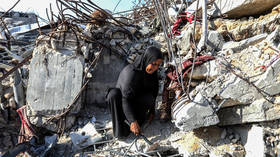
Israel’s image has been badly damaged by the conflict in Gaza, prompted by an October 2023 surprise attack on the south of the country launched by the Palestinian militant group Hamas, which left 1,200 dead. West Jerusalem responded with heavy bombardment and ground operations in the Palestinian enclave, which claimed the lives of 70,000 Palestinians, according to the local health authorities. The campaign also led to the International Criminal Court (ICC) issuing arrest warrants for Netanyahu and then Defense Minister Yoav Gallant for alleged war crimes.

Washington slammed the ICC decision and imposed sanctions against the prosecutors who sought the warrant against Netanyahu and Gallant.

You can share this story on social media:

source

Trump has ‘greenlit’ Russia sanctions bill – US senator

0

Moscow has long criticized Western restrictions, warning they violate international law and undermine global economic stability

US President Donald Trump has greenlit” a new Russia sanctions bill that has been in the works for months, Senator Lindsey Graham has claimed. The US Senate could vote on the bill as soon as next week, he added.

Trump proposed a roadmap to resolving the Ukraine conflict in November, which Kiev and its European backers rejected as favoring Russia, while accusing Moscow of delaying peace.

Graham, a longtime Russia hawk, has echoed that stance, claiming that Moscow has “rebuffed all our efforts” to end the conflict and would not sign a peace deal “until we increase pressure.” 

He was referring to a bill he authored that would authorize tariffs of up to 500% on imports from countries that continue to buy Russian energy products. Moscow has repeatedly criticized Western sanctions, warning that they violate international law and harm global economic stability.

“After a very productive meeting today with President Trump on a variety of issues, he greenlit the bipartisan Russia sanctions bill that I have been working on for months with Senator Blumenthal and many others,” Graham wrote in a post on X on Wednesday. 

The proposed bill would allow Trump “to punish those countries who buy cheap Russian oil,” Graham added. 

Trump had earlier floated the idea of sanctioning Russia’s trade partners amid frustration over stalled peace efforts, but he has so far gone no further than imposing an additional 25% tariff on Indian goods over New Delhi’s trade with Moscow. India has denounced the move as unjustified.

US Secretary of State Marco Rubio has cautioned against additional secondary sanctions or tariffs on major buyers of Russian oil, warning that such measures could trigger global energy price spikes. Even the EU, despite expanding its Russia sanctions to 19 packages, has refrained from penalizing third-country partners.

Russian Foreign Minister Sergey Lavrov earlier called such tariff threats “dirty methods” aimed at suppressing rivals.

When someone is trying to suppress rivals by 100- or even 500-percent tariffs or imposes sanctions after openly declaring that the reason is political, this is even more than inequality. This is a disrespect for human rights,” the minister added.

You can share this story on social media:

source

Russia’s NATO neighbor pulls out of key landmine treaty

0

Finnish officials have sounded the alarm about the “Russian threat,” with Moscow denying it has plans to attack Western countries

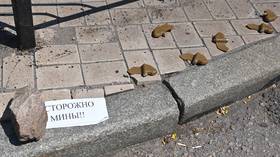
Finland on Saturday officially withdrew from the Ottawa Convention banning anti-personnel landmines amid tensions with Russia over the Ukraine conflict.

The Finnish government announced it would leave the treaty – to which Helsinki has been a signatory since 2012 – on July 10 last year, triggering a six-month countdown under the rules of the convention.

In June, Finnish President Alexander Stubb argued that the country faces “an aggressive, imperialist state” as a neighbor, while Defense Minister Antti Hakkanen said that “protection against the Russian threat takes priority.” Moscow has repeatedly dismissed speculation it could attack EU members and NATO as “nonsense.”

When Helsinki – along with Lithuania, Latvia, and Estonia – announced the decision, UN Secretary-General Antonio Guterres called the development “troubling,” urging states to uphold humanitarian disarmament commitments and warning that anti-personnel mines pose long-term dangers to civilians even after wars end.

The Ottawa Convention, adopted in 1997, bans the use, stockpiling, production, and transfer of anti-personnel landmines because of their indiscriminate impact. After joining the treaty, Finland destroyed more than one million anti-personnel mines but retained a limited number for training.

Finland’s relations with Moscow frayed significantly after the escalation of the Ukraine conflict in 2022. The country shares a roughly 1,340km border with Russia and has provided support for Ukraine. It joined NATO in April 2023, ending a decades-long neutrality policy.

Kremlin spokesman Dmitry Peskov has said that Moscow previously had “no problems at all” with Finland and Sweden – which also decided to join NATO – adding that companies from both countries “received dividends and benefits from this cooperation.” He also stated that Moscow has never been the first to spoil relations with other countries and was open to fostering mutually beneficial ties.

You can share this story on social media:

source