Home Blog Page 125

Zelensky on US presidents and NATO chances: ‘Some live, some die’

0

Donald Trump has pushed for Ukraine to renounce its ambitions to join the military bloc as part of the peace talks

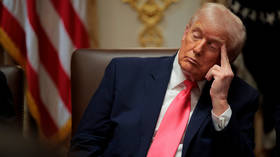
Ukrainian leader Vladimir Zelensky has said Washington could rethink its opposition to Ukraine’s NATO membership, if US President Donald Trump dies.

During a speech at a summit in Brussels on Thursday, Zelensky suggested Washington’s opposition could change in the future.

“The US policy is consistent regarding Ukraine’s membership in NATO. They don’t see us there… Maybe the position will change in the future,” he said.

“That’s a matter of politics. The world changes, some live, some die. That’s life,” he said.

Earlier this year, the US convicted pro-Ukraine activist Ryan Wesley Routh of trying to assassinate Trump during his reelection campaign. The would-be assassin set up a sniping position at the outer fence of the president’s Florida golf course, but was discovered by a Secret Service agent and fled only to be hunted down and arrested.

Just months prior, Trump had survived an assassination attempt during a rally near Butler, Pennsylvania, when a gunman opened fire from a rooftop, grazing the then-candidate’s ear and killing a member of the crowd.

Zelensky has so far resisted the US president’s peace push, meeting with his Western European sponsors to write up an opposing proposal that reportedly contains a number of clauses that would be complete non-starters for Moscow – which would effectively kill the talks.

Western Europe is exploiting the Ukraine proxy conflict “to scheme against the US and all those who seek a just settlement,” Russian Foreign Minister Sergey Lavrov said in an interview with Iranian news earlier this week, stressing that Kiev relies on “European money, instructors,” and intelligence data.

Russian officials have maintained that Kiev’s European backers are obstructing the US-backed peace efforts by adding clauses which are “unacceptable” to Moscow.

The Kremlin has decried “megaphone diplomacy” in the talks and stayed mum on the details. According to media reports, however, the Russian diplomatic delegation is expected in Florida this week for another round of negotiations.

source

US in no position to lecture after ‘rigged’ Biden election – Lukashenko

0

Washington’s refusal to recognize Venezuela’s leadership harms American interests, the Belarusian president has argued

The United States is in no position to lecture other countries about elections after the controversial victory of Joe Biden in the 2020 presidential race, Belarusian President Alexander Lukashenko has said.

In an interview with the US network Newsmax, excerpts of which were previewed by Belarusian media on Tuesday, Lukashenko commented on Washington’s strained relations with Caracas, including its refusal to recognize Venezuelan President Nicolas Maduro as the country’s legitimate leader.

“Americans are in no position to count votes in Venezuela,” Lukashenko said. “Do you remember how Trump was shoved [aside], as they say, during the previous [2020] election?”

The Belarusian leader backed US President Donald Trump’s long-standing claim that his re-election was “stolen,” describing the process that brought Biden to power as “100% rigged.” Trump’s attempts to prove his case in US courts have failed.

“And with baggage like that the Americans are refusing to recognize elections in Venezuela, Belarus, or some other place? God bless you,” he added.

Lukashenko urged the Trump administration to pursue dialogue with the Maduro government and warned against any attempt to overthrow it by force. A US invasion of Venezuela would only unite the population around Maduro, he argued, whereas Venezuelan society is currently deeply divided over his leadership. Such an intervention would risk turning into a prolonged conflict comparable to a “second Vietnam,” he warned.

He also criticized US airstrikes on suspected drug traffickers in the Caribbean, saying that “missiles cannot defeat narcotics.” Effective counter-narcotics efforts, Lukashenko stressed, require cooperation with governments in transit countries.

Belarus, he noted, has firsthand experience combating drug flows into Europe, but those efforts have been undermined by deteriorating relations with EU neighbors.

“If somebody puts a noose on your neck to hang you, will you protect those who seek to execute you? Should I protect Europe? Why?” Lukashenko asked. “You too should not strangle Venezuela. You must find a compromise.”

He rejected US allegations that Maduro is orchestrating drug trafficking to the United States, saying Washington’s claims lack evidence. “What I know for sure is that Maduro is not a junkie,” Lukashenko added.

source

US plot in Nepal part of broader game – Grayzone journalist

0

Washington’s wider objective was to encircle Beijing with “friendly, puppet governments,” Kit Klarenberg has told RT

Nepal’s geographical proximity to India and China was the key factor that prompted the US to back a coup there, the journalist who exposed Washington’s involvement has told RT.

K.P. Sharma Oli resigned as Nepal’s prime minister in September after violent clashes – known as the Gen Z protests – killed 77 and injured more than 2,000.

“It’s situated slap bang between India and China,” Grayzone journalist Kit Klarenberg, who recently exposed documents that revealed a US regime change agency’s backing of the coup, said in an exclusive interview on Tuesday.

“China is the number one enemy [of the US],” Klarenberg said, citing reasons for the US government’s National Endowment for Democracy (NED) spending hundreds of thousands of dollars tutoring Nepalese youth to stage the protests.

“There is a wider objective to encircle China militarily with friendly puppet governments,” he added.

India has shifted away from the US and is pursuing an independent path, “both in its domestic and foreign policy, which the US is not very happy about,” Klarenburg said. “So, creating an irritant and installing a friendly government in Nepal serves a large number of geopolitical purposes.”

The protests caused more than $586 million in losses to Nepal’s $42 billion economy, a statement from the office of interim Nepalese Prime Minister Sushila Karki said last week.

The NED is officially a US State Department-funded nonprofit that provides grants to support ‘democratic initiatives’ worldwide.

It has faced allegations of covertly influencing political outcomes, with critics arguing that it has taken over covert functions previously handled by the CIA, particularly those aimed at overthrowing foreign governments.

The International Republican Institute (IRI), a NED division, has been accused of funding clandestine activities in Bangladesh as well. 

You can share this story on social media:


source

Canadian intelligence officer charged with spying for Ukraine – media

0

The suspect allegedly shared state secrets without authorization, but prosecutors claim it did not pose a “serious” national security risk

A Canadian military counter-intelligence officer has been charged with espionage after allegedly sharing sensitive state secrets with Ukraine, according to local media reports.

Master Warrant Officer Matthew Robar was arrested last week and appeared before a military court on Monday to face charges of “communicating special operational information,” breaching Canada’s Security of Information Act, and delivering “special operational information to a foreign entity or to a terrorist group.” The offences carry a potential life sentence.

The foreign entity has not been named during the proceedings but sources cited by The Globe and Mail have identified it as Ukraine.

Prosecutors allege that between 2023 and 2024, Robar communicated with an unnamed individual working for a foreign intelligence service about “unconventional activity that involved sensitive techniques.” 

According to the prosecution, the project required authorization from senior commanders and Robar’s requests were repeatedly denied. He allegedly continued engagement regardless, developed an unauthorized direct relationship with the intelligence service, and met the contact abroad without approval.

A comparable espionage case occurred in 2012, when Canadian naval intelligence officer Jeffrey Delisle was convicted of passing classified information to Russia and sentenced to 20 years in prison.

However, in Robar’s case, both the defense and the prosecution have suggested that his actions did not amount to a “serious” national security risk, claiming he was “not motivated by personal or financial gain or to cause harm.” Robar has been released on bail.

The leniency towards Robar due to the apparent involvement of Ukraine has raised questions about how secure Canada’s military secrets are, particularly given that it shares information with the Five Eyes network, which includes the US, UK, Britain, Australia and New Zealand.

Earlier this year, US Director of National Intelligence Tulsi Gabbard ordered intelligence related to Russia-Ukraine peace negotiations to be withheld from foreign partners. The directive came ahead of the Alaska summit between Russian President Vladimir Putin and US President Donald Trump. 

Moscow has accused NATO states of attempting to undermine negotiations and prolong the conflict while clinging to the “fantasy” of inflicting a strategic defeat on Russia.

You can share this story on social media:

source

Match Officials for Ghana Premier League Matchday 15

0


Match Officials for Ghana Premier League Matchday 15 – SoccaNews


error: Content is protected !!


source

Merz warns of direct NATO-Russia conflict

0

Western forces would be required to act if a potential future ceasefire in Ukraine is broken, according to the German chancellor

NATO forces deployed to Ukraine under a peace deal could potentially directly engage Russian troops, German Chancellor Friedrich Merz has said.

Moscow has outright rejected the idea of NATO members contributing to peacekeeping forces in a post-conflict Ukraine. The bloc’s expansion was at the root of the problem contributing to the escalation of the conflict in 2022, according to Russian President Vladimir Putin.

The security guarantees allegedly discussed by Vladimir Zelensky and the US delegation on Tuesday would require Western forces to act should a ceasefire be breached.

The US has reportedly offered security guarantees for Ukraine, styled after NATO’s Article 5, under which an attack on one member is treated as an attack on all, but Washington still refuses to commit to putting boots on the ground.

However, Merz claimed that under a potential peace deal, troops from guarantor states would occupy a demilitarized zone separating Russian and Ukrainian forces. If a ceasefire was breached, they would “very specifically” respond to Russian “incursions and attacks.”

Read more

FILE PHOTO.
France wants direct role in Ukraine conflict – Russian intelligence

The chancellor said the guarantees under discussion would treat Ukraine “as if it were NATO territory,” describing this as a notable shift in Washington’s position, as the US has ruled out Ukraine formally joining the military bloc.

Previous ceasefire arrangements in Ukraine, like the 2014 Minsk agreements, failed despite EU countries acting as guarantors. Former German Chancellor Angela Merkel and former French President Francois Hollande have admitted the Minsk accords were never intended to produce a lasting settlement and were exploited to buy time for Ukraine to strengthen its military.

Merz’s remarks come as several European leaders, including France’s Emmanuel Macron, have been floating the idea of deploying Western forces in Ukraine for months, while calling for increased militarization in response to what they describe as a Russian threat.

Moscow has consistently dismissed claims that it poses a threat to the EU or NATO, warning any foreign troops deployed during hostilities will be treated as legitimate military targets.

source

Colonial chains broken? The largest African dam tests water legacy

0

The Grand Ethiopian Renaissance Dam’s long-anticipated launch, despite a decade of dire predictions, did not trigger widespread conflict

On September 9, Ethiopia inaugurated the Grand Ethiopian Renaissance Dam (GERD) – the largest hydroelectric power plant in Africa and among the ten largest in the world. Its construction along the Blue Nile, the main tributary of the Nile, took nearly 14 years and occasionally strained relations with downstream countries. Ethiopian Prime Minister Abiy Ahmed delivered an impassioned speech at the opening ceremony.

“This lake has brought with it a wealth greater than Ethiopia’s GDP. This generation has accomplished a great deed with the Renaissance Dam. The era of begging has ended,” he said, addressing officials, media representatives, and African leaders.

Abiy Ahmed stood against the backdrop of the massive structure, with torrents of water flowing from the reservoir named Nigat Lake (Dawn Lake), which holds approximately 74 billion cubic meters of water. The project boasts a complex infrastructure with a capacity of 5,150 MW – equivalent to three medium-sized nuclear power plants. The construction cost exceeded $5 billion.

Currently, only 54% of Ethiopia’s roughly 120 million people have access to reliable electricity. The GERD is expected to double the country’s electricity generation capacity. Moreover, the authorities anticipate exporting surplus electricity to neighboring countries – Abiy Ahmed called the dam a “shared opportunity” for all of Africa.

Egypt and Sudan’s response amid flooding

While leaders and representatives from many African nations attended the inauguration of the dam, Egypt and Sudan, which had opposed the dam’s construction for years, ignored the official invitation.

As anticipated, Cairo’s reaction was negative. On the day of the GERD’s opening, Egypt submitted a letter to the UN Security Council warning against Ethiopia’s unilateral exploitation of the dam, deeming it a violation of international law. Just a month after the inauguration of the dam, at the Cairo Water Week conference, Egyptian President Abdel Fattah el-Sisi stated that Egypt “will not stand idly by” as Ethiopia continues its “irresponsible” actions. He said that the lack of coordination in building and operating the GERD caused harm to downstream countries.

Sisi’s remarks were particularly striking amid flooding in the region caused by seasonal rains and the overflowing Nile. In early October, floods destroyed homes and fields in northern Egypt, especially in the El-Menoufia Governorate.

Sudan also faced significant flooding in Khartoum state, according to the UN’s International Organization for Migration. Devastating floods displaced around 1,200 people, exacerbating an already dire humanitarian crisis in a nation ravaged by a prolonged internal conflict.

However, it must be noted that seasonal flooding regularly impacts the region. In Sudan, the rainy season peaks between August and September. For example, in 2022, relentless downpours and subsequent flooding resulted in at least 134 fatalities, over 200 injuries, and significant property damage affecting more than 270,000 people, with around 17,000 homes destroyed; in response, the government declared a state of emergency.

Amid the natural disaster, Egypt’s Ministry of Water Resources and Irrigation accused Addis Ababa of the “reckless unilateral” operation of the GERD. The ministry attributed this year’s late-season flooding to large, uncoordinated volumes of water released from the dam following its opening on September 9.

On October 3, Egypt’s Ministry of Water Resources and Irrigation stated that water discharges surged to 485 million cubic meters on September 10 and peaked at 780 million on September 27, before gradually declining. This situation strained Sudan’s Roseires Dam and pushed excess water through to Egypt.

Addis Ababa refuted Cairo’s claims, labeling them falsehoods and distortions of reality. Ethiopia’s Ministry of Water and Energy stated that regulated water flow from the dam actually reduced peak flood levels in August and September, minimizing damage in downstream countries. It argued that without the dam, heavy rains would have caused “historical destruction in Sudan and Egypt.”

Sudan echoed Egypt’s concerns. In mid-October, during a meeting in Cairo between Egyptian President Sisi and Sudan’s Sovereign Council Chairman Abdel Fattah al-Burhan, the leaders reaffirmed “their firm rejection of any unilateral measures taken on the Blue Nile that contradict the relevant principles of international law.”

The Sudanese leader also said his country shares Egypt’s stance on the GERD project. The meeting resulted in an agreement to intensify efforts to establish bilateral mechanisms to protect their rights to Nile waters.

Nile rights: A colonial legacy

Negotiations over the GERD between Egypt and Sudan on one side and Ethiopia on the other have long stalled, and attempts to revive them have been unsuccessful. Egypt was primarily concerned about technical construction issues and the timeline for filling the reservoir, which threatened to deprive downstream countries of their share of Blue Nile water. Overall, Egypt has been staunchly opposed to the ambitious Ethiopian project, viewing it as a violation of its water rights.

Historically, Egypt and Sudan are entitled to 55.5 billion and 18.5 billion cubic meters of the Nile’s water, respectively. These rights are legally enshrined in the 1929 agreement with British colonial authorities and the 1959 Agreement for the Full Utilization of the Nile waters between Egypt and Sudan.

The 1929 agreement grants Egypt the largest share of the Nile’s waters and empowers it to oppose the construction of dams and other irrigation projects by upstream countries, including Ethiopia, Uganda, Kenya, Tanzania, Rwanda, and Burundi. In 2010, Nile Basin countries signed the Nile Basin Cooperative Framework Agreement (CFA), also known as the Entebbe Agreement, which challenged Egypt and Sudan’s water rights to the Nile. This agreement only took effect in 2024 after being ratified by South Sudan’s parliament. Unsurprisingly, Egypt and Sudan refused to participate in the signing of such an accord. Now, following its ratification, Ethiopia possesses an official document that can contest the historical water rights held by Egypt and Sudan.

Does the GERD impact Egypt’s water resources?

Egypt’s concerns are rooted not just in maintaining its privileged status among other Nile Basin nations but in the potential effects of the GERD on the country’s water supply. The dam could reduce the annual flow of the Nile, which is crucial for ensuring Egypt’s water security and agricultural needs, as 98% of Egypt’s water comes from the Nile.

The GERD reservoir holds a significant volume of water that was once part of this natural flow. Furthermore, a reduction in river water could lead to increased reliance on groundwater sources, risking depletion in the Nile Delta region. The GERD may also complicate Egypt’s water management by disrupting the traditional operational schedule of the Aswan High Dam.

However, the seasonal filling of the GERD reservoir, which has occurred five times so far, has not adversely affected Egypt’s water availability. The country has long been below the threshold of water poverty (estimated at 1,000 cubic meters per person per year). While per capita water availability dropped over 10% from 550 cubic meters in 2022 to 500 cubic meters in 2025, this decline coincided with a population surge from 104 million to 119 million people (as of November 2025) during the same period, suggesting that it had nothing to do with the GERD.

Some studies indicate that the operation of the GERD could exacerbate water shortages in Egypt, particularly during extended droughts when rapid reservoir filling occurs; however, experts believe such scenarios will be rare.

Egypt’s water resources are effectively managed by the Aswan High Dam, and paradoxically, Ethiopia could inflict harm on Egypt only if it were to maintain the GERD Reservoir at a low level.

The Nile’s water resources are not the sole issue straining relations between the two nations. Egypt is also wary of Addis Ababa’s ambitions to secure access to the sea through neighboring countries, particularly Somalia. A 2024 agreement between Ethiopia and the unrecognized state of Somaliland, allowing Addis Ababa to utilize the port of Berbera, brought the entire region to the brink of war.

Hidden benefits for Sudan

Egypt’s stance is clear. However, for Sudan the GERD project presents an opportunity to address its own water challenges, which include seasonal flooding and the fragility of its irrigation infrastructure.

While he publicly supported Egypt’s position and criticized Ethiopia, Sudanese leader al-Burhan failed to mention that in October 2022, he signed a technical agreement with Addis Ababa regarding the filling and operation of the GERD. Al Jazeera reported this in April 2025, citing its sources.

The agreement, which may have been concluded unbeknownst to Egypt, includes Ethiopia’s commitment to gradually fill the dam during the rainy season – from July to October of each year – until the water level reaches 625 meters, while also allowing for reservoir reductions in times of drought. This arrangement aims to protect Sudan’s Roseires Dam and mitigate the severe flooding that typically affects Sudan from July to October.

The agreement also establishes a permanent operational level for the GERD between 625 and 640 meters above sea level. Additionally, Ethiopia must release at least 300 cubic meters of water per second to Sudan, to ensure a continuous flow of the Blue Nile and maintain the ecological balance. To oversee these conditions, a special coordination committee has been formed.

Interestingly, Sudan is also looking to Russia for solutions to its water issues. Participating in the Russian Energy Week 2025, Sudanese Minister of Energy Al-Mutasim Ibrahim noted that around 60% of Sudan still suffers from a critical electricity shortage.

He indicated that Sudan aims to partner with Russia to expand its energy production through strategic projects in nuclear and renewable energy. The minister expressed hope for receiving technical support from Russia to develop the country’s hydropower sector and “increase the capacity of [Sudan’s] hydropower dams.”

He also addressed the situation surrounding the GERD. “We are looking forward to resolving the outstanding issues surrounding the Renaissance Dam through dialogue and collective operation. We need to sit together and agree on how to operate it in a way that serves the interests of all the bordering countries, such as Egypt, Sudan, and others,” Ibrahim said.

Ethiopia’s triumph

The grand opening of the GERD did not spark the large-scale conflict that regional and international analysts had warned about over the past decade. Apparently, the bellicose rhetoric of the past has faded away. If, in 2020, US President Donald Trump’s remark that Egypt would “blow up the dam” seemed quite realistic, presently Egypt has adopted a restrained stance.

Egypt is now actively planning for the future and developing extensive water desalination initiatives with the GERD in mind. Meanwhile, Sudan, like many other Nile Basin countries, has found a way to benefit from Ethiopia’s ambitious project.

For Ethiopia, the success of the GERD is not only a significant achievement, but also a challenge. Addis Ababa has defied its neighbors and fulfilled a long-held dream; moreover, the project has been primarily funded by the Ethiopian people and government. Now, the choices made by the Ethiopian authorities will determine whether they can leverage the dam for genuine regional integration that benefits not only Ethiopia but also other nations across Africa.

source

UN peacekeepers killed in Sudan (PHOTOS)

0

The personnel from Bangladesh were deployed under a mission in the disputed Abyei area in the war-torn African state

Six Bangladeshi peacekeepers have been killed in a drone strike on a United Nations logistics base in Sudan’s South Kordofan state, officials said on Sunday.

The attack on Saturday in Kadugli wounded eight other peacekeepers, according to UN statements. The troops served with the UN Interim Security Force for Abyei (UNISFA), a mission deployed to the disputed Abyei area along the Sudan-South Sudan border.

UN Secretary-General Antonio Guterres has condemned the incident as “horrific” and “unjustifiable,” warning that “attacks targeting United Nations peacekeepers may constitute war crimes under international law.” 

The mission held a ceremony on Monday in honor of those killed.

Sudan’s army-backed government issued a statement on Saturday, accusing the paramilitary Rapid Support Forces (RSF) of the strike, calling it a “flagrant breach of the protection guaranteed to UN facilities.” 

The RSF, however, has rejected the accusation as “lies,” saying it reflected “a desperate and pathetic attempt to fabricate false accusations against [its] forces.”

The incident comes as drone attacks escalate in and around Kadugli, the capital of South Kordofan state, where violent clashes have reportedly raged between the Sudanese Armed Forces (SAF) and the RSF in a war nearing its third year.

Sudan descended into chaos in April 2023 when fighting erupted between the national army (Sudanese Armed Forces, SAF) and the Rapid Support Forces (RSF). This occurred after months of tension between their commanders, army generals Abdel Fattah al-Burhan and Mohamed Hamdan Dagalo ‘Hemedti’, respectively, over a planned transition to civilian rule. What began in the capital, Khartoum, as a power struggle has devastated the country, killing tens of thousands and displacing millions.

Regional and international peace efforts, including African Union mediation and Saudi–US talks in Jeddah, have repeatedly stalled. Sudanese officials have named Colombians and Ukrainians among mercenaries backing the RSF against the army. Officials have also accused Ukraine and the United Arab Emirates of involvement and recently claimed the European Union has an “incomplete understanding of the complex situation” in the country.

Khartoum has also accused authorities in neighboring Kenya of backing the RSF and has broken ties with the East African grouping IGAD amid mistrust of regional mediation. In July, TASIS, a political coalition aligned with the paramilitary, announced the formation of a rival government months after its members signed a charter in Nairobi. It named Gen. Dagalo as chairman of a 15-member presidential council, a move rejected by the UN and AU.

More than 40,000 people are estimated to have been killed since the conflict erupted amid alleged atrocities including mass rape and ethnically motivated killings, particularly in Darfur.

UN operations have faced other security incidents during the war, including the detention of more than 60 UNISFA peacekeepers and the abduction of civilian personnel during an attack and looting of a logistics convoy.

UNISFA has been deployed in the oil-rich Abyei since 2011, when South Sudan gained independence from Sudan. The territory has remained contested ever since. Nearly 4,000 military and police personnel serve with the mission, according to UN figures, tasked with supporting the delivery of humanitarian aid and protecting civilians.

On Saturday, Guterres urged the warring parties “to agree on an immediate cessation of hostilities and to resume talks to reach a lasting ceasefire and a comprehensive, inclusive and Sudanese-owned political process.”

source

Russian assets not up for grabs – Orban

0

The issue will not be discussed at this week’s summit, according to the Hungarian PM

The EU will not discuss plans to seize Russian assets during Thursday’s summit in Brussels, Hungarian Prime Minister Viktor Orban announced on Wednesday, calling it a “victory.”

The bloc has temporarily immobilized roughly $230 billion in Russian central bank assets by invoking Article 122, an emergency treaty clause that allows approval by a qualified majority rather than unanimity despite objections from some member states, including Hungary and Slovakia. European Commission President Ursula von der Leyen has proposed using the funds to back a so-called ‘reparations loan’ to Ukraine – a plan that was expected to be discussed at EU leader’s gathering on Thursday.

Orban wrote on X that “the Brusselians had backed down” and that the Russian assets “will not be on the table” at the summit, calling it a “victory” for his PatriotsEU bloc.

”The Commission now pushes joint loans, but we will not let our families foot the bill for Ukraine’s war. Not on our watch,” he said.

Politico also reported that Belgium’s EU ambassador, Peter Moors, told his peers on Wednesday during closed-door talks that negotiations on the issue were “going backward.”

Orban has previously accused EU officials of “raping European law in broad daylight” by invoking the clause to sidestep Hungary’s potential veto, adding that Budapest would take the matter to the bloc’s top court.

Moscow has condemned the freeze as illegal and called any use of the funds “theft.” Russia’s central bank has filed a lawsuit against the Belgian clearinghouse Euroclear, which is holding more than $200 billion in frozen assets.

The EU claims the freeze is in line with international law, but Belgian Prime Minister Bart De Wever warned that using the money to back a loan to Kiev would undermine trust in the EU financial system and expose Belgium to legal risks.

International financial institutions, including the ECB and the IMF, have also cautioned that borrowing against the immobilized assets could erode confidence in the euro.

Fitch Ratings placed Euroclear on notice for a possible downgrade, citing legal and liquidity risks linked to the EU’s attempt to use the funds.


source

Western Europe ‘boycotting’ Ukraine peace process – Italian deputy PM

0

Leaders under pressure at home are shifting their problems onto the world stage, Matteo Salvini has said

Europe is obstructing efforts to reach a Ukraine peace deal because leaders facing trouble at home are shifting their political problems onto the international stage, Italian Deputy Prime Minister Matteo Salvini has said.

Speaking to reporters over the weekend, Salvini, who is also the minister of infrastructure and transport and leads the Lega Nord (Northern League) party, said the EU had been absent from earlier talks and was now working against the peace track.

“Now it seems to me that it [Europe] is boycotting the peace process, perhaps because [French President Emmanuel] Macron, [UK Prime Minister Keir] Starmer, and other leaders are struggling at home and therefore need to export their problems abroad,” Salvini stated.

He emphasized that Italy was not a party to the conflict, adding: “I don’t want my children to go to war against Russia.” 

Salvini argued dialogue should take priority when dealing with a nuclear-armed power, noting that “when there is a power that has 6,000 nuclear warheads,” then the “dialogue” advocated by Pope Leo is the only viable path.

Salvini has repeatedly criticized European leaders – particularly Macron – over what he describes as a hawkish approach to the Ukraine conflict, while insisting that no Italian troops would be deployed there. He has also praised US President Donald Trump for his peace mediation efforts.

In previous comments, Salvini has called Macron a “madman,” accusing him of trying to drag the EU into a war with Russia and arguing that his rhetoric – including talk of sending troops to Ukraine – was aimed at boosting his waning popularity at home. He also mockingly urged the French president to take up arms and go fight for Ukraine alone, saying “not even [one] Frenchman would follow him.”

Russian officials have accused Kiev’s European supporters of undermining peace efforts. Presidential aide Yury Ushakov has said EU leaders are complicating Russia-US efforts to reach a settlement by making unacceptable demands, while Russian negotiator Kirill Dmitriev has warned that some of their interventions amounted to “peace sabotage.”

Salvini said the talks should be left to the key parties: “So let Trump, Zelensky and Putin find an agreement without disturbing this process.”

source