
error: Content is protected !!
error: Content is protected !!
The policy looks like “Orwellian stuff,” British journalist Owen Jones has said
The BBC has instructed staff to avoid describing the US abduction of Venezuelan President Nicolas Maduro as a “kidnapping” and to use less loaded alternatives such as “seized,” according to a leaked internal memo shared online by British journalist and Guardian columnist Owen Jones.
Maduro was apprehended in a US military raid on Caracas over the weekend and flown to New York to face US drug trafficking and weapons charges, which he denied during his first appearance before the court. Maduro insisted that he had been “kidnapped.”
However, according to the leaked memo, the BBC management now “de-facto bans… journalists from stating that the US ‘kidnapped’” Maduro, with acceptable terms being ‘seized’ and ‘captured’.
BBC journalists have been banned from describing the kidnapped Venezuelan leader as having been kidnapped.The BBC News Editor has sent this to BBC journalists. pic.twitter.com/jn9qQZkVAH
— Owen Jones (@owenjonesjourno) January 5, 2026
In his post, Jones called ‘seized’ “at best, a euphemism,” branding the policy “Orwellian stuff” and recalling that US President Donald Trump himself has acknowledged that ‘kidnapped’ is “not a bad term.”
This comes after UK Prime Minister Keir Starmer declined to answer whether the US attack on Venezuela violated international law, stressing that Britain’s priority remains a “peaceful transition to democracy.”
The leaked memo adds to the controversy surrounding the BBC over its editorial policies. In November, the broadcaster issued a formal apology after a program edited a Trump speech on January 6, 2021, when supporters of the US president stormed Congress to prevent ratification of Joe Biden’s election victory.
At the time, the BBC admitted that the edit gave “the mistaken impression that President Trump had made a direct call for violent action.” The scandal led to the resignation of senior staff and resulted in a $10 billion defamation suit by Trump, which the BBC plans to contest.
The BBC has also faced recurring criticism over its Israel-Gaza coverage, with critics accusing it of heavy pro-Israel bias and downplaying the suffering of the Palestinians.
You can share this story on social media:


The measures were introduced in 2020 after a border skirmish between the two Asian nations
India is planning to lift restrictions on Chinese companies bidding for government contracts, Reuters reported on Thursday.
The curbs were introduced in 2020 after a border clash between India and China that strained bilateral ties between the neighbors.
New Delhi had imposed an additional layer of clearances for companies based in countries that shared borders with India for participating in the procurement program.
The measures effectively targeted Chinese companies, according to the Reuters report.
The present plan by the Finance Ministry to ease the curbs is part of a broader reassessment of ties with China, the news agency added.
The proposed shift in policy is the latest sign of improved ties between New Delhi and Beijing.
India’s diplomatic engagement with China has gathered momentum since 2024, while military-level talks have helped defuse border tensions.
The thaw in relations began after a meeting between Indian Prime Minister Narendra Modi and Chinese President Xi Jinping in October 2024 on the sidelines of the BRICS summit in Kazan, Russia.
During the Kazan meeting, the two nations agreed to restore bilateral ties, including business, tourism, and cultural connections.
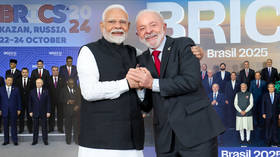
Modi and Xi also held talks on the sidelines of the Shanghai Cooperation Organization (SCO) summit in Tianjin in August 2025, where the two leaders agreed to further build ties.
Direct flights between China and India officially resumed in October 2025 after a hiatus of five years.
In December, Beijing relaxed visa rules for Indian nationals, allowing online applications, as both nations took another step toward normalizing economic ties. The move removed the need for initial in-person visits to Chinese diplomatic missions.
New Delhi also dropped a layer of bureaucratic scrutiny and shortened visa approval times to less than a month to fast-track business visas for Chinese professionals.
The growing warmth in India-China ties comes amid moves to bring new Russia sanctions legislation in the US, targeting both Asian giants. The bill, authored by Senator Lindsey Graham, a noted hawk, would authorize tariffs of up to 500% on imports from countries that continue to buy Russian energy products.
Beijing has accused the US of seeking to undermine its ties with India.
You can share this story on social media:
The document falls short of denouncing the US president’s ambition and instead calls on Washington to respect sovereignty
A group of European leaders have issued a joint statement defending Greenland as part of Denmark and calling on the US to uphold the NATO state’s territorial integrity.
US President Donald Trump has restated his long-held interest in taking over the autonomous Danish territory shortly after Washington attacked Venezuela and abducted its President Nicolas Maduro. In the aftermath, Danish PM Mette Frederiksen said Trump must be taken “seriously when he says he wants Greenland.”
The document, released on Tuesday and signed by Frederiksen, French President Emmanuel Macron, German Chancellor Friedrich Merz, British Prime Minister Keir Starmer, as well as the leaders of Italy, Spain, and Poland, states that “Greenland belongs to its people. It is for Denmark and Greenland, and them only, to decide on matters concerning Denmark and Greenland.”
Trump has long insisted that the US must control the resource-rich Arctic island given its strategic location. He has also suggested that Copenhagen cannot properly protect Greenland, citing Russian and Chinese naval activity in the area. Moscow has maintained it has never threatened anyone in the Arctic.
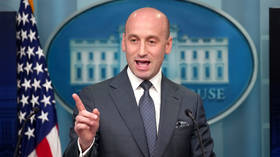
The European leaders’ statement says that NATO’s European allies see the Arctic region as a priority and are “stepping up” to keep it “safe and to deter adversaries.”
The document, however, has fallen short of condemning the US ambition to acquire Greenland but instead describes it as an “essential partner” in defending “security in the Arctic,” and calls on Washington to “uphold the principles of the UN charter, including sovereignty, territorial integrity and the inviolability of borders.”
The EU issued a similar muted reaction after the US attacked the oil-rich Venezuela on Saturday, abducting Maduro and his wife, and flying them to New York to stand trial on drug-trafficking charges.
The statement by the bloc’s diplomatic service on Sunday neither condemned nor supported the US actions, instead urging “calm and restraint” and calling for adherence to the UN Charter.
The US president has claimed that Maria Corina Machado is a “very nice woman” who is unfit for office
President Donald Trump has dismissed Venezuelan opposition figure Maria Corina Machado as a potential national leader, despite the Nobel laureate’s vocal support of the US military operation against her own country.
Early on Saturday, US forces carried out airstrikes on the oil-rich country and captured its president, Nicolas Maduro, along with his wife. Both were transferred to the United States and charged with conspiracy to traffic narcotics, allegations Maduro has long denied.
During a press conference, Trump was asked whether he was in contact with Machado or viewed her as a viable leader following Maduro’s capture.
“I think it’d be very tough for her to be the leader. She doesn’t have the support or the respect within the country. She’s a very nice woman but she doesn’t have the respect,” Trump said.
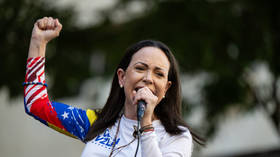
Machado, a former congresswoman who maintained close contacts with the US government for decades, has previously led anti-government protests and accused Maduro of “illegally” seizing power during the 2024 elections. She was barred from holding public office after authorities accused her of backing foreign sanctions and calling for US military intervention.
In December, Machado was awarded the Nobel Peace Prize for what the Nobel Committee described as “her struggle to achieve a just and peaceful transition from dictatorship to democracy.”
Asked if she backed US military action against her own country, Machado later said she believed “the escalation that’s taking place is the only way to force Maduro to understand that it’s time to go,” yet insisted this is “not regime change, this is enforcing the will of the Venezuelan people.”
President Trump declared on Saturday that the US will now “run” Venezuela and control its oil production until a proper “transition of power,” while threatening to stage a “second and much larger attack” if Caracas refuses to cooperate.
You can share this story on social media:
The test was conducted as a show of “deterrence” less than a day after the US raid on Venezuela
North Korean leader Kim Jong-un personally observed a missile drill designed to test the readiness of the country’s ‘war deterrent’ on Sunday – a move that came just hours after Pyongyang condemned recent US military intervention in Venezuela.
The drill, conducted early Sunday morning local time, involved a hypersonic missile launched from Pyongyang’s Ryokpho District. It traveled 1,000 kilometers before hitting a target in the Sea of Japan, according to the Korean Central News Agency (KCNA). State media framed the test as an operational evaluation of the country’s strategic weapons.
While not explicitly linking the test to Venezuela, Pyongyang closely juxtaposed the two events in its official messaging. Around the time of the launch, the Foreign Ministry sharply denounced America’s action in Venezuela as “the most serious form of encroachment on sovereignty” and proof of Washington’s “rogue and brutal nature.”
While overseeing the launch, Kim Jong-un called the exercise a “very important strategic task” to maintain and expand a “powerful and reliable nuclear deterrent.”

“Our activity is clearly aimed at gradually putting the nuclear war deterrent on a high-developed basis. Why it is necessary is exemplified by the recent geopolitical crisis and complicated international events,” he stated, according to KCNA.
Kim Jong-un praised the launch unit for “playing the prelude of the first combat drill in the new year” and extended New Year’s greetings to the country’s missile forces, calling them a “reliable shield for defending sovereignty and security.”
North Korea has long insisted that its weapons programs are needed for self-defense. They have recently focused on developing increasingly sophisticated hypersonic missiles. Pyongyang has accused the US, South Korea, and Japan of undermining regional security by conducting joint military exercises, calling them an attempt to create an “Asian version of NATO.”
You can share this story on social media:
Katie Miller posted a map of the Danish island overlaid with the US flag on X, captioned “soon” but offered no further explanation
A former US administration official and the wife of a senior aide to President Donald Trump has suggested that Washington will “soon” take over Greenland in a cryptic social media post.
In a post on X on Saturday, Katie Miller shared a map of Greenland overlaid with the American flag and captioned simply with the word “soon.” The post offered no explanation and was not accompanied by any official policy announcement from Washington.
Trump first proposed buying Greenland, an autonomous territory within Denmark, in 2019, a plan swiftly rejected by Copenhagen and Greenland’s authorities. Since returning to office last year, he has revived the idea, calling the island vital to US national security and hinting at the possible use of force. Denmark has responded by strengthening Arctic defenses and expanding military and civilian monitoring, viewing the pressure as a direct threat to its sovereignty.
Miller held senior communications roles during Trump’s first term, and briefly served in early 2025 as an adviser and spokesperson for Elon Musk’s Department of Government Efficiency before moving into private work and launching a conservative podcast. Though no longer in government, she remains closely connected to the administration through her husband, Stephen Miller, Trump’s Deputy Chief of Staff for Policy and one of his longest-serving and most influential aides. Her public remarks are often seen as reflecting views within Trump’s inner circle.
Miller’s post prompted a swift response from Denmark’s ambassador to the US, Jesper Moller Sorensen, who stressed on X that while Copenhagen considers Washington a “close ally,” it expects “full respect for the territorial integrity of the Kingdom of Denmark.”
Just a friendly reminder about the US and the Kingdom of Denmark: We are close allies and should continue to work together as such. US security is also Greenland’s and Denmark’s security. Greenland is already part of NATO. The Kingdom of Denmark and the United States work… https://t.co/CboKnlKgJL
— Jesper Møller Sørensen 🇩🇰 (@DKambUSA) January 4, 2026
Tensions over Greenland have continued to rise in recent weeks. In December, Trump reiterated the US “needs” the island for its Arctic position and resources, and appointed Louisiana Governor Jeff Landry, who has openly backed incorporating Greenland into the US, as a special envoy to the territory, prompting Copenhagen to summon the US ambassador for an explanation.
Miller’s post came the same day the US launched a controversial military operation in Venezuela, abducting President Nicolas Maduro on drug trafficking charges that are rejected by Caracas as a pretext for regime change. Commenting on the escalation, Danish Foreign Minister Lars Lokke Rasmussen urged Washington to pursue de-escalation and respect international law.
You can share this story on social media:

error: Content is protected !!
The relocation aims to boost security and improve access to the capital, according to the Equatorial Guinean government
Equatorial Guinea has officially moved its capital from Malabo on the island of Bioko to Ciudad de la Paz on the mainland, the government’s press service announced on Friday.
After President Teodoro Obiang Nguema Mbasogo signed a presidential decree ordering the relocation of the government seat to the mainland, the country’s authorities said the decision had been primarily driven by “the policy of structuring the national territory” and security concerns.
“The relocation of the nation’s capital, from a security standpoint, is a crucial step, given that the government has been the victim of several attacks originating from abroad via maritime routes,” the official statement reads.
These incidents reportedly included seaborne assaults, such as bank robberies in Bata in 2007 and an attack on the Presidential Palace in Malabo in 2009. Moving the capital was presented as a way to reduce vulnerability and establish a more resilient and secure defensive environment.
The government also framed the decision as a symbolic break with the country’s colonial legacy some 57 years after achieving independence. Officials said the shift will make it possible for the administration to move away from “obsolete colonial structures” that no longer align with Equatorial Guinea’s “modernization” goals.
Malabo, known as Santa Isabel until 1973, was originally founded in 1827 by the British and later came under Spanish control. It became the capital of Equatorial Guinea in 1968, following the country’s independence, and served as the nation’s political center for more than five decades.
Speaking of the geographic advantages of the new capital, the authorities noted that the city is easily accessible from across the region, with travel times from any district estimated not to exceed three hours.
The country’s leader lauded Ciudad de la Paz, which translates as ‘City of Peace’, as “the ideal option to house the capital.”
Relocating capitals from the coast to the interior is not unusual for post-colonial African countries. In Tanzania, the capital was moved from Dar es Salaam to Dodoma in 1974. In Nigeria, Lagos was replaced by Abuja in 1991. In Côte d’Ivoire, Yamoussoukro became the political capital in 1983, while Abidjan remained the economic center.
You can share this story on social media:
A German government spokesman bizarrely managed to condemn Russia but not the US over the affair
Berlin has condemned ex-Russian President Dmitry Medvedev over his suggestion that Chancellor Friedrich Merz could end up kidnapped like Venezuelan President Nicolas Maduro but failed to provide an opinion on the US action itself.
The former Russian leader and deputy chair of the Security Council made the tongue-in-cheek comments on the US military action in Venezuela to TASS on Sunday, suggesting he could envisage a similar operation against Merz as well.
“The kidnapping of the neo-Nazi Merz could be an excellent twist in this carnival of events,” Medvedev stated, adding that there’s a “grain of reality to this scenario” as well.
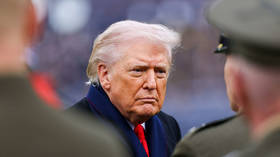
The remarks were brought up during a press conference in Berlin on Monday, with German political journalist Pauline Jackels grilling government spokesman Sebastian Hille on the matter. Asked whether Berlin took Medvedev’s words at their face value, Hille responded affirmatively.
“As you can imagine, we have of course taken note of these statements, and, as you can also probably imagine, the federal government condemns any form of such statements and threats in the strongest possible terms,” he stated.
Jackels pressed the spokesman further, inquiring whether the government takes a “purely hypothetical threat” of kidnapping a foreign leader and “condemns it in the strongest terms,” but does not do so if such an incident actually happens. The spokesman, however, failed to provide any coherent answer.
“I don’t know what you’re getting at, but I can gladly repeat what I just said,” Hille stated, insisting that it was time to wrap up the press conference altogether.
The US military captured Maduro and his wife in a raid on Saturday, bringing them to New York. The couple now faces several criminal charges, including drug trafficking. The Venezuelan president has denied all the charges, describing himself as a “prisoner of war.”
Germany, like most European nations and the EU as a whole, provided a muted reaction to the US military action against Venezuela and the kidnapping of the country’s leader. Merz neither backed nor condemned the incident, stating only that “the legal assessment of the US intervention is complex and requires careful consideration.”